Home > Press > Scientists use DNA to assemble complex nanomaterials: Researchers create DNA nano-chambers with bonds that can control the assembly of targeted nanoparticle structures
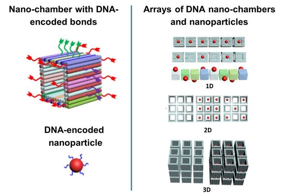 |
| IMAGE: SEPARATELY ADDRESSABLE BONDS EXTENDING FROM EACH FACE OF THE CUBE-SHAPED DNA CHAMBER (LEFT) ARE ASSEMBLED INTO ARRAYS OF CHAMBERS CONTAINING NANOPARTICLES (RIGHT). view more CREDIT: IMAGE COURTESY OF OLEG GANG, COLUMBIA UNIVERSITY. PORTIONS APPEARED IN LIN, Z., ET AL., ENGINEERING ORGANIZATION OF DNA NANO-CHAMBERS THROUGH DIMENSIONALLY CONTROLLED AND MULTI-SEQUENCE ENCODED DIFFERENTIATED BONDS, J. AM. CHEM. SOC. 142, 17531 (2020). |
Abstract:
The Science
In nature, DNA contains the instructions for the cells that allow life to grow, thrive, and reproduce. Researchers see great potential in DNA for its ability to direct assemble of a wide range of customized artificial materials. Scientists have developed a way to design and assemble artificial DNA objects tens of thousands of times smaller than a human hair. These objects can host nanoparticles and link them together into complex structures. Researchers recently extended this approach to include the tunable construction of complex 1, 2, and 3-dimensional structures. The method forms DNA strands into hollow cubes that can carry nanoparticle cargoes. The DNA strands that extend from the cube are encoded with specific assembly directions. This binding information allowed the scientists to precisely control the orientation of the objects in each direction at each step along the assembly pathway.
Scientists use DNA to assemble complex nanomaterials: Researchers create DNA nano-chambers with bonds that can control the assembly of targeted nanoparticle structures
Washington, DC | Posted on February 11th, 2022The Impact
Scientists are excited about DNA-directed assembly for its potential in next-generation applications. For example, these materials could make nano-robots for use in manufacturing and medicine or new materials to harvest light for energy. This research controlled the creation of complex nanostructures using molecular design and nanoscale programming of DNA for assembly. This approach allows scientists to control the orientation and position of building blocks via each individual bond connecting those blocks. It represents an important advance in the use of DNA for assembling new materials.
Summary
The assembly of nanoscale objects into complex, predetermined structures requires control over the type and direction of the linkages connecting those objects. Scientists have made progress in their ability to design complex nanoscale objects. However, researchers face challenges in precisely assembling these objects as designed with full control over how they bind together. This requires a fundamental understanding of the assembly pathways. In this research, scientists developed a straightforward strategy for creating a cube-shaped DNA nano chamber (DNC) with fully prearranged DNA bonds encoded with all the information needed to direct assembly as designed along each of the three axes of the chamber. The researchers built one-, two-, and three-dimensional ordered arrays of DNCs by fine tuning the directionality of DNA bonds. The researchers also developed computational methods to predict structure formation in these systems. The DNC can host nanoscale cargoes such as metal ions. This allows for the construction of complex organizations of nano cargoes with controlled architectures in a fully prescribed manner across much larger length scales. This effort was greatly enhanced by use of the Transmission Electron Microscopy (TEM) facilities at the Center for Functional Nanomaterials (CFN), a Department of Energy user facility. The researchers used the TEM to directly visualize the DNCs and their organized arrays. They used the X-ray scattering capabilities at the CFN and the National Synchrotron Light Source II (NSLS II), another DOE user facility, to provide additional structural analysis.
####
For more information, please click here
Contacts:
Michael Church
DOE/US Department of Energy
Office: 2028416299
Oleg Gang
Columbia University
Copyright © DOE/US Department of Energy
If you have a comment, please Contact us.Issuers of news releases, not 7th Wave, Inc. or Nanotechnology Now, are solely responsible for the accuracy of the content.
Bookmark:


| Related Links |
| Related News Press |
News and information
 Quantum computer improves AI predictions April 17th, 2026
Flexible sensor gains sensitivity under pressure April 17th, 2026
A reusable chip for particulate matter sensing April 17th, 2026
Detecting vibrational quantum beating in the predissociation dynamics of SF6 using time-resolved photoelectron spectroscopy April 17th, 2026
Laboratories
Researchers develop molecular qubits that communicate at telecom frequencies October 3rd, 2025
A battery’s hopping ions remember where they’ve been: Seen in atomic detail, the seemingly smooth flow of ions through a battery’s electrolyte is surprisingly complicated February 16th, 2024
Govt.-Legislation/Regulation/Funding/Policy
Quantum computer improves AI predictions April 17th, 2026
Metasurfaces smooth light to boost magnetic sensing precision January 30th, 2026
New imaging approach transforms study of bacterial biofilms August 8th, 2025
Possible Futures
A fundamentally new therapeutic approach to cystic fibrosis: Nanobody repairs cellular defect April 17th, 2026
UC Irvine physicists discover method to reverse ‘quantum scrambling’ : The work addresses the problem of information loss in quantum computing system April 17th, 2026
Nanomedicine
A fundamentally new therapeutic approach to cystic fibrosis: Nanobody repairs cellular defect April 17th, 2026
New molecular technology targets tumors and simultaneously silences two ‘undruggable’ cancer genes August 8th, 2025
New imaging approach transforms study of bacterial biofilms August 8th, 2025
Electrifying results shed light on graphene foam as a potential material for lab grown cartilage June 6th, 2025
Discoveries
Quantum computer improves AI predictions April 17th, 2026
Flexible sensor gains sensitivity under pressure April 17th, 2026
A reusable chip for particulate matter sensing April 17th, 2026
Detecting vibrational quantum beating in the predissociation dynamics of SF6 using time-resolved photoelectron spectroscopy April 17th, 2026
Announcements
A fundamentally new therapeutic approach to cystic fibrosis: Nanobody repairs cellular defect April 17th, 2026
UC Irvine physicists discover method to reverse ‘quantum scrambling’ : The work addresses the problem of information loss in quantum computing system April 17th, 2026
Interviews/Book Reviews/Essays/Reports/Podcasts/Journals/White papers/Posters
A fundamentally new therapeutic approach to cystic fibrosis: Nanobody repairs cellular defect April 17th, 2026
UC Irvine physicists discover method to reverse ‘quantum scrambling’ : The work addresses the problem of information loss in quantum computing system April 17th, 2026
Nanobiotechnology
A fundamentally new therapeutic approach to cystic fibrosis: Nanobody repairs cellular defect April 17th, 2026
New molecular technology targets tumors and simultaneously silences two ‘undruggable’ cancer genes August 8th, 2025
New imaging approach transforms study of bacterial biofilms August 8th, 2025
Electrifying results shed light on graphene foam as a potential material for lab grown cartilage June 6th, 2025
 |
||
 |
||
| The latest news from around the world, FREE | ||
 |
||
|
|
||
| Premium Products | ||
 |
||
|
Only the news you want to read!
Learn More |
||
 |
||
|
Full-service, expert consulting
Learn More |
||
|
|
||