Home > Press > Scientists enhance energy storage capacity of graphene supercapacitors via solar heating
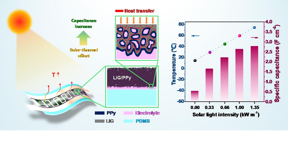 |
| Schematic diagram of fabricating process for the solar-thermal MSC and their energy storage performance under different light intensities CREDIT LI Nian |
Abstract:
Prof. WANG Zhenyang's research group from the Hefei Institutes of Physical Science (HFIPS) of the Chinese Academy of Sciences (CAS) has enhanced the energy storage capacity of graphene supercapacitors via solar heating. Related research results were published in the Journal of Materials Chemistry A.
Scientists enhance energy storage capacity of graphene supercapacitors via solar heating
Hefei, China | Posted on January 28th, 2022In low temperature environments, the hindered diffusion of electrolyte ions seriously restricts the electrochemical performance of supercapacitors. Electrode materials with solar-thermal properties are expected to provide a new strategy to solve this problem. However, it remains a challenge to develop electrode materials with both excellent solar-thermal properties and high energy storage capacity.
In this research, the researchers prepared graphene films with three-dimensional porous structures using laser-induction technology. They composited the polypyrrole uniformly composited into the graphene network by pulse electrodeposition. Graphene/polypyrrole composite electrodes were obtained and a new type of solar-thermally enhanced supercapacitor was thus constructed.
This supercapacitor has many advantages. When the temperature dropped to -30 centigrade, the electrochemical performance of the supercapacitor, which is normally severely degraded, could be enhanced rapidly to room temperature under solar irradiation at light intensities of 1.0 kW m-2. Meanwhile, at room temperature (15°C), the surface temperature of the devices increased by 45°C under solar irradiation at light intensities of 1.0 kW m-2.
"After the temperature of electrodes was raised, the optimized pore structure and the increased electrolyte ion diffusion rate increased the energy storage capacity by 4.8 times. In addition, since the solid electrolyte was well protected, the capacitance retention rate of the supercapacitor was still as high as 85.8% after 10,000 times of charging and discharging," said Dr. LI Nian, a member of the team.
This work provided new solutions for solving the low temperature problem of supercapacitors and developing high energy density devices and was supported by the National Key R&D Project of China, the National Natural Science Foundation of China, the Anhui Provincial Science and Technology Major Project, and the Anhui Provincial Key R&D Program.
####
For more information, please click here
Contacts:
Weiwei Zhao
Hefei Institutes of Physical Science, Chinese Academy of Sciences
Office: 86-551-655-91206
Copyright © Hefei Institutes of Physical Science, Chinese Academy of Sciences
If you have a comment, please Contact us.Issuers of news releases, not 7th Wave, Inc. or Nanotechnology Now, are solely responsible for the accuracy of the content.
Bookmark:


| Related Links |
| Related News Press |
News and information
 Quantum computer improves AI predictions April 17th, 2026
Flexible sensor gains sensitivity under pressure April 17th, 2026
A reusable chip for particulate matter sensing April 17th, 2026
Detecting vibrational quantum beating in the predissociation dynamics of SF6 using time-resolved photoelectron spectroscopy April 17th, 2026
Graphene/ Graphite
Electrifying results shed light on graphene foam as a potential material for lab grown cartilage June 6th, 2025
Breakthrough in proton barrier films using pore-free graphene oxide: Kumamoto University researchers achieve new milestone in advanced coating technologies September 13th, 2024
Govt.-Legislation/Regulation/Funding/Policy
Quantum computer improves AI predictions April 17th, 2026
Metasurfaces smooth light to boost magnetic sensing precision January 30th, 2026
New imaging approach transforms study of bacterial biofilms August 8th, 2025
Possible Futures
A fundamentally new therapeutic approach to cystic fibrosis: Nanobody repairs cellular defect April 17th, 2026
UC Irvine physicists discover method to reverse ‘quantum scrambling’ : The work addresses the problem of information loss in quantum computing system April 17th, 2026
Discoveries
Quantum computer improves AI predictions April 17th, 2026
Flexible sensor gains sensitivity under pressure April 17th, 2026
A reusable chip for particulate matter sensing April 17th, 2026
Detecting vibrational quantum beating in the predissociation dynamics of SF6 using time-resolved photoelectron spectroscopy April 17th, 2026
Announcements
A fundamentally new therapeutic approach to cystic fibrosis: Nanobody repairs cellular defect April 17th, 2026
UC Irvine physicists discover method to reverse ‘quantum scrambling’ : The work addresses the problem of information loss in quantum computing system April 17th, 2026
Battery Technology/Capacitors/Generators/Piezoelectrics/Thermoelectrics/Energy storage
Decoding hydrogen‑bond network of electrolyte for cryogenic durable aqueous zinc‑ion batteries January 30th, 2026
COF scaffold membrane with gate‑lane nanostructure for efficient Li+/Mg2+ separation January 30th, 2026
MXene nanomaterials enter a new dimension Multilayer nanomaterial: MXene flakes created at Drexel University show new promise as 1D scrolls January 30th, 2026
Solar/Photovoltaic
Spinel-type sulfide semiconductors to operate the next-generation LEDs and solar cells For solar-cell absorbers and green-LED source October 3rd, 2025
KAIST researchers introduce new and improved, next-generation perovskite solar cell November 8th, 2024
Groundbreaking precision in single-molecule optoelectronics August 16th, 2024
Development of zinc oxide nanopagoda array photoelectrode: photoelectrochemical water-splitting hydrogen production January 12th, 2024
 |
||
 |
||
| The latest news from around the world, FREE | ||
 |
||
|
|
||
| Premium Products | ||
 |
||
|
Only the news you want to read!
Learn More |
||
 |
||
|
Full-service, expert consulting
Learn More |
||
|
|
||