Home > Press > A single molecule makes a big splash in the understanding of the two types of water
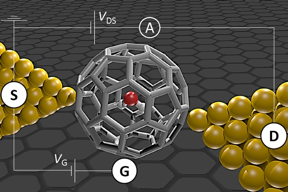 |
| A collaborative team led by researchers from Institute of Industrial Science, The University of Tokyo uses a single water molecule in a C60 cage to probe quantum mechanics CREDIT Institute of Industrial Science, the University of Tokyo |
Abstract:
It plays a fundamental role in human existence and is a major component of our universe, yet there are still things we don’t understand about water. To address the knowledge gaps, a collaborative team of Institute of Industrial Science, The University of Tokyo, Kyoto University, and Tohoku University investigated electron transport through a single water molecule in a C60 cage. Their findings are published in Nano Letters.
A single molecule makes a big splash in the understanding of the two types of water
Tokyo, Japan | Posted on January 7th, 2022Simple systems are often the best starting point for determining complex information. A single water molecule is one such system. Made up of just three atoms, it provides an excellent model for establishing quantum mechanical information.
Introducing a water molecule into a C60 cage—a soccer ball-shaped molecule made entirely of carbon atoms—gives and is an excellent way of isolating water for investigation. The researchers achieved this using “molecular surgery”, which involves opening the cage, injecting water, and closing the cage again.
was then used as a single molecule transistor (SMT) by mounting one molecule in the very small gap—less than 1 nm—between two gold electrodes. Because the electric current then passes through the isolated molecule only, the electron transport can be studied with high specificity.
A conductance map, also known as a “Coulomb stability diagram”, was generated for the SMT. It showed multiple tunneling-induced excited states for the water molecule. In contrast, the Coulomb stability diagram of an empty C60 cage SMT showed only two excited states.
“Because it contains two hydrogen atoms, water has two different nuclear spin states: ortho- and para-water. In ortho-water the hydrogen nuclear spins are in the same direction, while in para-water they are opposite to one another,” explains study lead author Shaoqing Du. “Understanding the transition between these two types of water is an important area of research.”
The researchers measured tunneling spectra for the system and, by comparing the findings with theoretical calculations, were able to attribute the measured conductance peaks to rotational and vibrational excitations of the water molecule. They also investigated using terahertz spectroscopy and the results agreed with the tunneling spectroscopy data.
Both techniques showed quantum rotational excitations of ortho- and para-water simultaneously. This demonstrates that the single water molecule transitioned between the two nuclear isomers (ortho- and para-water) within the timeframe of the experiment, which was approximately one minute.
“Our findings make an important contribution to the understanding of ortho-para fluctuation in water molecules,” says study corresponding author Kazuhiko Hirakawa. “Because water plays such an important role in chemistry and biology, and even in understanding our universe, we expect our findings to have a wide-ranging impact.”
####
About Institute of Industrial Science, The University of Tokyo
Institute of Industrial Science (IIS), the University of Tokyo is one of the largest university-attached research institutes in Japan.
More than 120 research laboratories, each headed by a faculty member, comprise IIS, with more than 1,200 members including approximately 400 staff and 800 students actively engaged in education and research. Our activities cover almost all the areas of engineering disciplines. Since its foundation in 1949, IIS has worked to bridge the huge gaps that exist between academic disciplines and realworld applications.
For more information, please click here
Contacts:
Kazuhiko Hirakawa
Institute of Industrial Science, The University of Tokyo
Office: 81-3-5452-6260
Copyright © Institute of Industrial Science, The University of Tokyo
If you have a comment, please Contact us.Issuers of news releases, not 7th Wave, Inc. or Nanotechnology Now, are solely responsible for the accuracy of the content.
Bookmark:


| Related Links |
| Related News Press |
News and information
 Quantum computer improves AI predictions April 17th, 2026
Flexible sensor gains sensitivity under pressure April 17th, 2026
A reusable chip for particulate matter sensing April 17th, 2026
Detecting vibrational quantum beating in the predissociation dynamics of SF6 using time-resolved photoelectron spectroscopy April 17th, 2026
Physics
UC Irvine physicists discover method to reverse ‘quantum scrambling’ : The work addresses the problem of information loss in quantum computing system April 17th, 2026
Quantum computers simulate fundamental physics: shedding light on the building blocks of nature June 6th, 2025
Possible Futures
A fundamentally new therapeutic approach to cystic fibrosis: Nanobody repairs cellular defect April 17th, 2026
UC Irvine physicists discover method to reverse ‘quantum scrambling’ : The work addresses the problem of information loss in quantum computing system April 17th, 2026
Chip Technology
A reusable chip for particulate matter sensing April 17th, 2026
Metasurfaces smooth light to boost magnetic sensing precision January 30th, 2026
Nanotubes/Buckyballs/Fullerenes/Nanorods/Nanostrings/Nanosheets
Tiny nanosheets, big leap: A new sensor detects ethanol at ultra-low levels January 30th, 2026
Enhancing power factor of p- and n-type single-walled carbon nanotubes April 25th, 2025
Chainmail-like material could be the future of armor: First 2D mechanically interlocked polymer exhibits exceptional flexibility and strength January 17th, 2025
Innovative biomimetic superhydrophobic coating combines repair and buffering properties for superior anti-erosion December 13th, 2024
Discoveries
Quantum computer improves AI predictions April 17th, 2026
Flexible sensor gains sensitivity under pressure April 17th, 2026
A reusable chip for particulate matter sensing April 17th, 2026
Detecting vibrational quantum beating in the predissociation dynamics of SF6 using time-resolved photoelectron spectroscopy April 17th, 2026
Announcements
A fundamentally new therapeutic approach to cystic fibrosis: Nanobody repairs cellular defect April 17th, 2026
UC Irvine physicists discover method to reverse ‘quantum scrambling’ : The work addresses the problem of information loss in quantum computing system April 17th, 2026
Interviews/Book Reviews/Essays/Reports/Podcasts/Journals/White papers/Posters
A fundamentally new therapeutic approach to cystic fibrosis: Nanobody repairs cellular defect April 17th, 2026
UC Irvine physicists discover method to reverse ‘quantum scrambling’ : The work addresses the problem of information loss in quantum computing system April 17th, 2026
Water
Taking salt out of the water equation October 7th, 2022
 |
||
 |
||
| The latest news from around the world, FREE | ||
 |
||
|
|
||
| Premium Products | ||
 |
||
|
Only the news you want to read!
Learn More |
||
 |
||
|
Full-service, expert consulting
Learn More |
||
|
|
||