Home > Press > Development of a high-energy-resolution, LaB6 nanowire-based field emission gun: Electron source enables atomic resolution TEM observation
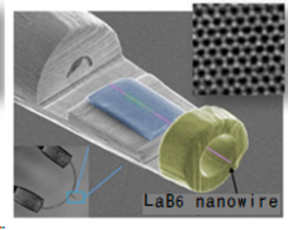 |
| SEM image of the LaB6 nanowire-based electron source. An atomic resolution image of single-layer graphene taken by a TEM equipped with this electron source is shown in the boxed image at upper right. CREDIT Koji Kimoto National Institute for Materials Science Tel: +81-29-860-4402 Email: KIMOTO.Koji@nims.go.jp Zhang Han National Institute for Materials Science Email: Zhang.han@nims.go.jp |
Abstract:
The National Institute for Materials Science (NIMS) and JEOL, Ltd. have developed a lanthanum hexaboride (LaB6) nanowire-based field emission gun that is installable on an aberration-corrected transmission electron microscope (TEM). This combined unit is able to perform atomic resolution observation at an energy resolution of 0.2 eV—the highest resolution ever recorded for non-monochromatic electron guns—with a high current stability of 0.4%.
Development of a high-energy-resolution, LaB6 nanowire-based field emission gun: Electron source enables atomic resolution TEM observation
Sengen, Japan | Posted on December 10th, 2021Unsuccessful efforts have been made for more than 20 years to develop field emission guns using theoretically high-performance nano materials. It has been found challenging to integrate a nanowire-based field emission gun into an electron microscope without undermining its physical properties, such as lives and stability. For this reason, commercially available field emission guns are still equipped with tungsten needles developed more than half a century ago.
This NIMS-JEOL research team 1) developed techniques to chemically synthesize and grow high-purity, single-crystal nanowires of LaB6, known to be an excellent electron-emitting hot cathode material, 2) designed an electron source mechanism capable of efficiently emitting electrons and 3) developed techniques to extract a single nanowire and integrate it into an optimized electron source structure.
The LaB6 nanowire-based electron source has a number of advantages: relatively moderate vacuum condition requirements, very high current stability, low extraction voltage, narrow electron beam energy distribution width and high brightness. This electron source may be applicable to the development of next-generation field emission electron microscopes with higher spatial and energy resolution—potentially valuable tools in the semiconductor and medical fields.
***
This project was carried out by a team of NIMS researchers (Han Zhang, Cretu Ovidiu, Koji Kimoto, Takeshi Kasaya, Hideki T. Miyazaki, Naohito Tsujii, Hongxin Wang, Yasushi Yamauchi and Daisuke Fujita) and JEOL researchers (Yu Jimbo, Akira Niwata, Akihiro Ikeda, Akira Yasuhara, Shin-ichi Kitamura and Hironobu Manabe).
This research was published in the online version of Nature Nanotechnology on November 9, 2021, Japan Time (DOI: 10.1038/s41565-021-00999-w).
####
For more information, please click here
Contacts:
Yasufumi Nakamichi
National Institute for Materials Science, Japan
Office: 81-29-859-2105
Expert Contacts
Zhang Han
National Institute for Materials Science
Koji Kimoto
National Institute for Materials Science
Copyright © National Institute for Materials Science, Japan
If you have a comment, please Contact us.Issuers of news releases, not 7th Wave, Inc. or Nanotechnology Now, are solely responsible for the accuracy of the content.
Bookmark:


| Related News Press |
News and information
 Quantum computer improves AI predictions April 17th, 2026
Flexible sensor gains sensitivity under pressure April 17th, 2026
A reusable chip for particulate matter sensing April 17th, 2026
Detecting vibrational quantum beating in the predissociation dynamics of SF6 using time-resolved photoelectron spectroscopy April 17th, 2026
Imaging
Simple algorithm paired with standard imaging tool could predict failure in lithium metal batteries August 8th, 2025
Possible Futures
A fundamentally new therapeutic approach to cystic fibrosis: Nanobody repairs cellular defect April 17th, 2026
UC Irvine physicists discover method to reverse ‘quantum scrambling’ : The work addresses the problem of information loss in quantum computing system April 17th, 2026
Discoveries
Quantum computer improves AI predictions April 17th, 2026
Flexible sensor gains sensitivity under pressure April 17th, 2026
A reusable chip for particulate matter sensing April 17th, 2026
Detecting vibrational quantum beating in the predissociation dynamics of SF6 using time-resolved photoelectron spectroscopy April 17th, 2026
Announcements
A fundamentally new therapeutic approach to cystic fibrosis: Nanobody repairs cellular defect April 17th, 2026
UC Irvine physicists discover method to reverse ‘quantum scrambling’ : The work addresses the problem of information loss in quantum computing system April 17th, 2026
Tools
Metasurfaces smooth light to boost magnetic sensing precision January 30th, 2026
From sensors to smart systems: the rise of AI-driven photonic noses January 30th, 2026
Japan launches fully domestically produced quantum computer: Expo visitors to experience quantum computing firsthand August 8th, 2025
 |
||
 |
||
| The latest news from around the world, FREE | ||
 |
||
|
|
||
| Premium Products | ||
 |
||
|
Only the news you want to read!
Learn More |
||
 |
||
|
Full-service, expert consulting
Learn More |
||
|
|
||