Home > Press > Review on the femtosecond laser precision micro/nano-engineering
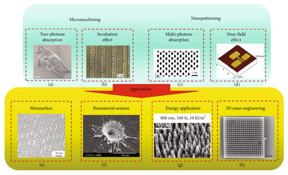 |
| Femtosecond laser precision engineering strategies and the related applications: (a) bull sculpture produced by TPA, the scale bar is 2 μm, (b) microhole array fabricated on 150 μm Al film by femtosecond laser direct scanning, (c) wet etching of nanopores fabricated by 3D femtosecond laser writing in YAG crystal, (d) negative metal oxide semiconductor patterns fabricated by femtosecond laser assisting NSOM, (e) functional microstructures made by parallel femtosecond laser processing, (f) surface morphology of HP-PCL achieved by femtosecond laser microperforation, (g) SEM image of laser microstructured Si surface formed in SF6 with femtosecond laser pulses, and (h) 3D functional photonic crystal fabricated using 1030 nm femtosecond laser in a SZ2080 photoresist without using of photo initiator. CREDIT Ultrafast Science |
Abstract:
Femtosecond laser precision engineering has been applied in industries for device micro/nano-fabrication due to its unique advantages of being a dry and noncontact process, coupled with the availability of reliable light sources and affordable system cost. It is an important advanced manufacturing means for high quality micro/nano-structures creation and related surface processing, especially to create new functional MEM/NEM devices and structures.
Review on the femtosecond laser precision micro/nano-engineering
Shaanxi, P.R.China | Posted on December 3rd, 2021Prof. Hong Minghui's research group at the National University of Singapore summarizes the development and latest progress of laser precision engineering from micron, sub-micron, to nanoscale. Combined with other advanced processing tools, femtosecond laser precision engineering’s resolution has been much smaller than the optical diffraction limit, which will play an important role in next-generation nano-manufacturing. For the micron-scale creation, the widely employed femtosecond laser fabrication strategies, including two/multi-photons absorption, laser-induced plasma-assisted ablation, and incubation effect are highlighted.
Furthermore, the recent progress about micro-lens arrays and interference lithography techniques for the sub-micron feature creation, especially large area periodic surface structuring, are also discussed. For the femtosecond laser nano-fabrication, both the processing strategies working in near field and far field are summarized.
The outlook of femtosecond laser precision engineering is also evaluated. How to achieve small heat affected zone is the first key issue in high quality laser precision engineering to push its resolution from micro-scale to nano-scale. Secondly, ensuring a high enough processing speed to meet various industrial needs is also a key challenge since one beam laser processing at high resolution could not meet this requirement. The third challenge is how to carry out the laser nano-structuring in the far field as the near field effect requires tiny optics working very close to sample surfaces, which confines the near field laser nano-fabrication to be only suitable for a few super-smooth surface samples.
####
For more information, please click here
Contacts:
Jiangbo She
Ultrafast Science
Copyright © Ultrafast Science
If you have a comment, please Contact us.Issuers of news releases, not 7th Wave, Inc. or Nanotechnology Now, are solely responsible for the accuracy of the content.
Bookmark:


| Related Links |
| Related News Press |
News and information
 Quantum computer improves AI predictions April 17th, 2026
Flexible sensor gains sensitivity under pressure April 17th, 2026
A reusable chip for particulate matter sensing April 17th, 2026
Detecting vibrational quantum beating in the predissociation dynamics of SF6 using time-resolved photoelectron spectroscopy April 17th, 2026
Nanofabrication
Self-propelled protein-based nanomotors for enhanced cancer therapy by inducing ferroptosis June 6th, 2025
Multiphoton polymerization: A promising technology for precision medicine February 28th, 2025
New chip opens door to AI computing at light speed February 16th, 2024
Possible Futures
A fundamentally new therapeutic approach to cystic fibrosis: Nanobody repairs cellular defect April 17th, 2026
UC Irvine physicists discover method to reverse ‘quantum scrambling’ : The work addresses the problem of information loss in quantum computing system April 17th, 2026
Discoveries
Quantum computer improves AI predictions April 17th, 2026
Flexible sensor gains sensitivity under pressure April 17th, 2026
A reusable chip for particulate matter sensing April 17th, 2026
Detecting vibrational quantum beating in the predissociation dynamics of SF6 using time-resolved photoelectron spectroscopy April 17th, 2026
Announcements
A fundamentally new therapeutic approach to cystic fibrosis: Nanobody repairs cellular defect April 17th, 2026
UC Irvine physicists discover method to reverse ‘quantum scrambling’ : The work addresses the problem of information loss in quantum computing system April 17th, 2026
Interviews/Book Reviews/Essays/Reports/Podcasts/Journals/White papers/Posters
A fundamentally new therapeutic approach to cystic fibrosis: Nanobody repairs cellular defect April 17th, 2026
UC Irvine physicists discover method to reverse ‘quantum scrambling’ : The work addresses the problem of information loss in quantum computing system April 17th, 2026
Photonics/Optics/Lasers
Metasurfaces smooth light to boost magnetic sensing precision January 30th, 2026
From sensors to smart systems: the rise of AI-driven photonic noses January 30th, 2026
 |
||
 |
||
| The latest news from around the world, FREE | ||
 |
||
|
|
||
| Premium Products | ||
 |
||
|
Only the news you want to read!
Learn More |
||
 |
||
|
Full-service, expert consulting
Learn More |
||
|
|
||