Home > Press > Reaction-dependent coffee-ring-regulating method in spray-coating perovskite
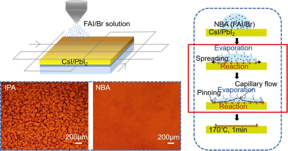 |
| SCHEMATIC OF SPRAY-COATING PROCESS; OPTICAL MICROSCOPY IMAGES OF PEROVSKITE FILMS; SCHEMATIC OF DROPLET DRYING. CREDIT Journal of Energy Chemistry |
Abstract:
When droplets containing non-volatile solutes dry on substrates, the fluid migrates outward via capillary force. Consequently, the solutes are carried to the periphery of the droplets and form “coffee rings” after drying. This is known as the coffee ring effect (CRE). The CRE is typically observed during printing, and it significantly affects the uniformity and quality of films, especially in droplet-based dispersed deposition methods, such as spray-coating.
Reaction-dependent coffee-ring-regulating method in spray-coating perovskite
Dalian, China | Posted on November 5th, 2021Recently, spray-coating, which is a mature industrial method, has been widely used for the fabrication of perovskite solar cells (PSCs) owing to its high throughput, outstanding compatibility with diverse substrates, and good scalability. However, the CRE-induced inhomogeneity of the sprayed films leads to poor device reproducibility and limits the improvement in device performance. The power conversion efficiencies (PCEs) of sprayed PSCs are still significantly lower than those of their spin-coated counterparts. Therefore, CRE elimination is of significant practical interest for the development of spraying methods for PSCs.
Recently, Prof. Peng and colleagues at Wuhan University of Technology reported a reaction-dependent coffee-ring-regulating method. In most studies about CRE, the solution does not react with the substrate. However, in their study, the liquid droplets formamidinium iodide/formamidinium bromide (FAI/Br) reacted with the solid CsI/PbI2 films, which affected solute distribution. Therefore, the reaction process was regulated via solvent selection, and it was determined that solvents with adequate drying rates, such as n-butyl alcohol, can effectively suppress coffee ring formation. On one hand, an appropriate long drying time promoted droplets spreading and merging, and ultimately favored the integrated wet films formation, which decreased the “rings” counts . Conversely, during spreading, the reaction between FAI/Br and the CsI/PbI2 films hindered solute accumulation at droplet periphery, resulting in a uniform solute deposition. Lastly, dense, homogeneous, and highly uniform Cs0.19FA0.81PbI0.5Br2.5 perovskite films were prepared. Owing to the high quality of the perovskite films, the PCEs of the fabricated PSCs reached 19.17%, which was among the highest PCEs of spray-coated PSCs reported to date.
In this study, an effective approach for controlling the CRE of spraying methods to achieve high-performance PSCs was developed. Moreover, a new idea for the development of other printing technologies was proposed.
####
About Dalian Institute of Chemical Physics, Chinese Academy Sciences
The Journal of Energy Chemistry is a publication that mainly reports on creative researches and innovativeapplications of chemical conversions of fossil energy, carbon dioxide, electrochemical energy and hydrogen energy,as well as the conversions of biomass and solar energy related with chemical issues to promote academicexchanges in the field of energy chemistry and to accelerate the exploration, research and development of energyscience and technologies.
At Elsevier
https://www.sciencedirect.com/journal/journal-of-energy-chemistry
Manuscript submission
https://www.editorialmanager.com/jechem/default.aspx
For more information, please click here
Contacts:
Xiaoluan Wei
Dalian Institute of Chemical Physics, Chinese Academy Sciences
Office: 86-041-184-379-021
Copyright © Dalian Institute of Chemical Physics, Chinese Academy Sciences
If you have a comment, please Contact us.Issuers of news releases, not 7th Wave, Inc. or Nanotechnology Now, are solely responsible for the accuracy of the content.
Bookmark:


| Related Links |
| Related News Press |
News and information
 Quantum computer improves AI predictions April 17th, 2026
Flexible sensor gains sensitivity under pressure April 17th, 2026
A reusable chip for particulate matter sensing April 17th, 2026
Detecting vibrational quantum beating in the predissociation dynamics of SF6 using time-resolved photoelectron spectroscopy April 17th, 2026
Perovskites
KAIST researchers introduce new and improved, next-generation perovskite solar cell November 8th, 2024
Efficient and stable hybrid perovskite-organic light-emitting diodes with external quantum efficiency exceeding 40 per cent July 5th, 2024
Possible Futures
A fundamentally new therapeutic approach to cystic fibrosis: Nanobody repairs cellular defect April 17th, 2026
UC Irvine physicists discover method to reverse ‘quantum scrambling’ : The work addresses the problem of information loss in quantum computing system April 17th, 2026
Discoveries
Quantum computer improves AI predictions April 17th, 2026
Flexible sensor gains sensitivity under pressure April 17th, 2026
A reusable chip for particulate matter sensing April 17th, 2026
Detecting vibrational quantum beating in the predissociation dynamics of SF6 using time-resolved photoelectron spectroscopy April 17th, 2026
Announcements
A fundamentally new therapeutic approach to cystic fibrosis: Nanobody repairs cellular defect April 17th, 2026
UC Irvine physicists discover method to reverse ‘quantum scrambling’ : The work addresses the problem of information loss in quantum computing system April 17th, 2026
Interviews/Book Reviews/Essays/Reports/Podcasts/Journals/White papers/Posters
A fundamentally new therapeutic approach to cystic fibrosis: Nanobody repairs cellular defect April 17th, 2026
UC Irvine physicists discover method to reverse ‘quantum scrambling’ : The work addresses the problem of information loss in quantum computing system April 17th, 2026
Energy
Sensors innovations for smart lithium-based batteries: advancements, opportunities, and potential challenges August 8th, 2025
Simple algorithm paired with standard imaging tool could predict failure in lithium metal batteries August 8th, 2025
Solar/Photovoltaic
Spinel-type sulfide semiconductors to operate the next-generation LEDs and solar cells For solar-cell absorbers and green-LED source October 3rd, 2025
KAIST researchers introduce new and improved, next-generation perovskite solar cell November 8th, 2024
Groundbreaking precision in single-molecule optoelectronics August 16th, 2024
Development of zinc oxide nanopagoda array photoelectrode: photoelectrochemical water-splitting hydrogen production January 12th, 2024
 |
||
 |
||
| The latest news from around the world, FREE | ||
 |
||
|
|
||
| Premium Products | ||
 |
||
|
Only the news you want to read!
Learn More |
||
 |
||
|
Full-service, expert consulting
Learn More |
||
|
|
||