Home > Press > How to program DNA robots to poke and prod cell membranes: A discovery of how to build little blocks out of DNA and get them to stick to lipids has implications for biosensing and mRNA vaccines
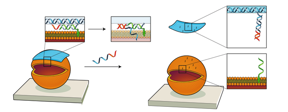 |
| Image shows how to build DNA ‘nanostructures’ to effectively manipulate synthetic liposomes. (Left) DNA strands are woven to bind a DNA nanotile (blue) to the liposome (orange) and then (right) release it when it is given a specific signal. CREDIT Graphic: Dr Jasleen Daljit Singh and Dr Jon Berengut, University of Sydney. |
Abstract:
Scientists have worked out how to best get DNA to communicate with membranes in our body, paving the way for the creation of ‘mini biological computers’ in droplets that have potential uses in biosensing and mRNA vaccines.
How to program DNA robots to poke and prod cell membranes: A discovery of how to build little blocks out of DNA and get them to stick to lipids has implications for biosensing and mRNA vaccines
Sydney, Australia | Posted on October 15th, 2021UNSW’s Dr Matthew Baker and the University of Sydney’s Dr Shelley Wickham co-led the study, published recently in Nucleic Acids Research.
It discovered the best way to design and build DNA ‘nanostructures’ to effectively manipulate synthetic liposomes – tiny bubbles which have traditionally been used to deliver drugs for cancer and other diseases.
But by modifying the shape, porosity and reactivity of liposomes, there are far greater applications, such as building small molecular systems that sense their environment and respond to a signal to release a cargo, such as a drug molecule when it nears its target.
Lead author Dr Matt Baker from UNSW’s School of Biotechnology and Biomolecular Sciences says the study discovered how to build “little blocks” out of DNA and worked out how best to label these blocks with cholesterol to get them to stick to lipids, the main constituents of plant and animal cells.
“One major application of our study is biosensing: you could stick some droplets in a person or patient, as it moves through the body it records local environment, processes this and delivers a result so you can 'read out', the local environment,” Dr Baker says.
Liposome nanotechnology has shot into prominence with the use of liposomes alongside RNA vaccines such as the Pfizer and Moderna COVID-19 vaccines.
“This work shows new ways to corral liposomes into place and then pop them open at just the right time,” Dr Baker says.
“What's better is because they are built from the bottom-up out of individual parts we design, we can easily bolt in and out different components to change the way they work.
Previously scientists struggled to find the right buffer conditions for lipids and liposomes to make sure that their DNA ‘computers’ actually stuck to liposomes.
They also struggled with the best way to decorate the DNA with cholesterols so that it would not only go to the membrane but stay there as long as was needed.
“Is it better at the edge? The centre? Heaps of them? Few of them? Close as possible to structure, or far as possible?,” Dr Baker says.
“We looked at all these things and showed that we could make good conditions for DNA structures to bind to liposomes reliably and 'do something'.”
Dr Baker says membranes are critical in life as they allow compartments to form and therefore different types of tissue and cells to be separated.
“This all relies on membranes being generally quite impermeable,” he says.
“Here we have built totally new DNA nanotechnology where we can punch holes in membranes, on demand, to be able to pass important signals across a membrane.
“This is ultimately the basis in life of how cells communicate with each other, and how something useful can be made in one cell and then exported to be used elsewhere.”
Alternately, in pathogens, membranes can be disrupted to destroy cells, or viruses can sneak into cells to replicate themselves.
The scientists will next work on how to control DNA-based pores that can be triggered with light to develop synthetic retinas out of entirely novel parts.
####
For more information, please click here
Contacts:
Diane Nazaroff
University of New South Wales
Office: 042-447-9199
Copyright © UNSW Sydney
If you have a comment, please Contact us.Issuers of news releases, not 7th Wave, Inc. or Nanotechnology Now, are solely responsible for the accuracy of the content.
Bookmark:


| Related Links |
| Related News Press |
News and information
 Quantum computer improves AI predictions April 17th, 2026
Flexible sensor gains sensitivity under pressure April 17th, 2026
A reusable chip for particulate matter sensing April 17th, 2026
Detecting vibrational quantum beating in the predissociation dynamics of SF6 using time-resolved photoelectron spectroscopy April 17th, 2026
Robotics
Nanofibrous metal oxide semiconductor for sensory face November 8th, 2024
Femtosecond laser technique births "dancing microrobots": USTC's breakthrough in multi-material microfabrication August 11th, 2023
Possible Futures
A fundamentally new therapeutic approach to cystic fibrosis: Nanobody repairs cellular defect April 17th, 2026
UC Irvine physicists discover method to reverse ‘quantum scrambling’ : The work addresses the problem of information loss in quantum computing system April 17th, 2026
Nanomedicine
A fundamentally new therapeutic approach to cystic fibrosis: Nanobody repairs cellular defect April 17th, 2026
New molecular technology targets tumors and simultaneously silences two ‘undruggable’ cancer genes August 8th, 2025
New imaging approach transforms study of bacterial biofilms August 8th, 2025
Electrifying results shed light on graphene foam as a potential material for lab grown cartilage June 6th, 2025
Sensors
Flexible sensor gains sensitivity under pressure April 17th, 2026
Tiny nanosheets, big leap: A new sensor detects ethanol at ultra-low levels January 30th, 2026
From sensors to smart systems: the rise of AI-driven photonic noses January 30th, 2026
Sensors innovations for smart lithium-based batteries: advancements, opportunities, and potential challenges August 8th, 2025
Discoveries
Quantum computer improves AI predictions April 17th, 2026
Flexible sensor gains sensitivity under pressure April 17th, 2026
A reusable chip for particulate matter sensing April 17th, 2026
Detecting vibrational quantum beating in the predissociation dynamics of SF6 using time-resolved photoelectron spectroscopy April 17th, 2026
Announcements
A fundamentally new therapeutic approach to cystic fibrosis: Nanobody repairs cellular defect April 17th, 2026
UC Irvine physicists discover method to reverse ‘quantum scrambling’ : The work addresses the problem of information loss in quantum computing system April 17th, 2026
Interviews/Book Reviews/Essays/Reports/Podcasts/Journals/White papers/Posters
A fundamentally new therapeutic approach to cystic fibrosis: Nanobody repairs cellular defect April 17th, 2026
UC Irvine physicists discover method to reverse ‘quantum scrambling’ : The work addresses the problem of information loss in quantum computing system April 17th, 2026
Nanobiotechnology
A fundamentally new therapeutic approach to cystic fibrosis: Nanobody repairs cellular defect April 17th, 2026
New molecular technology targets tumors and simultaneously silences two ‘undruggable’ cancer genes August 8th, 2025
New imaging approach transforms study of bacterial biofilms August 8th, 2025
Electrifying results shed light on graphene foam as a potential material for lab grown cartilage June 6th, 2025
 |
||
 |
||
| The latest news from around the world, FREE | ||
 |
||
|
|
||
| Premium Products | ||
 |
||
|
Only the news you want to read!
Learn More |
||
 |
||
|
Full-service, expert consulting
Learn More |
||
|
|
||