Home > Press > Putting a new theory of many-particle quantum systems to the test: Experiments show that generalized hydrodynamics accurately simulates an out-of-equilibrium quantum system
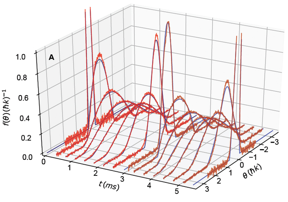 |
| New experiments using trapped one-dimensional quantum gases fit with the predictions of the recently developed theory of generalized hydrodynamics. Graph showing the time evolution of the quasiparticle momentum distribution—a property of the atoms in the gases—in a bundle of one-dimensional gases. The experimental data (red lines) nearly perfectly match the predictions of generalized hydrodynamics theory (blue lines). CREDIT Weiss Laboratory, Penn State |
Abstract:
New experiments using trapped one-dimensional gases—atoms cooled to the coldest temperatures in the universe and confined so that they can only move in a line—fit with the predictions of the recently developed theory of “generalized hydrodynamics.” Quantum mechanics is necessary to describe the novel properties of these gases. Achieving a better understanding of how such systems with many particles evolve in time is a frontier of quantum physics. The result could greatly simplify the study of quantum systems that have been excited out of equilibrium. Besides its fundamental importance, it could eventually inform the development of quantum-based technologies, which include quantum computers and simulators, quantum communication, and quantum sensors. A paper describing the experiments by a team led by Penn State physicists appears September 2, 2021 in the journal Science.
Putting a new theory of many-particle quantum systems to the test: Experiments show that generalized hydrodynamics accurately simulates an out-of-equilibrium quantum system
University Park, PA | Posted on September 3rd, 2021Even within classical physics, where the additional complexities of quantum mechanics can be ignored, it is impossible to simulate the motion of all the atoms in a moving fluid. To approximate these systems of particles, physicists use hydrodynamics descriptions.
“The basic idea behind hydrodynamics is to forget about the atoms and consider the fluid as a continuum,” said Marcos Rigol, professor of physics at Penn State and one of the leaders of the research team. “To simulate the fluid, one ends up writing coupled equations that result from imposing a few constraints, such as the conservation of mass and energy. These are the same types of equations solved, for example, to simulate how air flows when you open windows to improve ventilation in a room.”
Matter becomes more complicated if quantum mechanics is involved, as is the case when one wants to simulate quantum many-body systems that are out of equilibrium.
“Quantum many body systems—which are composed of many interacting particles, such as atoms—are at the heart of atomic, nuclear, and particle physics,” said David Weiss, Distinguished Professor of Physics at Penn State and one of the leaders of the research team. “It used to be that except in extreme limits you couldn’t do a calculation to describe out-of-equilibrium quantum many-body systems. That recently changed.”
The change was motivated by the development of a theoretical framework known as generalized hydrodynamics.
“The problem with those quantum many-body systems in one dimension is that they have so many constraints on their motion that regular hydrodynamics descriptions cannot be used,” said Rigol. “Generalized hydrodynamics was developed to keep track of all those constraints.”
Until now, generalized hydrodynamics had only previously been experimentally tested under conditions where the strength of interactions among particles was weak.
“We set out to test the theory further, by looking at the dynamics of one dimensional gases with a wide range of interaction strengths,” said Weiss. “The experiments are extremely well controlled, so the results can be precisely compared to the predictions of this theory.
The research team uses one dimensional gases of interacting atoms that are initially confined in a very shallow trap in equilibrium. They then very suddenly increase the depth of the trap by 100 times, which forces the particles to collapse into the center of the trap, causing their collective properties to change. Throughout the collapse, the team precisely measures their properties, which they can then compare to the predictions of generalized hydrodynamics.
“Our measurements matched the prediction of theory across dozens of trap oscillations,” said Weiss. “There currently aren’t other ways to study out-of-equilibrium quantum systems for long periods of time with reasonable accuracy, especially with a lot of particles. Generalized hydrodynamics allow us to do this for some systems like the one we tested, but how generally applicable it is still needs to be determined.”
###
In addition to Weiss and Rigol, the research team includes Neel Malvania, Yicheng Zhang, and Yuan Le at Penn State; and Jerome Dubail at Université de Lorraine in France. The research was funded by the U.S. National Science Foundation and the U.S. Army Research Office.
####
For more information, please click here
Contacts:
Sam Sholtis
Office: 814-865-1390
Expert Contacts
David Weiss
Office: (814) 863-3076
Marcos Rigol
Office: (814) 865-6460
Copyright © Penn State
If you have a comment, please Contact us.Issuers of news releases, not 7th Wave, Inc. or Nanotechnology Now, are solely responsible for the accuracy of the content.
Bookmark:


| Related Links |
| Related News Press |
News and information
 Quantum computer improves AI predictions April 17th, 2026
Flexible sensor gains sensitivity under pressure April 17th, 2026
A reusable chip for particulate matter sensing April 17th, 2026
Detecting vibrational quantum beating in the predissociation dynamics of SF6 using time-resolved photoelectron spectroscopy April 17th, 2026
Quantum Physics
Detecting vibrational quantum beating in the predissociation dynamics of SF6 using time-resolved photoelectron spectroscopy April 17th, 2026
Beyond silicon: Electronics at the scale of a single molecule January 30th, 2026
Quantum chemistry
A 1960s idea inspires NBI researchers to study hitherto inaccessible quantum states June 6th, 2025
Three-pronged approach discerns qualities of quantum spin liquids November 17th, 2023
Govt.-Legislation/Regulation/Funding/Policy
Quantum computer improves AI predictions April 17th, 2026
Metasurfaces smooth light to boost magnetic sensing precision January 30th, 2026
New imaging approach transforms study of bacterial biofilms August 8th, 2025
Possible Futures
A fundamentally new therapeutic approach to cystic fibrosis: Nanobody repairs cellular defect April 17th, 2026
UC Irvine physicists discover method to reverse ‘quantum scrambling’ : The work addresses the problem of information loss in quantum computing system April 17th, 2026
Quantum Computing
Quantum computer improves AI predictions April 17th, 2026
UC Irvine physicists discover method to reverse ‘quantum scrambling’ : The work addresses the problem of information loss in quantum computing system April 17th, 2026
Researchers develop molecular qubits that communicate at telecom frequencies October 3rd, 2025
Discoveries
Quantum computer improves AI predictions April 17th, 2026
Flexible sensor gains sensitivity under pressure April 17th, 2026
A reusable chip for particulate matter sensing April 17th, 2026
Detecting vibrational quantum beating in the predissociation dynamics of SF6 using time-resolved photoelectron spectroscopy April 17th, 2026
Announcements
A fundamentally new therapeutic approach to cystic fibrosis: Nanobody repairs cellular defect April 17th, 2026
UC Irvine physicists discover method to reverse ‘quantum scrambling’ : The work addresses the problem of information loss in quantum computing system April 17th, 2026
Interviews/Book Reviews/Essays/Reports/Podcasts/Journals/White papers/Posters
A fundamentally new therapeutic approach to cystic fibrosis: Nanobody repairs cellular defect April 17th, 2026
UC Irvine physicists discover method to reverse ‘quantum scrambling’ : The work addresses the problem of information loss in quantum computing system April 17th, 2026
Military
Quantum engineers ‘squeeze’ laser frequency combs to make more sensitive gas sensors January 17th, 2025
Chainmail-like material could be the future of armor: First 2D mechanically interlocked polymer exhibits exceptional flexibility and strength January 17th, 2025
Single atoms show their true color July 5th, 2024
NRL charters Navy’s quantum inertial navigation path to reduce drift April 5th, 2024
 |
||
 |
||
| The latest news from around the world, FREE | ||
 |
||
|
|
||
| Premium Products | ||
 |
||
|
Only the news you want to read!
Learn More |
||
 |
||
|
Full-service, expert consulting
Learn More |
||
|
|
||