Home > Press > From anti-icing coatings to protection of containers with flammable liquids: heating films with graphene nanotubes enter the market
 |
Abstract:
•Heating films with graphene nanotubes have been proven to be an economical, efficient, and durable solution.
•Nanotube solutions have successfully passed probation as an anti-icing system for roofs.
•Optimization of energy consumption is achieved by efficient heating technology in combination with an automatic heat-stop system.
From anti-icing coatings to protection of containers with flammable liquids: heating films with graphene nanotubes enter the market
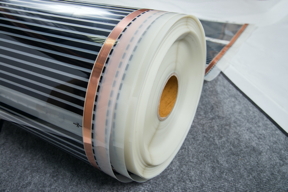
Luxembourg | Posted on August 20th, 2021Electrically conductive heating films with nanotubes feature a polyethylene film 8–150 cm wide and 0.35 mm thick with a conductive coating modified by TUBALL graphene nanotubes from OCSiAl. When connected to a standard 220 W power supply, the film generates heat. The power of such a heating system is 350 W/m2, while the service life surpasses 10,000 on/off cycles.
The fundamental difference between film heating and other anti-icing systems, such as, for example, a heating cable, lies in its high efficiency – the film is capable of heating a much larger surface area with the same power consumed. Heating films can be used both in industrial facilities for heating pipelines, tanks, and electrical cabinets, and in architectural facilities for roof anti-icing, heating sidewalks, steps, and ramps, and residential heating.
“Graphene nanotubes make it possible to produce heating elements that show no degradation over time. The solution that has been developed allows producers to integrate the film heating system into any complex surface,” said Vasily Kozhukhov, Sales Director of OCSiAl Russia. “Last winter, a heating film with nanotubes was tested on the roofs of two houses in St. Petersburg, Russia, and received positive recommendations for further use from the municipal housing authorities.”
The solution developed with graphene nanotubes also demonstrates a “self-regulation effect,” which allows the system to automatically stop heating when the required temperature is reached, without the use of additional temperature sensors. This is crucial when maintaining a stable temperature in containers with flammable liquids.
####
About OCSiAl Group
Today, OCSiAl offers a wide range of nanotube solutions for coatings, providing them with high electrical conductivity, additionally maintaining or improving mechanical properties. Conductive primers and flooring, lining and powder coatings, gelcoats and PU cast systems – these and more final products empowered by graphene nanotubes are already on the market.
For more information, please click here
Contacts:
Anastasia Zirka
Senior PR & Advertising Manager
OCSiAl Group
+7 913 989 9239
Copyright © OCSiAl Group
If you have a comment, please Contact us.Issuers of news releases, not 7th Wave, Inc. or Nanotechnology Now, are solely responsible for the accuracy of the content.
Bookmark:


| Related News Press |
News and information
 Quantum computer improves AI predictions April 17th, 2026
Flexible sensor gains sensitivity under pressure April 17th, 2026
A reusable chip for particulate matter sensing April 17th, 2026
Detecting vibrational quantum beating in the predissociation dynamics of SF6 using time-resolved photoelectron spectroscopy April 17th, 2026
Graphene/ Graphite
Electrifying results shed light on graphene foam as a potential material for lab grown cartilage June 6th, 2025
Breakthrough in proton barrier films using pore-free graphene oxide: Kumamoto University researchers achieve new milestone in advanced coating technologies September 13th, 2024
Possible Futures
A fundamentally new therapeutic approach to cystic fibrosis: Nanobody repairs cellular defect April 17th, 2026
UC Irvine physicists discover method to reverse ‘quantum scrambling’ : The work addresses the problem of information loss in quantum computing system April 17th, 2026
Nanotubes/Buckyballs/Fullerenes/Nanorods/Nanostrings/Nanosheets
Tiny nanosheets, big leap: A new sensor detects ethanol at ultra-low levels January 30th, 2026
Enhancing power factor of p- and n-type single-walled carbon nanotubes April 25th, 2025
Chainmail-like material could be the future of armor: First 2D mechanically interlocked polymer exhibits exceptional flexibility and strength January 17th, 2025
Innovative biomimetic superhydrophobic coating combines repair and buffering properties for superior anti-erosion December 13th, 2024
Discoveries
Quantum computer improves AI predictions April 17th, 2026
Flexible sensor gains sensitivity under pressure April 17th, 2026
A reusable chip for particulate matter sensing April 17th, 2026
Detecting vibrational quantum beating in the predissociation dynamics of SF6 using time-resolved photoelectron spectroscopy April 17th, 2026
Announcements
A fundamentally new therapeutic approach to cystic fibrosis: Nanobody repairs cellular defect April 17th, 2026
UC Irvine physicists discover method to reverse ‘quantum scrambling’ : The work addresses the problem of information loss in quantum computing system April 17th, 2026
Aerospace/Space
Decoding hydrogen‑bond network of electrolyte for cryogenic durable aqueous zinc‑ion batteries January 30th, 2026
ICFO researchers overcome long-standing bottleneck in single photon detection with twisted 2D materials August 8th, 2025
Onion-like nanoparticles found in aircraft exhaust May 14th, 2025
 |
||
 |
||
| The latest news from around the world, FREE | ||
 |
||
|
|
||
| Premium Products | ||
 |
||
|
Only the news you want to read!
Learn More |
||
 |
||
|
Full-service, expert consulting
Learn More |
||
|
|
||