Home > Press > Silica nanostructure with chemo-enzymatic compartmentalization
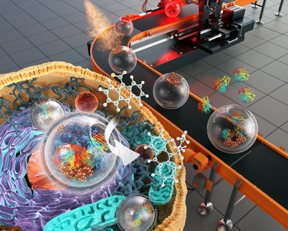 |
| Schematic diagram of in vivo enantioselective molecular synthesis using SiJAR CREDIT POSTECH |
Abstract:
As COVID-19 vaccinations are well underway, people await a return to normal life. However, fears also grow due to unforeseen side effects like the rare thrombosis. In the body, life is maintained by the movement of substances or energy. Chemical reactions are regulated by the presence of organelles or core structures of cells that accommodate specific enzymes or cofactors. A nanoreactor with both the activity of a synthetic catalyst, such as an artificial organelle that mimics a cell, and the properties of an enzyme creates a platform for selectively synthesizing natural enantiomeric bioactive molecules that can respond to pathogens – such as drugs – in the body. However, until now, a nanoreactor with the functions of both a synthetic catalyst and an enzyme for such a platform has not been reported.
Silica nanostructure with chemo-enzymatic compartmentalization
Pohang, South Korea | Posted on August 13th, 2021To this, a research team at POSTECH has recently synthesized a chemo-enzymatic nanostructure that can selectively synthesize one enantiomer while acting like an artificial organelle in the cell.
A research team led by Professor In Su Lee, Research Professor Amit Kumar, and Ph.D. candidate Seonock Kim of POSTECH’s Department of Chemistry has succeeded in designing a silica nanostructure (SiJAR) as an artificial organelle for selective synthesis of enantiomers in cells. This research finding was selected as the front cover of Angewandte Chemie, a prestigious academic journal in the field of chemistry and published online on June 21, 2021.
The first consideration in designing nanostructures for intracellular applications is to stably co-localize and maintain the reactive surface of catalytic nanocrystals while protecting the enzyme from inactivation. Until now, the catalysis of nature-inspired hollow nanostructures accommodating catalytic nanocrystals or enzymes, or both, has only been experimentally proven and has not been demonstrated in living organisms. This is because microporous closed nanostructures restrict the entry and co-localization of catalytic nanocrystals and large-size biomolecules.
The research team synthesized round jar-shaped SiJARs with chemo-responsive metal-silicate lids by modifying the chemical composition of a section in the reactor using spatiotemporal-controlled thermal conversion chemistry. Due to the divided configuration of SiJAR, different catalytic noble metals (Pt, Pd, Ru) were selectively modified on the lid-section by galvanic reactions. Subsequently, the lid was opened under mild acidic conditions or an intracellular environment, creating a wide-passage into the shell while shifting the residual metal catalyst of the lid inwards. This open structure accommodates large enzymes, thus facilitating encapsulation.
The nanoreactor synthesized in this study is composed of silica with high biocompatibility and by protecting catalytic nanocrystals or large biomolecules in an open-mouth silica-compartment, it performed asymmetric aldol reaction with high enantioselectivity via an enzyme-metal co-operative transition state stabilization. In addition, the researchers confirmed that it functions as an artificial catalytic organelle by stably performing the reaction inside living cells.
The hybrid chemoenzymatic nanodevice, customizable through this sophisticated solid-state conversion strategy, has a structure and function similar to that of intracellular organelles, and can be utilized for synthesizing active therapeutics and bioimaging probes locally inside cells to be suitable for use in next generation bioimaging and treatment.
"With the results of this research using the unique Nanospace-Confined Chemical Reactions (NCCR), we look forward to developing the technology that artificially regulates cell functions,” commented Professor In Su Lee who led the study.
This study was conducted with the support from the Leader Researcher Program and the National Creative Research Initiative Program of the National Research Foundation of Korea funded by the Ministry of Science and ICT of Korea.
####
For more information, please click here
Contacts:
Jinyoung Huh
Office: 82-54-279-2415
Copyright © POSTECH
If you have a comment, please Contact us.Issuers of news releases, not 7th Wave, Inc. or Nanotechnology Now, are solely responsible for the accuracy of the content.
Bookmark:


| Related Links |
| Related News Press |
News and information
 Quantum computer improves AI predictions April 17th, 2026
Flexible sensor gains sensitivity under pressure April 17th, 2026
A reusable chip for particulate matter sensing April 17th, 2026
Detecting vibrational quantum beating in the predissociation dynamics of SF6 using time-resolved photoelectron spectroscopy April 17th, 2026
Possible Futures
A fundamentally new therapeutic approach to cystic fibrosis: Nanobody repairs cellular defect April 17th, 2026
UC Irvine physicists discover method to reverse ‘quantum scrambling’ : The work addresses the problem of information loss in quantum computing system April 17th, 2026
Nanomedicine
A fundamentally new therapeutic approach to cystic fibrosis: Nanobody repairs cellular defect April 17th, 2026
New molecular technology targets tumors and simultaneously silences two ‘undruggable’ cancer genes August 8th, 2025
New imaging approach transforms study of bacterial biofilms August 8th, 2025
Electrifying results shed light on graphene foam as a potential material for lab grown cartilage June 6th, 2025
Discoveries
Quantum computer improves AI predictions April 17th, 2026
Flexible sensor gains sensitivity under pressure April 17th, 2026
A reusable chip for particulate matter sensing April 17th, 2026
Detecting vibrational quantum beating in the predissociation dynamics of SF6 using time-resolved photoelectron spectroscopy April 17th, 2026
Announcements
A fundamentally new therapeutic approach to cystic fibrosis: Nanobody repairs cellular defect April 17th, 2026
UC Irvine physicists discover method to reverse ‘quantum scrambling’ : The work addresses the problem of information loss in quantum computing system April 17th, 2026
Interviews/Book Reviews/Essays/Reports/Podcasts/Journals/White papers/Posters
A fundamentally new therapeutic approach to cystic fibrosis: Nanobody repairs cellular defect April 17th, 2026
UC Irvine physicists discover method to reverse ‘quantum scrambling’ : The work addresses the problem of information loss in quantum computing system April 17th, 2026
Nanobiotechnology
A fundamentally new therapeutic approach to cystic fibrosis: Nanobody repairs cellular defect April 17th, 2026
New molecular technology targets tumors and simultaneously silences two ‘undruggable’ cancer genes August 8th, 2025
New imaging approach transforms study of bacterial biofilms August 8th, 2025
Electrifying results shed light on graphene foam as a potential material for lab grown cartilage June 6th, 2025
 |
||
 |
||
| The latest news from around the world, FREE | ||
 |
||
|
|
||
| Premium Products | ||
 |
||
|
Only the news you want to read!
Learn More |
||
 |
||
|
Full-service, expert consulting
Learn More |
||
|
|
||