Home > Press > Quantum computing enables unprecedented materials science simulations: Multi-institutional team provides a foundation for unraveling the mysteries of magnetic materials
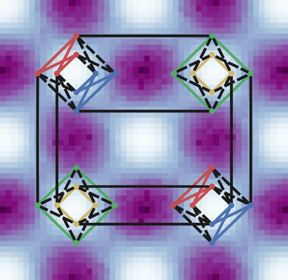 |
| Researchers used a D-Wave quantum computer chip to create this simulation of a sample material with results comparable to those of real-world experiments. CREDIT Image courtesy of Paul Kairys |
Abstract:
The Science
Researchers have for the first time used a quantum computer to generate accurate results from materials science simulations that can be verified with practical techniques. The team used a form of quantum computing called quantum annealing. This approach uses quantum physics to simplify a computer model. The team overcame quantum hardware limitations by programming various parameters into a materials science model. Next, they embedded the model into team member D-Wave’s 2000Q quantum computer.
Quantum computing enables unprecedented materials science simulations: Multi-institutional team provides a foundation for unraveling the mysteries of magnetic materials
Washington, DC | Posted on August 6th, 2021The Impact
The results from the simulation strongly resembled the output from real-world experiments. This demonstrates that quantum resources are capable of studying the magnetic structure and properties of magnetic materials. Eventually, such simulations on quantum computers could be more accurate and complex than simulations on classical digital computers. This would provide precise answers to materials science questions instead of approximations. It would also lead to a better understanding of spin liquids and spin ices. These are quantum states of matter that are potentially useful for data storage and other applications.
Summary
Using the largest quantum computer available at the time, researchers completed the largest simulation possible for the Ising model, a mathematical model of ferromagnetism. The research provides a foundation to streamline future efforts on next-generation quantum computers. Although quantum resources have previously simulated small molecules to examine chemical or material systems, studying massive magnetic materials containing thousands of atoms would not have been possible on a smaller system. By using a Monte Carlo simulation technique powered by the quantum evolution of the Ising model, the team gained valuable insights into the formation of a phenomenon known as fractional magnetization plateaus within materials called rare earth tetraborides in microscopic detail. This exotic phenomenon occurs in frustrated materials when an applied magnetic field, which normally causes all spins in a material to point in one direction, affects only some spins in the usual way while others point in the opposite direction instead.
Funding
This work was funded by the Department of Energy (DOE) Office of Science Early Career Research Program. Access to the D-Wave 2000Q system was provided through the Quantum Computing User Program managed by the Oak Ridge Leadership Computing Facility, a DOE Office of Science user facility located at Oak Ridge National Laboratory (ORNL). Research performed at ORNL’s Spallation Neutron Source, also a DOE Office of Science user facility located at ORNL, was supported by the DOE Office of Science. All the individuals and institutions involved with this research are members of the Quantum Science Center, a DOE Quantum Information Science Research Center established at ORNL in 2020.
####
For more information, please click here
Contacts:
Michael Church
Office: 505-358-1481
Copyright © U.S. Department of Energy
If you have a comment, please Contact us.Issuers of news releases, not 7th Wave, Inc. or Nanotechnology Now, are solely responsible for the accuracy of the content.
Bookmark:


| Related Links |
| Related News Press |
News and information
 Quantum computer improves AI predictions April 17th, 2026
Flexible sensor gains sensitivity under pressure April 17th, 2026
A reusable chip for particulate matter sensing April 17th, 2026
Detecting vibrational quantum beating in the predissociation dynamics of SF6 using time-resolved photoelectron spectroscopy April 17th, 2026
Govt.-Legislation/Regulation/Funding/Policy
Quantum computer improves AI predictions April 17th, 2026
Metasurfaces smooth light to boost magnetic sensing precision January 30th, 2026
New imaging approach transforms study of bacterial biofilms August 8th, 2025
Possible Futures
A fundamentally new therapeutic approach to cystic fibrosis: Nanobody repairs cellular defect April 17th, 2026
UC Irvine physicists discover method to reverse ‘quantum scrambling’ : The work addresses the problem of information loss in quantum computing system April 17th, 2026
Quantum Computing
Quantum computer improves AI predictions April 17th, 2026
UC Irvine physicists discover method to reverse ‘quantum scrambling’ : The work addresses the problem of information loss in quantum computing system April 17th, 2026
Researchers develop molecular qubits that communicate at telecom frequencies October 3rd, 2025
Materials/Metamaterials/Magnetoresistance
First real-time observation of two-dimensional melting process: Researchers at Mainz University unveil new insights into magnetic vortex structures August 8th, 2025
Researchers unveil a groundbreaking clay-based solution to capture carbon dioxide and combat climate change June 6th, 2025
A 1960s idea inspires NBI researchers to study hitherto inaccessible quantum states June 6th, 2025
Institute for Nanoscience hosts annual proposal planning meeting May 16th, 2025
Announcements
A fundamentally new therapeutic approach to cystic fibrosis: Nanobody repairs cellular defect April 17th, 2026
UC Irvine physicists discover method to reverse ‘quantum scrambling’ : The work addresses the problem of information loss in quantum computing system April 17th, 2026
Interviews/Book Reviews/Essays/Reports/Podcasts/Journals/White papers/Posters
A fundamentally new therapeutic approach to cystic fibrosis: Nanobody repairs cellular defect April 17th, 2026
UC Irvine physicists discover method to reverse ‘quantum scrambling’ : The work addresses the problem of information loss in quantum computing system April 17th, 2026
 |
||
 |
||
| The latest news from around the world, FREE | ||
 |
||
|
|
||
| Premium Products | ||
 |
||
|
Only the news you want to read!
Learn More |
||
 |
||
|
Full-service, expert consulting
Learn More |
||
|
|
||