Home > Press > Verizon and Zurich Instruments join Q-NEXT national quantum science center
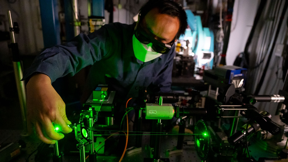 |
| The Q-NEXT collaboration works to develop the science and technology to control, store and transmit quantum information. CREDIT (Image by Argonne National Laboratory.) |
Abstract:
Q-NEXT has added two new corporate partners to its collaboration: Verizon and Zurich Instruments USA, Inc.
Verizon and Zurich Instruments join Q-NEXT national quantum science center
Argonne, IL | Posted on August 6th, 2021Q-NEXT, a National Quantum Information Science Research Center led by the U.S. Department of Energy’s (DOE) Argonne National Laboratory, is a partnership of three national laboratories, nine universities and, with the new addition, 12 leading U.S. quantum technology companies.
The Q-NEXT mission is to develop the science and technology to control, store and transmit quantum information, whether the information is distributed over the length of a computer chip or the distance between Chicago and San Francisco. Q-NEXT collaborators are working together toward this goal by developing new quantum materials and instruments that outperform current technology.
“I’m delighted that Verizon and Zurich Instruments have joined Q-NEXT. Both are global leaders in communication and tech innovation, and their collaboration will help us realize our vision to enable quantum technologies for science and society.” — Q-NEXT Director David Awschalom
Unlike traditional information technologies, such as the internet or smart phone, quantum information technologies work by taking advantage of physics that operates at nature’s smallest scales, manipulating information encoded in matter’s quantum properties. The successful development of such technologies can lead to unhackable communication channels, ultraprecise sensors and more powerful computers.
Quantum information can be conveyed through a quantum network, analogous to our current internet. The secure and efficient transmission of information over a quantum network places new requirements on lasers, sensors and optical fiber. Verizon’s expertise in networking and security will ensure that key requirements are considered in Q-NEXT’s technology R&D roadmap.
“Verizon is excited to be participating with national laboratory, academic and commercial teams in the quantum communications group at Q-NEXT," said Jean McManus, executive director of applied research at Verizon. "We look forward to contributing to the center's roadmap.”
Zurich Instruments brings innovation to advanced instrumentation in quantum technologies, enabling the reliable control and measurement of quantum information. Zurich Instruments’ goal is to support quantum researchers and engineers by allowing them to focus on developing quantum devices, even as they benefit from the most advanced traditional electronics and software. The company will collaborate with Q-NEXT by participating in all its major research areas, including partnering on cutting-edge projects and training the future quantum workforce.
“We are thrilled to be part of Q-NEXT. Our goal is to offer the best quantum technologies to support fundamental and applied research," said Vikrant Mahajan, vice president, sales and operations of Zurich Instruments USA, Inc. "Partnering with leading quantum organizations worldwide allows us to remain at the forefront of technology. We look forward to collaborating with national lab, academic and industry partners at Q-NEXT.”
Collaborators at the two companies will join Q-NEXT’s nearly 100 researchers, who have been actively working for the past 10 months on developing the organization’s quantum technology roadmap and preparing for the completion of its two national foundries. The foundries will act as a “quantum factory,” producing a robust supply chain of high-quality, standardized quantum materials and devices.
Industry collaboration is vital to the Q-NEXT mission. Members of industry are embedded in every level of the organization. Active industry engagement enables Q-NEXT to effectively target the needs of technology consumers and translate research into practical technologies.
Through industry partnerships, Q-NEXT also boosts the growth of the quantum workforce, as partner companies embed students and early-career professionals among their staff to work on the most pressing problems in quantum science.
“I’m delighted that Verizon and Zurich Instruments have joined Q-NEXT. Both are global leaders in communication and tech innovation, and their collaboration will help us realize our vision to enable quantum technologies for science and society,” said Q-NEXT Director David Awschalom, an Argonne National Laboratory senior scientist, University of Chicago Liew Family professor in molecular engineering and physics and vice dean for research and infrastructure, and Chicago Quantum Exchange director. “Their partnership, along with those of all Q-NEXT collaborators, strengthens the ecosystem in which we all work to advance this exciting, burgeoning area of quantum information science.”
Q-NEXT is supported by the U.S. Department of Energy Office of Science.
####
About Argonne National Laboratory
Argonne National Laboratory seeks solutions to pressing national problems in science and technology. The nation’s first national laboratory, Argonne conducts leading-edge basic and applied scientific research in virtually every scientific discipline. Argonne researchers work closely with researchers from hundreds of companies, universities, and federal, state and municipal agencies to help them solve their specific problems, advance America’s scientific leadership and prepare the nation for a better future. With employees from more than 60 nations, Argonne is managed by UChicago Argonne, LLC for the U.S. Department of Energy’s Office of Science.
The U.S. Department of Energy’s Office of Science is the single largest supporter of basic research in the physical sciences in the United States and is working to address some of the most pressing challenges of our time. For more information, visit https://energy.gov/science.
For more information, please click here
Contacts:
Leah Hesla
Office: 630-252-2000
Copyright © Argonne National Laboratory
If you have a comment, please Contact us.Issuers of news releases, not 7th Wave, Inc. or Nanotechnology Now, are solely responsible for the accuracy of the content.
Bookmark:


| Related News Press |
News and information
 Researchers develop molecular qubits that communicate at telecom frequencies October 3rd, 2025
Next-generation quantum communication October 3rd, 2025
"Nanoreactor" cage uses visible light for catalytic and ultra-selective cross-cycloadditions October 3rd, 2025
Laboratories
Researchers develop molecular qubits that communicate at telecom frequencies October 3rd, 2025
Govt.-Legislation/Regulation/Funding/Policy
New imaging approach transforms study of bacterial biofilms August 8th, 2025
Electrifying results shed light on graphene foam as a potential material for lab grown cartilage June 6th, 2025
Institute for Nanoscience hosts annual proposal planning meeting May 16th, 2025
Possible Futures
Spinel-type sulfide semiconductors to operate the next-generation LEDs and solar cells For solar-cell absorbers and green-LED source October 3rd, 2025
Announcements
Rice membrane extracts lithium from brines with greater speed, less waste October 3rd, 2025
Researchers develop molecular qubits that communicate at telecom frequencies October 3rd, 2025
Next-generation quantum communication October 3rd, 2025
"Nanoreactor" cage uses visible light for catalytic and ultra-selective cross-cycloadditions October 3rd, 2025
Alliances/Trade associations/Partnerships/Distributorships
Chicago Quantum Exchange welcomes six new partners highlighting quantum technology solutions, from Chicago and beyond September 23rd, 2022
University of Illinois Chicago joins Brookhaven Lab's Quantum Center June 10th, 2022
Research partnerships
Lab to industry: InSe wafer-scale breakthrough for future electronics August 8th, 2025
HKU physicists uncover hidden order in the quantum world through deconfined quantum critical points April 25th, 2025
 |
||
 |
||
| The latest news from around the world, FREE | ||
 |
||
|
|
||
| Premium Products | ||
 |
||
|
Only the news you want to read!
Learn More |
||
 |
||
|
Full-service, expert consulting
Learn More |
||
|
|
||