Home > Press > Argonne researchers use AI to optimize a popular material coating technique in real time
 |
| (Image by Fotogrin/Shutterstock.) |
Abstract:
To make computer chips, technologists around the world rely on atomic layer deposition (ALD), which can create films as fine as one atom thick. Businesses commonly use ALD to make semiconductor devices, but it also has applications in solar cells, lithium batteries and other energy-related fields.
Argonne researchers use AI to optimize a popular material coating technique in real time
Argonne, IL | Posted on June 25th, 2021Today, manufacturers increasingly rely on ALD to make new types of films, but figuring out how to tweak the process for each new material takes time.
Part of the problem is that researchers primarily use trial and error to identify optimal growth conditions. But a recently published study -- one of the first in this scientific field -- suggests that using artificial intelligence (AI) can be more efficient.
In the ACS Applied Materials & Interfaces study, researchers at the U.S. Department of Energy's (DOE) Argonne National Laboratory describe multiple AI-based approaches for optimizing the ALD processes autonomously. Their work details the relative strengths and weaknesses of each approach, as well as insights that can be used to develop new processes more efficiently and economically.
"All of these algorithms provide a much faster way of converging to optimum combinations because you're not spending time putting a sample in the reactor, taking it out, doing measurements etc. as you typically would today. Instead you have a real-time loop that connects with the reactor," said Argonne principal materials scientist Angel Yanguas-Gil, a co-author of the study.
Cutting edge, but with challenges
In ALD, two different chemical vapours, known as precursors, adhere to a surface, adding a thin layer of film in the process. This all happens inside a chemical reactor and is sequential: one precursor is added and interacts with the surface, then any excess of it is removed. Afterwards the second precursor is introduced then later removed, and the process repeats itself. In microelectronics, the ALD thin film might be used to electrically insulate nearby components in nanoscale transistors.
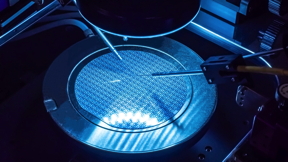
ALD excels at growing precise, nanoscale films on complex, 3D surfaces such as the deep and narrow trenches patterned into silicon wafers to manufacture today's computer chips. This has motivated scientists worldwide to develop new thin film ALD materials for future generations of semiconductor devices.
However, developing and optimizing these new ALD processes is challenging and labor-intensive. Researchers have to consider many different factors that can alter the process, including:
The complex chemistries between the molecular precursors
Reactor design, temperature and pressure
The timing for each dose of their precursors
In an effort to find ways of overcoming these challenges, Argonne scientists evaluated three optimization strategies -- random, expert system and Bayesian optimization -- the latter two utilizing different AI approaches.
Set it and forget it
Researchers evaluated their three strategies by comparing how they optimized the dosage and purge times of the two precursors used in ALD. Dosage time refers to the time period when a precursor is added to the reactor, while purge time refers to the time needed to remove excess precursor and gaseous chemical products.
The goal: Find the conditions that would achieve high and stable film growth in the shortest time. Scientists also judged the strategies on how quickly they converged on the ideal set of timings using simulations that represented the ALD process inside a reactor.
Linking their optimization approaches to their simulated system let them measure film growth in real time after each cycle, based on the processing conditions their optimization algorithms generated.
"All of these algorithms provide a much faster way of converging to optimum combinations because you're not spending time putting a sample in the reactor, taking it out, doing measurements, etc., as you would, typically. Instead you have a real-time loop that connects with the reactor," said Argonne Principal Materials Scientist Angel Yanguas-Gil, a co-author of the study.
This set up also made the process automatic for the two AI approaches by forming a closed-loop system.
"In a closed-loop system, the simulation performs an experiment, gets the results, and feeds it to the AI tool. The AI tool then learns from it or interprets it in some way, and then suggests the next experiment. And this all happens without human input," said Noah Paulson, a computational scientist at Argonne and the lead author.
Despite some weaknesses, the AI approaches effectively determined the optimal dose and purge timings for different simulated ALD processes. This makes the study among the first to show that thin-film optimization in real time is possible using AI.
"This is exciting because it opens up the possibility of using these types of approaches to rapidly optimize real ALD processes, a step that could potentially save manufacturers precious time and money when developing new applications in the future," concluded Jeff Elam, a senior chemist at Argonne and co-author.
###
For partnership opportunities, contact
The scientists used Argonne's Blues cluster in its Laboratory Computing Resource Center. This research was funded by the Laboratory Directed Research and Development (LDRD) program at Argonne.
####
About Argonne National Laboratory
Argonne National Laboratory seeks solutions to pressing national problems in science and technology. The nation's first national laboratory, Argonne conducts leading-edge basic and applied scientific research in virtually every scientific discipline. Argonne researchers work closely with researchers from hundreds of companies, universities, and federal, state and municipal agencies to help them solve their specific problems, advance America's scientific leadership and prepare the nation for a better future. With employees from more than 60 nations, Argonne is managed by UChicago Argonne, LLC for the U.S. Department of Energy's Office of Science.
The U.S. Department of Energy's Office of Science is the single largest supporter of basic research in the physical sciences in the United States and is working to address some of the most pressing challenges of our time. For more information, visit https://energy.gov/science .
For more information, please click here
Contacts:
Lynn Tefft Hoff
630-252-1750
@argonne
Copyright © Argonne National Laboratory
If you have a comment, please Contact us.Issuers of news releases, not 7th Wave, Inc. or Nanotechnology Now, are solely responsible for the accuracy of the content.
Bookmark:


| Related Links |
| Related News Press |
News and information
 Quantum computer improves AI predictions April 17th, 2026
Flexible sensor gains sensitivity under pressure April 17th, 2026
A reusable chip for particulate matter sensing April 17th, 2026
Detecting vibrational quantum beating in the predissociation dynamics of SF6 using time-resolved photoelectron spectroscopy April 17th, 2026
Laboratories
Researchers develop molecular qubits that communicate at telecom frequencies October 3rd, 2025
A battery’s hopping ions remember where they’ve been: Seen in atomic detail, the seemingly smooth flow of ions through a battery’s electrolyte is surprisingly complicated February 16th, 2024
Possible Futures
A fundamentally new therapeutic approach to cystic fibrosis: Nanobody repairs cellular defect April 17th, 2026
UC Irvine physicists discover method to reverse ‘quantum scrambling’ : The work addresses the problem of information loss in quantum computing system April 17th, 2026
Chip Technology
A reusable chip for particulate matter sensing April 17th, 2026
Metasurfaces smooth light to boost magnetic sensing precision January 30th, 2026
Discoveries
Quantum computer improves AI predictions April 17th, 2026
Flexible sensor gains sensitivity under pressure April 17th, 2026
A reusable chip for particulate matter sensing April 17th, 2026
Detecting vibrational quantum beating in the predissociation dynamics of SF6 using time-resolved photoelectron spectroscopy April 17th, 2026
Materials/Metamaterials/Magnetoresistance
First real-time observation of two-dimensional melting process: Researchers at Mainz University unveil new insights into magnetic vortex structures August 8th, 2025
Researchers unveil a groundbreaking clay-based solution to capture carbon dioxide and combat climate change June 6th, 2025
A 1960s idea inspires NBI researchers to study hitherto inaccessible quantum states June 6th, 2025
Institute for Nanoscience hosts annual proposal planning meeting May 16th, 2025
Announcements
A fundamentally new therapeutic approach to cystic fibrosis: Nanobody repairs cellular defect April 17th, 2026
UC Irvine physicists discover method to reverse ‘quantum scrambling’ : The work addresses the problem of information loss in quantum computing system April 17th, 2026
Interviews/Book Reviews/Essays/Reports/Podcasts/Journals/White papers/Posters
A fundamentally new therapeutic approach to cystic fibrosis: Nanobody repairs cellular defect April 17th, 2026
UC Irvine physicists discover method to reverse ‘quantum scrambling’ : The work addresses the problem of information loss in quantum computing system April 17th, 2026
Artificial Intelligence
Quantum computer improves AI predictions April 17th, 2026
From sensors to smart systems: the rise of AI-driven photonic noses January 30th, 2026
New quantum encoding methods slash circuit complexity in machine learning November 8th, 2024
Grants/Sponsored Research/Awards/Scholarships/Gifts/Contests/Honors/Records
Quantum computer improves AI predictions April 17th, 2026
Detecting vibrational quantum beating in the predissociation dynamics of SF6 using time-resolved photoelectron spectroscopy April 17th, 2026
Metasurfaces smooth light to boost magnetic sensing precision January 30th, 2026
 |
||
 |
||
| The latest news from around the world, FREE | ||
 |
||
|
|
||
| Premium Products | ||
 |
||
|
Only the news you want to read!
Learn More |
||
 |
||
|
Full-service, expert consulting
Learn More |
||
|
|
||