Home > Press > Compact quantum computer for server centers: Researchers build smallest quantum computer yet based on industry standards
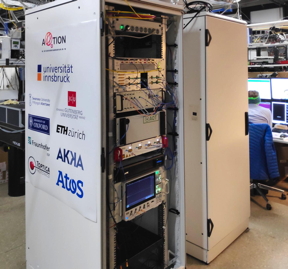 |
| The compact quantum computer fits into two 19-inch server racks. CREDIT University of Innsbruck |
Abstract:
Over the past three decades, fundamental groundwork for building quantum computers has been pioneered at the University of Innsbruck, Austria. As part of the EU Flagship Quantum Technologies, researchers at the Department of Experimental Physics in Innsbruck have now built a demonstrator for a compact ion trap quantum computer. "Our quantum computing experiments usually fill 30- to 50-square-meter laboratories," says Thomas Monz of the University of Innsbruck. "We were now looking to fit the technologies developed here in Innsbruck into the smallest possible space while meeting standards commonly used in industry." The new device aims to show that quantum computers will soon be ready for use in data centers. "We were able to show that compactness does not have to come at the expense of functionality," adds Christian Marciniak from the Innsbruck team.
Compact quantum computer for server centers: Researchers build smallest quantum computer yet based on industry standards
Innsbruck, Austria | Posted on June 18th, 2021The individual building blocks of the world's first compact quantum computer had to be significantly reduced in size. For example, the centerpiece of the quantum computer, the ion trap installed in a vacuum chamber, takes up only a fraction of the space previously required. It was provided to the researchers by Alpine Quantum Technologies (AQT), a spin-off of the University of Innsbruck and the Austrian Academy of Sciences which aims to build a commercial quantum computer. Other components were contributed by the Fraunhofer Institute for Applied Optics and Precision Engineering in Jena and laser specialist TOPTICA Photonics in Munich, Germany.
Up to 50 quantum bits
The compact quantum computer can be operated autonomously and will soon be programmable online. A particular challenge was to ensure the stability of the quantum computer. Quantum devices are very sensitive and in the laboratory they are protected from external disturbances with the help of elaborate measures. Amazingly, the Innsbruck team succeeded in applying this quality standard to the compact device as well, thus ensuring safe and uninterrupted operation.
In addition to stability, a decisive factor for the industrial use of a quantum computer is the number of available quantum bits. Thus, in its recent funding campaign, the German government has set the goal of initially building demonstration quantum computers that have 24 fully functional qubits. The Innsbruck quantum physicists have already achieved this goal. They were able to individually control and successfully entangle up to 24 ions with the new device. "By next year, we want to be able to provide a device with up to 50 individually controllable quantum bits," says Thomas Monz, already looking to the future.
The project is financially supported by the Austrian Science Fund FWF, the Research Funding Agency FFG, the European Union, and the Federation of Austrian Industries Tyrol, among others.
####
For more information, please click here
Contacts:
Thomas Monz
43-512-507-52452
@uniinnsbruck
Copyright © University of Innsbruck
If you have a comment, please Contact us.Issuers of news releases, not 7th Wave, Inc. or Nanotechnology Now, are solely responsible for the accuracy of the content.
Bookmark:


| Related Links |
| Related News Press |
News and information
 Quantum computer improves AI predictions April 17th, 2026
Flexible sensor gains sensitivity under pressure April 17th, 2026
A reusable chip for particulate matter sensing April 17th, 2026
Detecting vibrational quantum beating in the predissociation dynamics of SF6 using time-resolved photoelectron spectroscopy April 17th, 2026
Possible Futures
A fundamentally new therapeutic approach to cystic fibrosis: Nanobody repairs cellular defect April 17th, 2026
UC Irvine physicists discover method to reverse ‘quantum scrambling’ : The work addresses the problem of information loss in quantum computing system April 17th, 2026
Quantum Computing
Quantum computer improves AI predictions April 17th, 2026
UC Irvine physicists discover method to reverse ‘quantum scrambling’ : The work addresses the problem of information loss in quantum computing system April 17th, 2026
Researchers develop molecular qubits that communicate at telecom frequencies October 3rd, 2025
Discoveries
Quantum computer improves AI predictions April 17th, 2026
Flexible sensor gains sensitivity under pressure April 17th, 2026
A reusable chip for particulate matter sensing April 17th, 2026
Detecting vibrational quantum beating in the predissociation dynamics of SF6 using time-resolved photoelectron spectroscopy April 17th, 2026
Announcements
A fundamentally new therapeutic approach to cystic fibrosis: Nanobody repairs cellular defect April 17th, 2026
UC Irvine physicists discover method to reverse ‘quantum scrambling’ : The work addresses the problem of information loss in quantum computing system April 17th, 2026
Interviews/Book Reviews/Essays/Reports/Podcasts/Journals/White papers/Posters
A fundamentally new therapeutic approach to cystic fibrosis: Nanobody repairs cellular defect April 17th, 2026
UC Irvine physicists discover method to reverse ‘quantum scrambling’ : The work addresses the problem of information loss in quantum computing system April 17th, 2026
 |
||
 |
||
| The latest news from around the world, FREE | ||
 |
||
|
|
||
| Premium Products | ||
 |
||
|
Only the news you want to read!
Learn More |
||
 |
||
|
Full-service, expert consulting
Learn More |
||
|
|
||