Home > Press > Turning the heat on: A flexible device for localized heat treatment of living tissues
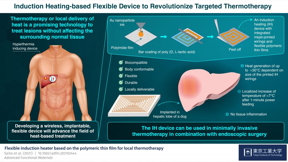 |
| Figure 1 Induction Heating-based Flexible Device to Revolutionize Targeted Thermotherapy. CREDIT Tokyo Tech |
Abstract:
Thermotherapy or heat treatment can help in treating lesions and other tissue injuries. For example, chemotherapy or radiotherapy, when combined with thermotherapy, kills tumorous cells more effectively. Thermotherapy is considered a promising approach for treating internal lesions, but the advancement in the field depends on the availability of patient-friendly heat-inducing devices capable of rapidly increasing the temperature of target tissues.
Turning the heat on: A flexible device for localized heat treatment of living tissues
Tokyo, Japan | Posted on June 11th, 2021Current clinical practices around thermotherapy majorly employ heat-generating devices that are probed inside the human body or are in contact with the skin. Receiving energy from external power sources and often operating through converging magnetic fields, these devices are usually large in size and static, limiting the movement of patients and also prolonging operational time.
An alternative option is small and flexible devices that can be implanted in the patient's body; however, such implantable devices must be flexible, body-compatible, heat resistant, and be powered wirelessly for heat generation--some of the criteria that are essential for their clinical use.
Recently, researchers at Tokyo Tech have innovated a heat-generating device that can revolutionize the field of thermotherapy by meeting all of the above criteria. Their innovation was reported in an article published in Advanced Functional Materials. Discussing their motivation, Associate Professor Toshinori Fujie, who led the study, explains ''One of the major obstacles in developing an implantable heating device is the requirement of incorporating electronic elements such capacitors in the circuit of the device itself. Such insertion takes away the flexibility required for internal implantation. To overcome this, we took the help of induction-heating, the same technology that is used in cooking heaters''. The working of such a device is based on the premise that the magnetic field generated by a coil with a high-frequency current induces current flow in a closely placed metal. Owing to its internal resistance, the metal then heats up automatically.
Developing such an induction heating device required ingenious design. First, the researchers printed the electronic wiring on a polyimide film with an 'ink' made of gold-nanoparticles. Next, a layer of poly (D, L-lactic acid) or PDLLA was coated above the printed film. In addition to heat-durability, the PDLLA layer is biodegradable and biocompatible, making it an excellent candidate for the base material of the device. Then, using tweezers, the researchers peeled off the PDLLA layer, causing it to come off the polyimide film. The result was a flexible device, conformably attaching to human skin, with electronic wirings printed on it.
Once the device showed satisfactory electrical performance, mechanical strength, and heat generation capacity, the researchers assessed its clinical functionality by planting it on living tissue--the hepatic lobe of a beagle dog. The results were extremely promising. When a transmitter coil was placed directly on the device for one minute, the temperature of the liver tissue increased up to 7°C without any indication of tissue burning.
Assoc. Prof. Fujie highlights the feat of their research ''The flexibility, biocompatibility, and wireless-powered heating capacity of our device opens up the possibility of using thermotherapy in wide clinical scenarios including minimally invasive endoscopic surgery. Moreover, by adjusting the number and size of these devices, lesions of different sizes can be treated''.
What an incredible localized solution to revolutionize the medical field globally!
####
For more information, please click here
Contacts:
Kazuhide Hasegawa
81-357-342-975
Copyright © Tokyo Institute of Technology
If you have a comment, please Contact us.Issuers of news releases, not 7th Wave, Inc. or Nanotechnology Now, are solely responsible for the accuracy of the content.
Bookmark:


| Related Links |
| Related News Press |
News and information
 Researchers develop molecular qubits that communicate at telecom frequencies October 3rd, 2025
Next-generation quantum communication October 3rd, 2025
"Nanoreactor" cage uses visible light for catalytic and ultra-selective cross-cycloadditions October 3rd, 2025
Cancer
New molecular technology targets tumors and simultaneously silences two ‘undruggable’ cancer genes August 8th, 2025
Ben-Gurion University of the Negev researchers several steps closer to harnessing patient's own T-cells to fight off cancer June 6th, 2025
Self-propelled protein-based nanomotors for enhanced cancer therapy by inducing ferroptosis June 6th, 2025
Possible Futures
Spinel-type sulfide semiconductors to operate the next-generation LEDs and solar cells For solar-cell absorbers and green-LED source October 3rd, 2025
Nanomedicine
New molecular technology targets tumors and simultaneously silences two ‘undruggable’ cancer genes August 8th, 2025
New imaging approach transforms study of bacterial biofilms August 8th, 2025
Cambridge chemists discover simple way to build bigger molecules – one carbon at a time June 6th, 2025
Electrifying results shed light on graphene foam as a potential material for lab grown cartilage June 6th, 2025
Discoveries
Researchers develop molecular qubits that communicate at telecom frequencies October 3rd, 2025
Next-generation quantum communication October 3rd, 2025
"Nanoreactor" cage uses visible light for catalytic and ultra-selective cross-cycloadditions October 3rd, 2025
Announcements
Rice membrane extracts lithium from brines with greater speed, less waste October 3rd, 2025
Researchers develop molecular qubits that communicate at telecom frequencies October 3rd, 2025
Next-generation quantum communication October 3rd, 2025
"Nanoreactor" cage uses visible light for catalytic and ultra-selective cross-cycloadditions October 3rd, 2025
Interviews/Book Reviews/Essays/Reports/Podcasts/Journals/White papers/Posters
Spinel-type sulfide semiconductors to operate the next-generation LEDs and solar cells For solar-cell absorbers and green-LED source October 3rd, 2025
Rice membrane extracts lithium from brines with greater speed, less waste October 3rd, 2025
Nanobiotechnology
New molecular technology targets tumors and simultaneously silences two ‘undruggable’ cancer genes August 8th, 2025
New imaging approach transforms study of bacterial biofilms August 8th, 2025
Ben-Gurion University of the Negev researchers several steps closer to harnessing patient's own T-cells to fight off cancer June 6th, 2025
Electrifying results shed light on graphene foam as a potential material for lab grown cartilage June 6th, 2025
 |
||
 |
||
| The latest news from around the world, FREE | ||
 |
||
|
|
||
| Premium Products | ||
 |
||
|
Only the news you want to read!
Learn More |
||
 |
||
|
Full-service, expert consulting
Learn More |
||
|
|
||