Home > Press > New form of silicon could enable next-gen electronic and energy devices: Novel crystalline form of silicon could potentially be used to create next-generation electronic and energy devices
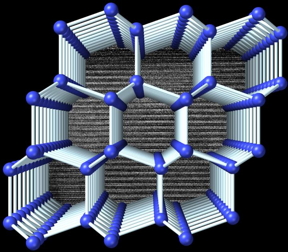 |
| Visualization of the structure of 4H-Si viewed perpendicular to the hexagonal axis. A transmission electron micrograph showing the stacking sequence is displayed in the background. CREDIT Image courtesy of Thomas Shiell and Timothy Strobel |
Abstract:
A team led by Carnegie's Thomas Shiell and Timothy Strobel developed a new method for synthesizing a novel crystalline form of silicon with a hexagonal structure that could potentially be used to create next-generation electronic and energy devices with enhanced properties that exceed those of the "normal" cubic form of silicon used today.
New form of silicon could enable next-gen electronic and energy devices: Novel crystalline form of silicon could potentially be used to create next-generation electronic and energy devices
Washington, DC | Posted on June 4th, 2021Their work is published in Physical Review Letters.
Silicon plays an outsized role in human life. It is the second most abundant element in the Earth's crust. When mixed with other elements, it is essential for many construction and infrastructure projects. And in pure elemental form, it is crucial enough to computing that the longstanding technological hub of the U.S.--California's Silicon Valley--was nicknamed in honor of it.
Like all elements, silicon can take different crystalline forms, called allotropes, in the same way that soft graphite and super-hard diamond are both forms of carbon. The form of silicon most commonly used in electronic devices, including computers and solar panels, has the same structure as diamond. Despite its ubiquity, this form of silicon is not actually fully optimized for next-generation applications, including high-performance transistors and some photovoltaic devices.
While many different silicon allotropes with enhanced physical properties are theoretically possible, only a handful exist in practice given the lack of known synthetic pathways that are currently accessible.
Strobel's lab had previously developed a revolutionary new form of silicon, called Si24, which has an open framework composed of a series of one-dimensional channels. In this new work, Shiell and Strobel led a team that used Si24 as the starting point in a multi-stage synthesis pathway that resulted in highly oriented crystals in a form called 4H-silicon, named for its four repeating layers in a hexagonal structure.
"Interest in hexagonal silicon dates back to the 1960s, because of the possibility of tunable electronic properties, which could enhance performance beyond the cubic form" Strobel explained.
Hexagonal forms of silicon have been synthesized previously, but only through the deposition of thin films or as nanocrystals that coexist with disordered material. The newly demonstrated Si24 pathway produces the first high-quality, bulk crystals that serve as the basis for future research activities.
Using the advanced computing tool called PALLAS, which was previously developed by members of the team to predict structural transition pathways--like how water becomes steam when heated or ice when frozen--the group was able to understand the transition mechanism from Si24 to 4H-Si, and the structural relationship that allows the preservation of highly oriented product crystals.
"In addition to expanding our fundamental control over the synthesis of novel structures, the discovery of bulk 4H-silicon crystals opens the door to exciting future research prospects for tuning the optical and electronic properties through strain engineering and elemental substitution," Shiell said. "We could potentially use this method to create seed crystals to grow large volumes of the 4H structure with properties that potentially exceed those of diamond silicon."
###
Carnegie's Li Zhu was also a member of the research team, along with Brenton Cook and Dougal McCulloch of RMIT University and Jodie Bradby of The Australian National University.
This work was supported by the National Science Foundation, Division of Materials Research.
Portions of this work were performed at HPCAT (Sector 16), Advanced Photon Source (APS), Argonne National Laboratory. HPCAT operations are supported by DOE-NNSA's Office of Experimental Sciences. The Advanced Photon Source is a U.S. Department of Energy (DOE) Office of Science User Facility operated for the DOE Office of Science by Argonne National Laboratory.
####
For more information, please click here
Contacts:
Tim Strobel
@carnegiescience
Copyright © Carnegie Institution for Science
If you have a comment, please Contact us.Issuers of news releases, not 7th Wave, Inc. or Nanotechnology Now, are solely responsible for the accuracy of the content.
Bookmark:


| Related Links |
| Related News Press |
News and information
 Quantum computer improves AI predictions April 17th, 2026
Flexible sensor gains sensitivity under pressure April 17th, 2026
A reusable chip for particulate matter sensing April 17th, 2026
Detecting vibrational quantum beating in the predissociation dynamics of SF6 using time-resolved photoelectron spectroscopy April 17th, 2026
Laboratories
Researchers develop molecular qubits that communicate at telecom frequencies October 3rd, 2025
A battery’s hopping ions remember where they’ve been: Seen in atomic detail, the seemingly smooth flow of ions through a battery’s electrolyte is surprisingly complicated February 16th, 2024
Govt.-Legislation/Regulation/Funding/Policy
Quantum computer improves AI predictions April 17th, 2026
Metasurfaces smooth light to boost magnetic sensing precision January 30th, 2026
New imaging approach transforms study of bacterial biofilms August 8th, 2025
Possible Futures
A fundamentally new therapeutic approach to cystic fibrosis: Nanobody repairs cellular defect April 17th, 2026
UC Irvine physicists discover method to reverse ‘quantum scrambling’ : The work addresses the problem of information loss in quantum computing system April 17th, 2026
Chip Technology
A reusable chip for particulate matter sensing April 17th, 2026
Metasurfaces smooth light to boost magnetic sensing precision January 30th, 2026
Discoveries
Quantum computer improves AI predictions April 17th, 2026
Flexible sensor gains sensitivity under pressure April 17th, 2026
A reusable chip for particulate matter sensing April 17th, 2026
Detecting vibrational quantum beating in the predissociation dynamics of SF6 using time-resolved photoelectron spectroscopy April 17th, 2026
Materials/Metamaterials/Magnetoresistance
First real-time observation of two-dimensional melting process: Researchers at Mainz University unveil new insights into magnetic vortex structures August 8th, 2025
Researchers unveil a groundbreaking clay-based solution to capture carbon dioxide and combat climate change June 6th, 2025
A 1960s idea inspires NBI researchers to study hitherto inaccessible quantum states June 6th, 2025
Institute for Nanoscience hosts annual proposal planning meeting May 16th, 2025
Announcements
A fundamentally new therapeutic approach to cystic fibrosis: Nanobody repairs cellular defect April 17th, 2026
UC Irvine physicists discover method to reverse ‘quantum scrambling’ : The work addresses the problem of information loss in quantum computing system April 17th, 2026
Interviews/Book Reviews/Essays/Reports/Podcasts/Journals/White papers/Posters
A fundamentally new therapeutic approach to cystic fibrosis: Nanobody repairs cellular defect April 17th, 2026
UC Irvine physicists discover method to reverse ‘quantum scrambling’ : The work addresses the problem of information loss in quantum computing system April 17th, 2026
Energy
Sensors innovations for smart lithium-based batteries: advancements, opportunities, and potential challenges August 8th, 2025
Simple algorithm paired with standard imaging tool could predict failure in lithium metal batteries August 8th, 2025
Grants/Sponsored Research/Awards/Scholarships/Gifts/Contests/Honors/Records
Quantum computer improves AI predictions April 17th, 2026
Detecting vibrational quantum beating in the predissociation dynamics of SF6 using time-resolved photoelectron spectroscopy April 17th, 2026
Metasurfaces smooth light to boost magnetic sensing precision January 30th, 2026
Solar/Photovoltaic
Spinel-type sulfide semiconductors to operate the next-generation LEDs and solar cells For solar-cell absorbers and green-LED source October 3rd, 2025
KAIST researchers introduce new and improved, next-generation perovskite solar cell November 8th, 2024
Groundbreaking precision in single-molecule optoelectronics August 16th, 2024
Development of zinc oxide nanopagoda array photoelectrode: photoelectrochemical water-splitting hydrogen production January 12th, 2024
 |
||
 |
||
| The latest news from around the world, FREE | ||
 |
||
|
|
||
| Premium Products | ||
 |
||
|
Only the news you want to read!
Learn More |
||
 |
||
|
Full-service, expert consulting
Learn More |
||
|
|
||