Home > Press > A novel nitrogen-doped dual-emission carbon dots as an effective fluorescent probe for ratiometric detection dopamine
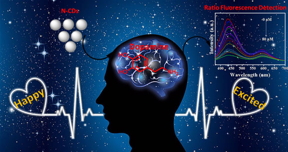 |
| A schematic illustration of Synthesis of nitrogen-doped double-emission carbon dots and ratio fluorescence detection for dopamine, which acts as a neurotransmitter to regulate various physiological functions of the central nervous system. |
Abstract:
How to construct the dual emission nitrogen-doped carbon dots (CDs) by a simple method? Professor Lili Ren with her collaborators proposed a new strategy to prepare such materials which were used to the detection of dopamine.
A novel nitrogen-doped dual-emission carbon dots as an effective fluorescent probe for ratiometric detection dopamine
Singapore | Posted on June 1st, 2021The traditional ratiometric fluorescence (FL) probe usually needs to combine different nanomaterials by chemical or physical methods and the manufacturing process is more complicated. While the dual-emission carbon dots (DECDs) can simplify the detection process. Therefore, it is of great significance to design a simple ratiometric fluorescence probe based on the DECDs for the accurate determination of DA concentration. Here, a new kind of dual-emission N-doped carbon dots (N-CDs) was prepared by one-pot hydrothermal method with p-phenylenediamineas as carbon source and triethylamine as nitrogen dopant. The synthesized N-CDs show FL emission at 435 nm and 595 nm under 360 nm excitation wavelength. The N-CDs can be used as a ratiometric fluorescence probe for highly selective detection of DA. This is the first time to report the dual-emission fluorescence carbon dots to detect DA.
This work not only develops a new method for preparing dual emission nitrogen-doped carbon dots, but also exploits an economic, environmentally friendly, sensitive and specific DA detection method.
This work was supported by A Project Subsidized the Priority Academic Program Development of Jiangsu Higher Education Institutions (1107047002).
####
For more information, please click here
Contacts:
Rebecca Atkinson
65-646-65775 x261
@worldscientific
Copyright © World Scientific
If you have a comment, please Contact us.Issuers of news releases, not 7th Wave, Inc. or Nanotechnology Now, are solely responsible for the accuracy of the content.
Bookmark:


| Related Links |
| Related News Press |
News and information
 Quantum computer improves AI predictions April 17th, 2026
Flexible sensor gains sensitivity under pressure April 17th, 2026
A reusable chip for particulate matter sensing April 17th, 2026
Detecting vibrational quantum beating in the predissociation dynamics of SF6 using time-resolved photoelectron spectroscopy April 17th, 2026
Possible Futures
A fundamentally new therapeutic approach to cystic fibrosis: Nanobody repairs cellular defect April 17th, 2026
UC Irvine physicists discover method to reverse ‘quantum scrambling’ : The work addresses the problem of information loss in quantum computing system April 17th, 2026
Discoveries
Quantum computer improves AI predictions April 17th, 2026
Flexible sensor gains sensitivity under pressure April 17th, 2026
A reusable chip for particulate matter sensing April 17th, 2026
Detecting vibrational quantum beating in the predissociation dynamics of SF6 using time-resolved photoelectron spectroscopy April 17th, 2026
Materials/Metamaterials/Magnetoresistance
First real-time observation of two-dimensional melting process: Researchers at Mainz University unveil new insights into magnetic vortex structures August 8th, 2025
Researchers unveil a groundbreaking clay-based solution to capture carbon dioxide and combat climate change June 6th, 2025
A 1960s idea inspires NBI researchers to study hitherto inaccessible quantum states June 6th, 2025
Institute for Nanoscience hosts annual proposal planning meeting May 16th, 2025
Announcements
A fundamentally new therapeutic approach to cystic fibrosis: Nanobody repairs cellular defect April 17th, 2026
UC Irvine physicists discover method to reverse ‘quantum scrambling’ : The work addresses the problem of information loss in quantum computing system April 17th, 2026
Interviews/Book Reviews/Essays/Reports/Podcasts/Journals/White papers/Posters
A fundamentally new therapeutic approach to cystic fibrosis: Nanobody repairs cellular defect April 17th, 2026
UC Irvine physicists discover method to reverse ‘quantum scrambling’ : The work addresses the problem of information loss in quantum computing system April 17th, 2026
Tools
Metasurfaces smooth light to boost magnetic sensing precision January 30th, 2026
From sensors to smart systems: the rise of AI-driven photonic noses January 30th, 2026
Japan launches fully domestically produced quantum computer: Expo visitors to experience quantum computing firsthand August 8th, 2025
 |
||
 |
||
| The latest news from around the world, FREE | ||
 |
||
|
|
||
| Premium Products | ||
 |
||
|
Only the news you want to read!
Learn More |
||
 |
||
|
Full-service, expert consulting
Learn More |
||
|
|
||