Home > Press > Thin is now in to turn terahertz polarization: Rice lab’s discovery of ‘magic angle’ builds on its ultrathin, highly aligned nanotube films
 |
| Rice University physicists have made unique broadband polarization rotators with ultrathin carbon nanotube films. The films optically rotate polarized light output by 90 degrees, but only when the input light’s polarization is at a specific angle with respect to the nanotube alignment direction: the “magic angle.” (Credit: Kono Laboratory/Rice University) |
Abstract:
It’s always good when your hard work reflects well on you. With the discovery of the giant polarization rotation of light, that is literally so.
Thin is now in to turn terahertz polarization: Rice lab’s discovery of ‘magic angle’ builds on its ultrathin, highly aligned nanotube films
Houston, TX | Posted on May 20th, 2021The ultrathin, highly aligned carbon nanotube films first made by Rice University physicist Junichiro Kono and his students a few years ago turned out to have a surprising phenomenon waiting within: an ability to make highly capable terahertz polarization rotation possible.
This rotation doesn’t mean the films are spinning. It does mean that polarized light from a laser or other source can now be manipulated in ways that were previously out of reach, making it completely visible or completely opaque with a device that’s extremely thin.
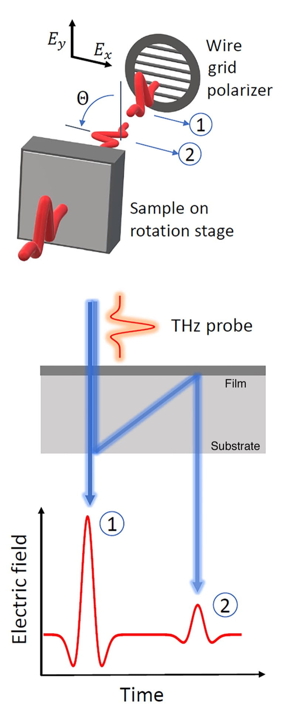
The unique optical rotation happens when linearly polarized pulses of light pass through the 45-nanometer film and hit the silicon surface on which it sits. The light bounces between the substrate and film before finally reflecting back, but with its polarization turned by 90 degrees.
This only occurs, Kono said, when the input light’s polarization is at a specific angle with respect to the nanotube alignment direction: the “magic angle.”
The discovery by lead author Andrey Baydin, a postdoctoral researcher in Kono’s lab, is detailed in Optica. The phenomenon, which can be tuned by changing the refractive index of the substrate and the film thickness, could lead to robust, flexible devices that manipulate terahertz waves.
Kono said easy-to-fabricate, ultrathin broadband polarization rotators that stand up to high temperatures will address a fundamental challenge in the development of terahertz optical devices. The bulky devices available until now only enable limited polarization angles, so compact devices with more capability are highly desirable.
Because terahertz radiation easily passes through materials like plastics and cardboard, they could be particularly useful in manufacturing, quality control and process monitoring. They could also be handy in telecommunications systems and for security screening, because many materials have unique spectral signatures in the terahertz range, he said.
“The discovery opens up new possibilities for waveplates,” Baydin said. A waveplate alters the polarization of light that travels through it. In devices like terahertz spectrometers used to analyze the molecular composition of materials, being able to adjust polarization up to a full 90 degrees would allow for data gathering at a much finer resolution.
“We found that specifically at far-infrared wavelengths -- in other words, in the terahertz frequency range -- this anisotropy is nearly perfect,” Baydin said. “Basically, there’s no attenuation in the perpendicular polarization, and then significant attenuation in the parallel direction.
“We did not look for this,” he said. “It was completely a surprise.”
He said theoretical analysis showed the effect is entirely due to the nature of the highly aligned nanotube films, which were vanishingly thin but about 2 inches in diameter. The researchers both observed and confirmed this giant polarization rotation with experiments and computer models.
“Usually, people have to use millimeter-thick quartz waveplates in order to rotate terahertz polarization,” said Baydin, who joined the Kono lab in late 2019 and found the phenomenon soon after that. “But in our case, the film is just nanometers thick.”
“Big and bulky waveplates are fine if you’re just using them in a laboratory setting, but for applications, you want a compact device,” Kono said. “What Andrey has found makes it possible.”
Co-authors of the paper are Rice graduate students Natsumi Komatsu and Fuyang Tay and alumni Saunab Ghosh, Takuma Makihara and Timothy Noe. Baydin is an Attwell-Welch Postdoctoral Fellow of Rice's Smalley-Curl Institute. Kono is the Karl F. Hasselmann Professor in Engineering and a professor of electrical and computer engineering, of physics and astronomy and of materials science and nanoengineering.
The National Science Foundation and the U.S. Department of Energy supported the research.
####
About Rice University
Located on a 300-acre forested campus in Houston, Rice University is consistently ranked among the nation’s top 20 universities by U.S. News & World Report. Rice has highly respected schools of Architecture, Business, Continuing Studies, Engineering, Humanities, Music, Natural Sciences and Social Sciences and is home to the Baker Institute for Public Policy. With 3,978 undergraduates and 3,192 graduate students, Rice’s undergraduate student-to-faculty ratio is just under 6-to-1. Its residential college system builds close-knit communities and lifelong friendships, just one reason why Rice is ranked No. 1 for lots of race/class interaction and No. 1 for quality of life by the Princeton Review. Rice is also rated as a best value among private universities by Kiplinger’s Personal Finance.
Follow Rice News and Media Relations via Twitter @RiceUNews.
For more information, please click here
Contacts:
Jeff Falk
713-348-6775
Mike Williams
713-348-6728
Copyright © Rice University
If you have a comment, please Contact us.Issuers of news releases, not 7th Wave, Inc. or Nanotechnology Now, are solely responsible for the accuracy of the content.
Bookmark:


| Related Links |
 Nanotubes line up to form films:
Department of Physics and Astronomy:
Wiess School of Natural Sciences:
| Related News Press |
News and information
Quantum computer improves AI predictions April 17th, 2026
Flexible sensor gains sensitivity under pressure April 17th, 2026
A reusable chip for particulate matter sensing April 17th, 2026
Detecting vibrational quantum beating in the predissociation dynamics of SF6 using time-resolved photoelectron spectroscopy April 17th, 2026
Thin films
Tiny nanosheets, big leap: A new sensor detects ethanol at ultra-low levels January 30th, 2026
Utilizing palladium for addressing contact issues of buried oxide thin film transistors April 5th, 2024
Understanding the mechanism of non-uniform formation of diamond film on tools: Paving the way to a dry process with less environmental impact March 24th, 2023
New study introduces the best graphite films: The work by Distinguished Professor Feng Ding at UNIST has been published in the October 2022 issue of Nature Nanotechnology November 4th, 2022
Govt.-Legislation/Regulation/Funding/Policy
Quantum computer improves AI predictions April 17th, 2026
Metasurfaces smooth light to boost magnetic sensing precision January 30th, 2026
New imaging approach transforms study of bacterial biofilms August 8th, 2025
Possible Futures
A fundamentally new therapeutic approach to cystic fibrosis: Nanobody repairs cellular defect April 17th, 2026
UC Irvine physicists discover method to reverse ‘quantum scrambling’ : The work addresses the problem of information loss in quantum computing system April 17th, 2026
Nanotubes/Buckyballs/Fullerenes/Nanorods/Nanostrings/Nanosheets
Tiny nanosheets, big leap: A new sensor detects ethanol at ultra-low levels January 30th, 2026
Enhancing power factor of p- and n-type single-walled carbon nanotubes April 25th, 2025
Chainmail-like material could be the future of armor: First 2D mechanically interlocked polymer exhibits exceptional flexibility and strength January 17th, 2025
Innovative biomimetic superhydrophobic coating combines repair and buffering properties for superior anti-erosion December 13th, 2024
Discoveries
Quantum computer improves AI predictions April 17th, 2026
Flexible sensor gains sensitivity under pressure April 17th, 2026
A reusable chip for particulate matter sensing April 17th, 2026
Detecting vibrational quantum beating in the predissociation dynamics of SF6 using time-resolved photoelectron spectroscopy April 17th, 2026
Announcements
A fundamentally new therapeutic approach to cystic fibrosis: Nanobody repairs cellular defect April 17th, 2026
UC Irvine physicists discover method to reverse ‘quantum scrambling’ : The work addresses the problem of information loss in quantum computing system April 17th, 2026
Interviews/Book Reviews/Essays/Reports/Podcasts/Journals/White papers/Posters
A fundamentally new therapeutic approach to cystic fibrosis: Nanobody repairs cellular defect April 17th, 2026
UC Irvine physicists discover method to reverse ‘quantum scrambling’ : The work addresses the problem of information loss in quantum computing system April 17th, 2026
 |
||
 |
||
| The latest news from around the world, FREE | ||
 |
||
|
|
||
| Premium Products | ||
 |
||
|
Only the news you want to read!
Learn More |
||
 |
||
|
Full-service, expert consulting
Learn More |
||
|
|
||