Home > Press > Polarization-sensitive photodetection using 2D/3D perovskite heterostructure crystal
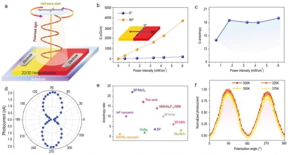 |
| (a) Schematic structure of polarized light detector. (b) Photoconductivity parallel and perpendicular to the interface. (c) Photoconductivity anisotropy versus excitation power. (d) Angle-resolved photocurrent as a function of polarization angle measured at 405 nm under zero bias. (e) Experimental polarization ratios of some reported polarized light detectors. (f) Angle-dependent photocurrent of the present device measured at different temperature. CREDIT @Science China Press |
Abstract:
Polarization-sensitive photodetectors, based on anisotropic semiconductors, have exhibited wide advantages in specialized applications, such as astronomy, remote sensing, and polarization-division multiplexing. For the active layer of polarization-sensitive photodetectors, recent researches focus on two-dimensional (2D) organic-inorganic hybrid perovskites, where inorganic slabs and organic spacers are alternatively arranged in parallel layered structures. Compared with inorganic 2D materials, importantly, the solution accessibility of hybrid perovskites makes it possible to obtain their large crystals at low cost, offering exciting opportunities to incorporate crystal out-of-plane anisotropy for polarization-sensitive photodetection. However, limited by the absorption anisotropy of the material structure, polarization sensitivity of such a device remains low. Thus, a new strategy to design 2D hybrid perovskites with large anisotropy for polarization-sensitive photodetection is urgently needed.
Polarization-sensitive photodetection using 2D/3D perovskite heterostructure crystal
Beijing, China | Posted on May 4th, 2021Heterostructures provide a clue to address this challenge. On the one hand, construction of heterostructures can improve the optical absorption and free-carrier densities of the composite. On the other hand, the built-in electric field at the heterojunction can spatially separate the photogenerated electron-hole pairs, significantly reducing the recombination rate and further enhancing the sensitivity for polarization-sensitive photodetectors. Therefore, constructing single-crystalline heterostructures of anisotropic 2D hybrid perovskites would realize devices with high polarization sensitivity.
In a new research article published in the Beijing-based National Science Review, scientists at the Fujian Institute of Research on the Structure of Matter, Chinese Academy of Sciences create a 2D/3D heterostructure crystal, combining the 2D hybrid perovskite with its 3D counterpart; and achieve polarization-sensitive photodetection with record-high performance. Different from the previous work, devices based on the heterostructure crystal deliberately leverage the anisotropy of 2D perovskite and the built-in electric field of heterostructure, permitting the first demonstration of a perovskite heterostructure-based polarization-sensitive photodetector that operates without the need for external energy supply. Notably, the polarization sensitivity of the device surpasses all of the reported perovskite-based devices; and can be competitive with conventional inorganic heterostructure-based photodetectors. Further studies disclose that the built-in electric field formed at the heterojunction can efficiently separate those photogenerated excitons, reducing their recombination rate and therefore enhancing the performance of the resulting polarization-sensitive photodetector.
"High polarization sensitivity is successfully achieved in self-driven polarization-sensitive photodetector based on a single-crystalline 2D/3D hybrid perovskite heterostructure which is grown via a delicate solution method," the author claims, "This innovative study broadens the choice of materials that can be used for high-performance polarization-sensitive photodetectors, and correspondingly, the design strategies."
###
This research received funding from the the National Natural Science Foundation of China, the Key Research Program of Frontier Sciences of the Chinese Academy of Sciences (CAS), the Natural Science Foundation of Fujian Province, the Strategic Priority Research Program of the CAS and the Youth Innovation Promotion of CAS.
####
About Science China Press
The National Science Review is the first comprehensive scholarly journal released in English in China that is aimed at linking the country's rapidly advancing community of scientists with the global frontiers of science and technology. The journal also aims to shine a worldwide spotlight on scientific research advances across China.
For more information, please click here
Contacts:
Junhua Luo
Copyright © Science China Press
If you have a comment, please Contact us.Issuers of news releases, not 7th Wave, Inc. or Nanotechnology Now, are solely responsible for the accuracy of the content.
Bookmark:


| Related Links |
| Related News Press |
News and information
 Quantum computer improves AI predictions April 17th, 2026
Flexible sensor gains sensitivity under pressure April 17th, 2026
A reusable chip for particulate matter sensing April 17th, 2026
Detecting vibrational quantum beating in the predissociation dynamics of SF6 using time-resolved photoelectron spectroscopy April 17th, 2026
2 Dimensional Materials
Flexible sensor gains sensitivity under pressure April 17th, 2026
ICFO researchers overcome long-standing bottleneck in single photon detection with twisted 2D materials August 8th, 2025
First real-time observation of two-dimensional melting process: Researchers at Mainz University unveil new insights into magnetic vortex structures August 8th, 2025
Lab to industry: InSe wafer-scale breakthrough for future electronics August 8th, 2025
Perovskites
Possible Futures
A fundamentally new therapeutic approach to cystic fibrosis: Nanobody repairs cellular defect April 17th, 2026
UC Irvine physicists discover method to reverse ‘quantum scrambling’ : The work addresses the problem of information loss in quantum computing system April 17th, 2026
Sensors
Flexible sensor gains sensitivity under pressure April 17th, 2026
Tiny nanosheets, big leap: A new sensor detects ethanol at ultra-low levels January 30th, 2026
From sensors to smart systems: the rise of AI-driven photonic noses January 30th, 2026
Sensors innovations for smart lithium-based batteries: advancements, opportunities, and potential challenges August 8th, 2025
Discoveries
Quantum computer improves AI predictions April 17th, 2026
Flexible sensor gains sensitivity under pressure April 17th, 2026
A reusable chip for particulate matter sensing April 17th, 2026
Detecting vibrational quantum beating in the predissociation dynamics of SF6 using time-resolved photoelectron spectroscopy April 17th, 2026
Announcements
A fundamentally new therapeutic approach to cystic fibrosis: Nanobody repairs cellular defect April 17th, 2026
UC Irvine physicists discover method to reverse ‘quantum scrambling’ : The work addresses the problem of information loss in quantum computing system April 17th, 2026
Interviews/Book Reviews/Essays/Reports/Podcasts/Journals/White papers/Posters
A fundamentally new therapeutic approach to cystic fibrosis: Nanobody repairs cellular defect April 17th, 2026
UC Irvine physicists discover method to reverse ‘quantum scrambling’ : The work addresses the problem of information loss in quantum computing system April 17th, 2026
Aerospace/Space
Decoding hydrogen‑bond network of electrolyte for cryogenic durable aqueous zinc‑ion batteries January 30th, 2026
ICFO researchers overcome long-standing bottleneck in single photon detection with twisted 2D materials August 8th, 2025
Onion-like nanoparticles found in aircraft exhaust May 14th, 2025
 |
||
 |
||
| The latest news from around the world, FREE | ||
 |
||
|
|
||
| Premium Products | ||
 |
||
|
Only the news you want to read!
Learn More |
||
 |
||
|
Full-service, expert consulting
Learn More |
||
|
|
||