Home > Press > Researchers analyzed circulating currents inside gold nanoparticles: A new method facilitates accurate analysis of magnetic field effects inside complex nanostructures
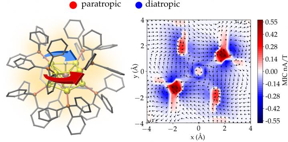 |
| The atomic structure of a gold nanoparticle protected by phosphine molecules (left) and magnetic-field-induced electron currents in a plane intersecting the center of the particle (right). The total electron current consists of two (paratropic and diatropic) components circulating in opposite directions. CREDIT University of Jyväskylä/Omar Lopez Estrada |
Abstract:
Researchers in the Nanoscience Center of University of Jyvaskyla, in Finland and in the Guadalajara University in Mexico developed a method that allows for simulation and visualization of magnetic-field-induced electron currents inside gold nanoparticles. The method facilitates accurate analysis of magnetic field effects inside complex nanostructures in nuclear magnetic resonance measurements and establishes quantitative criteria for aromaticity of nanoparticles. The work was published 30.4.2021 as an Open Access article in Nature Communications.
Researchers analyzed circulating currents inside gold nanoparticles: A new method facilitates accurate analysis of magnetic field effects inside complex nanostructures
Jyväskylä, Finland | Posted on April 30th, 2021According to the classical electromagnetism, a charged particle moving in an external magnetic field experiences a force that makes the particle's path circular. This basic law of physics is used, e.g., in designing cyclotrons that work as particle accelerators. When nanometer-size metal particles are placed in a magnetic field, the field induces a circulating electron current inside the particle. The circulating current in turn creates an internal magnetic field that opposes the external field. This physical effect is called magnetic shielding.
The strength of the shielding can be investigated by using nuclear magnetic resonance (NMR) spectroscopy. The internal magnetic shielding varies strongly in an atomic length scale even inside a nanometer-size particle. Understanding these atom-scale variations is possible only by employing quantum mechanical theory of the electronic properties of each atom making the nanoparticle.
Now, the research group of Professor Hannu Häkkinen in the University of Jyväskylä, in collaboration with University of Guadalajara in Mexico, developed a method to compute, visualize, and analyze the circulating electron currents inside complex 3D nanostructures. The method was applied to gold nanoparticles with a diameter of only about one nanometer. The calculations shed light onto unexplained experimental results from previous NMR measurements in the literature regarding how magnetic shielding inside the particle changes when one gold atom is replaced by one platinum atom.
A new quantitative measure to characterize aromaticity inside metal nanoparticles was also developed based on the total integrated strength of the shielding electron current.
"Aromaticity of molecules is one of the oldest concepts in chemistry, and it has been traditionally connected to ring-like organic molecules and to their delocalized valence electron density that can develop circulating currents in an external magnetic field. However, generally accepted quantitative criteria for the degree of aromaticity have been lacking. Our method yields now a new tool to study and analyze electron currents at the resolution of one atom inside any nanostructure, in principle. The peer reviewers of our work considered this as a significant advancement in the field", says Professor Häkkinen who coordinated the research.
###
The authors of the article included post-doctoral researcher Omar Lopez Estrada (lead author), PhD student Elli Selenius and university researcher Sami Malola in Häkkinen's group and professor Bernardo Zuniga-Gutierrez in Guadalaraja University in Mexico. The computations were made by using the Finnish Computing Competence Infrastructure (FCCI) in University of Jyväskylä.
Link to the research in Nature Communications in 30 April 2021
####
For more information, please click here
Contacts:
Hannu Häkkinen
358-400-247-973
Copyright © University of Jyvaskyla
If you have a comment, please Contact us.Issuers of news releases, not 7th Wave, Inc. or Nanotechnology Now, are solely responsible for the accuracy of the content.
Bookmark:


| Related Links |
| Related News Press |
News and information
 Quantum computer improves AI predictions April 17th, 2026
Flexible sensor gains sensitivity under pressure April 17th, 2026
A reusable chip for particulate matter sensing April 17th, 2026
Detecting vibrational quantum beating in the predissociation dynamics of SF6 using time-resolved photoelectron spectroscopy April 17th, 2026
Magnetism/Magnons
Metasurfaces smooth light to boost magnetic sensing precision January 30th, 2026
Researchers develop molecular qubits that communicate at telecom frequencies October 3rd, 2025
Chemistry
Projecting light to dispense liquids: A new route to ultra-precise microdroplets January 30th, 2026
From sensors to smart systems: the rise of AI-driven photonic noses January 30th, 2026
"Nanoreactor" cage uses visible light for catalytic and ultra-selective cross-cycloadditions October 3rd, 2025
Possible Futures
A fundamentally new therapeutic approach to cystic fibrosis: Nanobody repairs cellular defect April 17th, 2026
UC Irvine physicists discover method to reverse ‘quantum scrambling’ : The work addresses the problem of information loss in quantum computing system April 17th, 2026
Discoveries
Quantum computer improves AI predictions April 17th, 2026
Flexible sensor gains sensitivity under pressure April 17th, 2026
A reusable chip for particulate matter sensing April 17th, 2026
Detecting vibrational quantum beating in the predissociation dynamics of SF6 using time-resolved photoelectron spectroscopy April 17th, 2026
Announcements
A fundamentally new therapeutic approach to cystic fibrosis: Nanobody repairs cellular defect April 17th, 2026
UC Irvine physicists discover method to reverse ‘quantum scrambling’ : The work addresses the problem of information loss in quantum computing system April 17th, 2026
Interviews/Book Reviews/Essays/Reports/Podcasts/Journals/White papers/Posters
A fundamentally new therapeutic approach to cystic fibrosis: Nanobody repairs cellular defect April 17th, 2026
UC Irvine physicists discover method to reverse ‘quantum scrambling’ : The work addresses the problem of information loss in quantum computing system April 17th, 2026
 |
||
 |
||
| The latest news from around the world, FREE | ||
 |
||
|
|
||
| Premium Products | ||
 |
||
|
Only the news you want to read!
Learn More |
||
 |
||
|
Full-service, expert consulting
Learn More |
||
|
|
||