Home > Press > New Cypher VRS1250 Video-Rate Atomic Force Microscope Enables True Video-Rate Imaging at up to 45 Frames per Second
 |
Abstract:
Oxford Instruments Asylum Research today announced the launch of the new Cypher VRS1250 video-rate atomic force microscope (AFM). Twice as fast as the first-generation Cypher VRS, the new AFM enables scan rates up to 1250 lines/second and frame rates up to 45 frames/second. This new higher speed will enable researchers to capture nanoscale details of dynamic events that were previously inaccessible, including biochemical reactions, 2D molecular self-assembly, and etch and dissolution processes and more. The Cypher VRS1250 is unique among high-speed AFM’s in that it can also support a full range of modes and accessories, not just high-speed imaging, which makes it a very versatile tool for large interdisciplinary research groups and shared imaging facilities with multiple projects.
New Cypher VRS1250 Video-Rate Atomic Force Microscope Enables True Video-Rate Imaging at up to 45 Frames per Second
Santa Barbara, CA | Posted on April 30th, 2021“Asylum Research continues to push the boundaries of high-speed AFM technology. By doubling the maximum scan rate, the Cypher VRS1250 allows researchers to improve both the spatial and temporal resolution of their measurements. Combined with a full range of modes and accessories, this makes the Cypher VRS1250 an incredibly powerful AFM for studying biomolecules, bio-membranes, self-assembly processes, 2D materials, polymers and more,” said Terry Hannon, President at Asylum Research.
The Cypher VRS1250 is uniquely designed to support the fastest and highest resolution imaging. Its small spot cantilever detection maintains the lowest signal-to-noise even on the extremely small cantilevers required for video-rate AFM. Asylum’s exclusive blueDrive photothermal excitation and advanced mechanical design for negligible thermal drift enables stable, gentle, high-resolution imaging for the duration of dynamic events, ensuring that you do not miss a critical moment in the process. Importantly, the Cypher VRS1250 is still an easy to use and highly versatile research AFM, capable of meeting the diverse needs of any research group.
Learn more about the Cypher VRS1250 at: https://AFM.oxinst.com/VRS1250
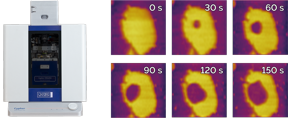
Image caption: (Left) The Cypher VRS1250 (Right) The degradation of a lipid bilayer by an antimicrobial peptide was monitored by Cypher VRS1250 video-rate AFM imaging at 28 fps. The peptide degrades the lipid molecules, eating away the bilayer patch from the inside out. Here, we show just 6 of the over 12,000 image frames collected during the experiment.
- Ends -
Issued for and on behalf of Oxford Instruments Asylum Research Inc.
####
About Oxford Instruments Asylum Research
Oxford Instruments Asylum Research is the technology leader in atomic force microscopy for both materials and bioscience research. Asylum Research AFMs are widely used by both academic and industrial researchers for characterizing samples from diverse fields spanning material science, polymers, thin films, energy research, and biophysics. In addition to routine imaging of sample topography and roughness, Asylum Research AFMs also offer unmatched resolution and quantitative measurement capability for nanoelectrical, nanomechanical and electromechanical characterization. Recent advances have made these measurements far simpler and more automated for increased consistency and productivity. Its Cypher™, MFP-3D™, and Jupiter™ AFM product lines span a wide range of performance and budgets. Asylum Research also offers a comprehensive selection of AFM probes, accessories, and consumables. Sales, applications and service offices are located in the United States, Germany, United Kingdom, Japan, France, India, China and Taiwan, with distributor offices in other global regions.
About Oxford Instruments plc
Oxford Instruments designs, supplies and supports high-technology tools and systems with a focus on research and industrial applications. Innovation has been the driving force behind Oxford Instruments' growth and success for 60 years, supporting its core purpose to address some of the world’s most pressing challenges.
The first technology business to be spun out from Oxford University, Oxford Instruments is now a global company and is listed on the FTSE250 index of the London Stock Exchange (OXIG). Its strategy focuses on being a customer-centric, market-focused Group, understanding the technical and commercial challenges faced by its customers. Key market segments include Semiconductor & Communications, Advanced Materials, Healthcare & Life Science, and Quantum Technology.
Their portfolio includes a range of core technologies in areas such as low temperature and high magnetic field environments; Nuclear Magnetic Resonance; X-ray, electron, laser and optical based metrology; atomic force microscopy; optical imaging; and advanced growth, deposition and etching.
Oxford Instruments is helping enable a greener economy, increased connectivity, improved health and leaps in scientific understanding. Their advanced products and services allow the world’s leading industrial companies and scientific research communities to image, analyse and manipulate materials down to the atomic and molecular level, helping to accelerate R&D, increase manufacturing productivity and make ground-breaking discoveries.
For more information, please click here
Contacts:
Dominic Paszkeicz
Oxford Instruments Asylum Research Inc.
E: | T: +1-805-696-6467
Copyright © Oxford Instruments Asylum Research
If you have a comment, please Contact us.Issuers of news releases, not 7th Wave, Inc. or Nanotechnology Now, are solely responsible for the accuracy of the content.
Bookmark:


| Related News Press |
News and information
 Quantum computer improves AI predictions April 17th, 2026
Flexible sensor gains sensitivity under pressure April 17th, 2026
A reusable chip for particulate matter sensing April 17th, 2026
Detecting vibrational quantum beating in the predissociation dynamics of SF6 using time-resolved photoelectron spectroscopy April 17th, 2026
Imaging
Simple algorithm paired with standard imaging tool could predict failure in lithium metal batteries August 8th, 2025
Possible Futures
A fundamentally new therapeutic approach to cystic fibrosis: Nanobody repairs cellular defect April 17th, 2026
UC Irvine physicists discover method to reverse ‘quantum scrambling’ : The work addresses the problem of information loss in quantum computing system April 17th, 2026
Announcements
A fundamentally new therapeutic approach to cystic fibrosis: Nanobody repairs cellular defect April 17th, 2026
UC Irvine physicists discover method to reverse ‘quantum scrambling’ : The work addresses the problem of information loss in quantum computing system April 17th, 2026
Tools
Metasurfaces smooth light to boost magnetic sensing precision January 30th, 2026
From sensors to smart systems: the rise of AI-driven photonic noses January 30th, 2026
Japan launches fully domestically produced quantum computer: Expo visitors to experience quantum computing firsthand August 8th, 2025
 |
||
 |
||
| The latest news from around the world, FREE | ||
 |
||
|
|
||
| Premium Products | ||
 |
||
|
Only the news you want to read!
Learn More |
||
 |
||
|
Full-service, expert consulting
Learn More |
||
|
|
||