Home > Press > An easy-to-use platform is a gateway to AI in microscopy
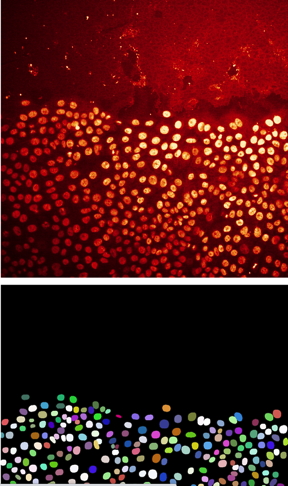 |
| Example illustrating how AI via ZeroCostDL4Mic can be used to detect the nucleus of cancer cells from microscopy images. Upper picture: Original microscopy image. Lower picture: Image where each detected cancer cell has a different colour. Pictures: Guillaume Jacquemet. |
Abstract:
Software using artificial intelligence, AI, is revolutionizing how microscopy images are analysed. For instance, AI can be used to detect features in images (i.e., tumours in biopsy samples) or improve the quality of images by removing unwanted noise. However, non-experts continue to find AI technologies difficult to use.
An easy-to-use platform is a gateway to AI in microscopy
Turku, Finland | Posted on April 23rd, 2021In the article "Democratising deep learning for microscopy with ZeroCostDL4Mic", published in Nature Communications on 15 April 2021, researchers describe a platform called ZeroCostDL4Mic, which makes these AI technologies accessible to everyone.
"The key novelty is that ZeroCostDL4Mic runs in the cloud for free and does not require users to have any coding experience or advanced computational skills. Effectively, it runs on any computer that has a web browser," says Guillaume Jacquemet, Senior Researcher in Cell Biology at Åbo Akademi University.
Over the last 400 years, microscopes have allowed mankind to observe objects that are otherwise too small to be seen with the naked eye. Today, microscopy is a leading technology used worldwide to perform not only research but also diagnostics.
Modern microscopes are directly connected to digital cameras, leading to the acquisition of hundreds to thousands of images per sample. These images need to be processed on a computer to gain meaningful data, which is a huge undertaking.
To help with the number of images, Jacquemet and his colleagues have used AI to train a machine to do the work. In practice, ZeroCostDL4Mic is a collection of self-explanatory notebooks for Google Colab, featuring an easy-to-use graphical user interface.
"We believe that ZeroCostDL4Mic will acts as 'a gateway drug' for AI, luring users to explore these new technologies that will transform biomedical research and diagnostics in the decades to come," says Jacquemet.
###
The development of the ZeroCostDL4Mic platform was coordinated by Guillaume Jacquemet's (Åbo Akademi University, Turku, Finland) and Ricardo Henriques' laboratories (Instituto Gulbenkian de Ciência, Oeiras, Portugal). It involved a large international consortium encompassing 12 laboratories, spread across nine countries and two continents.
####
For more information, please click here
Contacts:
Guillaume Jacquemet
358-503-235-606
@aboakademi
Copyright © Åbo Akademi University
If you have a comment, please Contact us.Issuers of news releases, not 7th Wave, Inc. or Nanotechnology Now, are solely responsible for the accuracy of the content.
Bookmark:


| Related Links |
| Related News Press |
News and information
 Quantum computer improves AI predictions April 17th, 2026
Flexible sensor gains sensitivity under pressure April 17th, 2026
A reusable chip for particulate matter sensing April 17th, 2026
Detecting vibrational quantum beating in the predissociation dynamics of SF6 using time-resolved photoelectron spectroscopy April 17th, 2026
Imaging
Simple algorithm paired with standard imaging tool could predict failure in lithium metal batteries August 8th, 2025
Possible Futures
A fundamentally new therapeutic approach to cystic fibrosis: Nanobody repairs cellular defect April 17th, 2026
UC Irvine physicists discover method to reverse ‘quantum scrambling’ : The work addresses the problem of information loss in quantum computing system April 17th, 2026
Discoveries
Quantum computer improves AI predictions April 17th, 2026
Flexible sensor gains sensitivity under pressure April 17th, 2026
A reusable chip for particulate matter sensing April 17th, 2026
Detecting vibrational quantum beating in the predissociation dynamics of SF6 using time-resolved photoelectron spectroscopy April 17th, 2026
Announcements
A fundamentally new therapeutic approach to cystic fibrosis: Nanobody repairs cellular defect April 17th, 2026
UC Irvine physicists discover method to reverse ‘quantum scrambling’ : The work addresses the problem of information loss in quantum computing system April 17th, 2026
Interviews/Book Reviews/Essays/Reports/Podcasts/Journals/White papers/Posters
A fundamentally new therapeutic approach to cystic fibrosis: Nanobody repairs cellular defect April 17th, 2026
UC Irvine physicists discover method to reverse ‘quantum scrambling’ : The work addresses the problem of information loss in quantum computing system April 17th, 2026
Tools
Metasurfaces smooth light to boost magnetic sensing precision January 30th, 2026
From sensors to smart systems: the rise of AI-driven photonic noses January 30th, 2026
Japan launches fully domestically produced quantum computer: Expo visitors to experience quantum computing firsthand August 8th, 2025
 |
||
 |
||
| The latest news from around the world, FREE | ||
 |
||
|
|
||
| Premium Products | ||
 |
||
|
Only the news you want to read!
Learn More |
||
 |
||
|
Full-service, expert consulting
Learn More |
||
|
|
||