Home > Press > Compression or strain - the material expands always the same
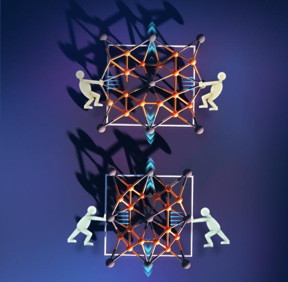 |
| Regardless if strained or compressed, the new material always expands. CREDIT Thomas Heine et al. |
Abstract:
If you stretch an elastic band, it becomes thinner - a physical behavior that applies to most "common" materials. Since the 20th century, an opposite behavior has been known in materials research: The so-called auxetic (from ancient Greek auxetos, meaning 'stretchable') materials expand in the direction orthogonal to the strain. Likewise, they shrink when they are compressed. Scientifically, they are characterized by a negative Poisson's ratio. Probably the best known and oldest application of unusual Poisson's ratios is the bottle cork, which has a Poisson's ratio of zero. This has the effect that the cork can be put into the thinner neck of the bottle.
Compression or strain - the material expands always the same
Dresden, Germany | Posted on March 10th, 2021Due to their special properties, auxetic materials allow for completely new functionalities and design solutions for a variety of innovative products with adjustable functional properties, including applications in medical technology or in the development of protective equipment such as bicycle helmets or safety jackets.
Thomas Heine, Professor of Theoretical Chemistry at TU Dresden, and his team have now discovered a previously unknown phenomenon. Based on borophene, an atomically thin configuration of the element boron, a stable form was found by adding palladium, yielding the chemical composition PdB4. The computational modelling shows that this material behaves like an auxetic material under strain, but expands like an ordinary material under compression. In other words, regardless if it is strained or compressed, the material always expands.
"In addition to thorough characterization in terms of stability, mechanical and electronic properties of the material, we have identified the origin of this half-auxetic character and believe that this mechanism can be used as a design concept for new half-auxetic materials," explains Prof. Heine, "These novel materials could lead to innovative applications in nanotechnology, for example in sensing or magneto-optics. A transfer to macroscopic materials is equally conceivable."
####
For more information, please click here
Contacts:
rof. Thomas Heine
49-351-463-37637
@tudresden_de
Copyright © TU Dresden
If you have a comment, please Contact us.Issuers of news releases, not 7th Wave, Inc. or Nanotechnology Now, are solely responsible for the accuracy of the content.
Bookmark:


| Related Links |
| Related News Press |
News and information
 Quantum computer improves AI predictions April 17th, 2026
Flexible sensor gains sensitivity under pressure April 17th, 2026
A reusable chip for particulate matter sensing April 17th, 2026
Detecting vibrational quantum beating in the predissociation dynamics of SF6 using time-resolved photoelectron spectroscopy April 17th, 2026
Magnetism/Magnons
Metasurfaces smooth light to boost magnetic sensing precision January 30th, 2026
Researchers develop molecular qubits that communicate at telecom frequencies October 3rd, 2025
First real-time observation of two-dimensional melting process: Researchers at Mainz University unveil new insights into magnetic vortex structures August 8th, 2025
Magnetism in new exotic material opens the way for robust quantum computers June 4th, 2025
Possible Futures
A fundamentally new therapeutic approach to cystic fibrosis: Nanobody repairs cellular defect April 17th, 2026
UC Irvine physicists discover method to reverse ‘quantum scrambling’ : The work addresses the problem of information loss in quantum computing system April 17th, 2026
Sensors
Flexible sensor gains sensitivity under pressure April 17th, 2026
Tiny nanosheets, big leap: A new sensor detects ethanol at ultra-low levels January 30th, 2026
From sensors to smart systems: the rise of AI-driven photonic noses January 30th, 2026
Sensors innovations for smart lithium-based batteries: advancements, opportunities, and potential challenges August 8th, 2025
Discoveries
Quantum computer improves AI predictions April 17th, 2026
Flexible sensor gains sensitivity under pressure April 17th, 2026
A reusable chip for particulate matter sensing April 17th, 2026
Detecting vibrational quantum beating in the predissociation dynamics of SF6 using time-resolved photoelectron spectroscopy April 17th, 2026
Materials/Metamaterials/Magnetoresistance
First real-time observation of two-dimensional melting process: Researchers at Mainz University unveil new insights into magnetic vortex structures August 8th, 2025
Researchers unveil a groundbreaking clay-based solution to capture carbon dioxide and combat climate change June 6th, 2025
A 1960s idea inspires NBI researchers to study hitherto inaccessible quantum states June 6th, 2025
Institute for Nanoscience hosts annual proposal planning meeting May 16th, 2025
Announcements
A fundamentally new therapeutic approach to cystic fibrosis: Nanobody repairs cellular defect April 17th, 2026
UC Irvine physicists discover method to reverse ‘quantum scrambling’ : The work addresses the problem of information loss in quantum computing system April 17th, 2026
Interviews/Book Reviews/Essays/Reports/Podcasts/Journals/White papers/Posters
A fundamentally new therapeutic approach to cystic fibrosis: Nanobody repairs cellular defect April 17th, 2026
UC Irvine physicists discover method to reverse ‘quantum scrambling’ : The work addresses the problem of information loss in quantum computing system April 17th, 2026
Photonics/Optics/Lasers
Metasurfaces smooth light to boost magnetic sensing precision January 30th, 2026
From sensors to smart systems: the rise of AI-driven photonic noses January 30th, 2026
 |
||
 |
||
| The latest news from around the world, FREE | ||
 |
||
|
|
||
| Premium Products | ||
 |
||
|
Only the news you want to read!
Learn More |
||
 |
||
|
Full-service, expert consulting
Learn More |
||
|
|
||