Home > Press > Instrument at BESSY II shows how light activates MoS2 layers to become catalysts
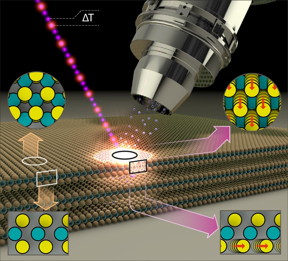 |
| A new instrument at BESSY II can be used to study molybdenum-sulfide thin films that are of interest as catalysts for solar hydrogen production. A light pulse triggers a phase transition from the semiconducting to the metallic phase and thus enhances the catalytic activity. CREDIT Martin Künsting /HZB |
Abstract:
MoS2 thin films of superposed alternating layers of molybdenum and sulfur atoms form a two-dimensional semiconducting surface. However, even a surprisingly low-intensity blue light pulse is enough to alter the properties of the surface and make it metallic. This has now been demonstrated by a team at BESSY II.
Instrument at BESSY II shows how light activates MoS2 layers to become catalysts
Berlin, Germany | Posted on March 8th, 2021The exciting thing is that the MoS2 layers in this metallic phase are also particularly active catalytically. They can then be employed, for example, as catalysts for splitting of water into hydrogen and oxygen. As inexpensive catalysts, they could facilitate the production of hydrogen - an energy carrier whose combustion produces no CO2, only water.
Physicist Dr. Nomi Sorgenfrei and her team have constructed a new instrument at BESSY II to precisely measure the changes in samples using temporally-resolved electron spectroscopy for chemical analysis (trESCA) when irradiating the samples with low-intensity, ultra-short light pulses. These light pulses are generated at BESSY II using femtosecond time-slicing (femtoslicing) and are therefore both low intensity and extremely short duration. The new instrument, named can also rapidly obtain meaningful measurements of electron energies, surface chemistry, and transient alterations using these low-intensity light pulses.
Analysis of the empirical data showed that the light pulse leads to a transient accumulation of charge at the surface of the sample, triggering the phase transition at the surface from a semiconducting to a metallic state.
"This phenomenon should also occur in other representatives of this class of materials, the p-doped semiconducting dichalcogenides, so it opens up possibilities of influencing functionality and catalytic activity in a deliberate way", Sorgenfrei explains.
####
For more information, please click here
Contacts:
Antonia Roetger
@HZBde
Copyright © Helmholtz-Zentrum Berlin für Materialien und Energie
If you have a comment, please Contact us.Issuers of news releases, not 7th Wave, Inc. or Nanotechnology Now, are solely responsible for the accuracy of the content.
Bookmark:


| Related Links |
| Related News Press |
News and information
 Quantum computer improves AI predictions April 17th, 2026
Flexible sensor gains sensitivity under pressure April 17th, 2026
A reusable chip for particulate matter sensing April 17th, 2026
Detecting vibrational quantum beating in the predissociation dynamics of SF6 using time-resolved photoelectron spectroscopy April 17th, 2026
2 Dimensional Materials
Flexible sensor gains sensitivity under pressure April 17th, 2026
Possible Futures
A fundamentally new therapeutic approach to cystic fibrosis: Nanobody repairs cellular defect April 17th, 2026
UC Irvine physicists discover method to reverse ‘quantum scrambling’ : The work addresses the problem of information loss in quantum computing system April 17th, 2026
Chip Technology
A reusable chip for particulate matter sensing April 17th, 2026
Metasurfaces smooth light to boost magnetic sensing precision January 30th, 2026
Discoveries
Quantum computer improves AI predictions April 17th, 2026
Flexible sensor gains sensitivity under pressure April 17th, 2026
A reusable chip for particulate matter sensing April 17th, 2026
Detecting vibrational quantum beating in the predissociation dynamics of SF6 using time-resolved photoelectron spectroscopy April 17th, 2026
Materials/Metamaterials/Magnetoresistance
First real-time observation of two-dimensional melting process: Researchers at Mainz University unveil new insights into magnetic vortex structures August 8th, 2025
Researchers unveil a groundbreaking clay-based solution to capture carbon dioxide and combat climate change June 6th, 2025
A 1960s idea inspires NBI researchers to study hitherto inaccessible quantum states June 6th, 2025
Institute for Nanoscience hosts annual proposal planning meeting May 16th, 2025
Announcements
A fundamentally new therapeutic approach to cystic fibrosis: Nanobody repairs cellular defect April 17th, 2026
UC Irvine physicists discover method to reverse ‘quantum scrambling’ : The work addresses the problem of information loss in quantum computing system April 17th, 2026
Interviews/Book Reviews/Essays/Reports/Podcasts/Journals/White papers/Posters
A fundamentally new therapeutic approach to cystic fibrosis: Nanobody repairs cellular defect April 17th, 2026
UC Irvine physicists discover method to reverse ‘quantum scrambling’ : The work addresses the problem of information loss in quantum computing system April 17th, 2026
Photonics/Optics/Lasers
Metasurfaces smooth light to boost magnetic sensing precision January 30th, 2026
From sensors to smart systems: the rise of AI-driven photonic noses January 30th, 2026
 |
||
 |
||
| The latest news from around the world, FREE | ||
 |
||
|
|
||
| Premium Products | ||
 |
||
|
Only the news you want to read!
Learn More |
||
 |
||
|
Full-service, expert consulting
Learn More |
||
|
|
||