Home > Press > Taking 2D materials for a spin: Scientists at the University of Tsukuba and the Institute of High Pressure Physics fabricate a novel molybdenum disulfide transistor and create an image of the spins of the electrons passing through which may open the way for new spintronic compute
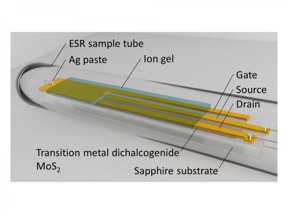 |
| Schematic diagram of the MoS2 transistor in an ESR sample tube. CREDIT University of Tsukuba |
Abstract:
Scientists from the University of Tsukuba and a scientist from the Institute of High Pressure Physics detected and mapped the electronic spins moving in a working transistor made of molybdenum disulfide. This research may lead to much faster computers that take advantage of the natural magnetism of electrons, as opposed to just their charge.
Taking 2D materials for a spin: Scientists at the University of Tsukuba and the Institute of High Pressure Physics fabricate a novel molybdenum disulfide transistor and create an image of the spins of the electrons passing through which may open the way for new spintronic compute
Tsukuba, Japan and Warsaw, Poland | Posted on March 5th, 2021Spintronics is a new area of condensed matter physics that attempts to use the intrinsic magnetic moment of electrons, called "spins," to perform calculations. This would be a major advance over all existing electronics that rely solely on the electron charge. However, it is difficult to detect these spins, and there are many unknowns regarding materials that can support the transport of spin-polarized electrons.
Now, an international research team led by the Division of Materials Science at the University of Tsukuba has successfully used electron spin resonance (ESR) to monitor the number and location of unpaired spins coursing through a molybdenum disulfide transistor. ESR uses the same physical principle as the MRI machines that create medical images. The spins are subject to a very strong magnetic field, which creates an energy difference between electrons with spins aligned and anti-aligned with the field. The absorbance of photons that match this energy gap can be measured to determine the presence of unpaired electron spins.
The experiment required the sample to be cooled to just four degrees above absolute zero, and the transistor to be in operation while the spins are being measured. "The ESR signals were measured simultaneously with the drain and gate currents," corresponding author Professor Kazuhiro Marumoto says. "Theoretical calculations further identified the origins of the spins," coauthor Professor Ma?gorzata Wierzbowska says. Molybdenum disulfide was used because its atoms naturally form a nearly flat two-dimensional structure. The molybdenum atoms form a plane with a layer of sulfide ions above and below.
The team found that charging the system with the additional electrons in a process called n-type doping was important for creating the spins. "In contrast with previous work on other 2D materials, the n-type doping allowed us to achieve better control of the electronic spins," Professors Marumoto and Wierzbowska explain. The scientists believe that molybdenum disulfide will prove to be an important testbed for spintronic devices as the technology advances towards future consumer products.
####
Contacts:
Naoko Yamashina
81-298-532-066
Copyright © University of Tsukuba
If you have a comment, please Contact us.Issuers of news releases, not 7th Wave, Inc. or Nanotechnology Now, are solely responsible for the accuracy of the content.
Bookmark:


| Related Links |
| Related News Press |
News and information
 Quantum computer improves AI predictions April 17th, 2026
Flexible sensor gains sensitivity under pressure April 17th, 2026
A reusable chip for particulate matter sensing April 17th, 2026
Detecting vibrational quantum beating in the predissociation dynamics of SF6 using time-resolved photoelectron spectroscopy April 17th, 2026
2 Dimensional Materials
Flexible sensor gains sensitivity under pressure April 17th, 2026
Possible Futures
A fundamentally new therapeutic approach to cystic fibrosis: Nanobody repairs cellular defect April 17th, 2026
UC Irvine physicists discover method to reverse ‘quantum scrambling’ : The work addresses the problem of information loss in quantum computing system April 17th, 2026
Spintronics
Quantum materials: Electron spin measured for the first time June 9th, 2023
Discoveries
Quantum computer improves AI predictions April 17th, 2026
Flexible sensor gains sensitivity under pressure April 17th, 2026
A reusable chip for particulate matter sensing April 17th, 2026
Detecting vibrational quantum beating in the predissociation dynamics of SF6 using time-resolved photoelectron spectroscopy April 17th, 2026
Announcements
A fundamentally new therapeutic approach to cystic fibrosis: Nanobody repairs cellular defect April 17th, 2026
UC Irvine physicists discover method to reverse ‘quantum scrambling’ : The work addresses the problem of information loss in quantum computing system April 17th, 2026
Interviews/Book Reviews/Essays/Reports/Podcasts/Journals/White papers/Posters
A fundamentally new therapeutic approach to cystic fibrosis: Nanobody repairs cellular defect April 17th, 2026
UC Irvine physicists discover method to reverse ‘quantum scrambling’ : The work addresses the problem of information loss in quantum computing system April 17th, 2026
 |
||
 |
||
| The latest news from around the world, FREE | ||
 |
||
|
|
||
| Premium Products | ||
 |
||
|
Only the news you want to read!
Learn More |
||
 |
||
|
Full-service, expert consulting
Learn More |
||
|
|
||