Home > Press > Scientists manipulate magnets at the atomic scale
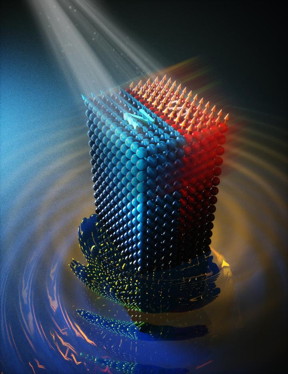 |
| The researchers used ultrashort laser pulse excitation to optically stimulate specific atomic vibrations of the magnet's crystal lattice CREDIT Lancaster University |
Abstract:
Fast and energy-efficient future data processing technologies are on the horizon after an international team of scientists successfully manipulated magnets at the atomic level.
Scientists manipulate magnets at the atomic scale
Lancaster, UK | Posted on February 12th, 2021Physicist Dr Rostislav Mikhaylovskiy from Lancaster University said: "With stalling efficiency trends of current technology, new scientific approaches are especially valuable. Our discovery of the atomically-driven ultrafast control of magnetism opens broad avenues for fast and energy-efficient future data processing technologies essential to keep up with our data hunger."
Magnetic materials are heavily used in modern life with applications ranging from fridge magnets to Google and Amazon's data centers used to store digital information.
These materials host trillions of mutually aligned elementary magnetic moments or "spins", whose alignment is largely governed by the arrangement of the atoms in the crystal lattice.
The spin can be seen as an elementary "needle of a compass", typically depicted as an arrow showing the direction from North to South poles. In magnets all spins are aligned along the same direction by the force called exchange interaction. The exchange interaction is one of the strongest quantum effects which is responsible for the very existence of magnetic materials.
The ever-growing demand for efficient magnetic data processing calls for novel means to manipulate the magnetic state and manipulating the exchange interaction would be the most efficient and ultimately fastest way to control magnetism.
To achieve this result, the researchers used the fastest and the strongest stimulus available: ultrashort laser pulse excitation. They used light to optically stimulate specific atomic vibrations of the magnet's crystal lattice which extensively disturbed and distorted the structure of the material.
The results of this study are published in the prestigious journal Nature Materials by the international team from Lancaster, Delft, Nijmegen, Liege and Kiev.
PhD student Jorrit Hortensius from the Technical University of Delft said: "We optically shake the lattice of a magnet that is made up of alternating up and down small magnetic moments and therefore does not have a net magnetization, unlike the familiar fridge magnets."
After shaking the crystal for a very short period of time, the researchers measured how the magnetic properties evolve directly in time. Following the shaking, the magnetic system of the antiferromagnet changes, such that a net magnetization appears: for a fraction of time the material becomes similar to the everyday fridge magnets.
This all occurs within an unprecedentedly short time of less than a few picoseconds (millionth of a millionth of a second). This time is not only orders of magnitude shorter than the recording time in modern computer hard drives, but also exactly matches the fundamental limit for the magnetization switching.
Dr Rostislav Mikhaylovskiy from Lancaster University explains: "It has long been thought that the control of magnetism by atomic vibrations is restricted to acoustic excitations (sound waves) and cannot be faster than nanoseconds. We have reduced the magnetic switching time by 1000 times that is a major milestone in itself."
Dr Dmytro Afanasiev from the Technical University of Delft adds: "We believe that our findings will stimulate further research into exploring and understanding the exact mechanisms governing the ultrafast lattice control of the magnetic state."
####
For more information, please click here
Contacts:
Gillian Whitworth
44-015-245-92612
Copyright © Lancaster University
If you have a comment, please Contact us.Issuers of news releases, not 7th Wave, Inc. or Nanotechnology Now, are solely responsible for the accuracy of the content.
Bookmark:


| Related Links |
| Related News Press |
News and information
 Quantum computer improves AI predictions April 17th, 2026
Flexible sensor gains sensitivity under pressure April 17th, 2026
A reusable chip for particulate matter sensing April 17th, 2026
Detecting vibrational quantum beating in the predissociation dynamics of SF6 using time-resolved photoelectron spectroscopy April 17th, 2026
Magnetism/Magnons
Metasurfaces smooth light to boost magnetic sensing precision January 30th, 2026
Researchers develop molecular qubits that communicate at telecom frequencies October 3rd, 2025
First real-time observation of two-dimensional melting process: Researchers at Mainz University unveil new insights into magnetic vortex structures August 8th, 2025
Magnetism in new exotic material opens the way for robust quantum computers June 4th, 2025
Possible Futures
A fundamentally new therapeutic approach to cystic fibrosis: Nanobody repairs cellular defect April 17th, 2026
UC Irvine physicists discover method to reverse ‘quantum scrambling’ : The work addresses the problem of information loss in quantum computing system April 17th, 2026
Chip Technology
A reusable chip for particulate matter sensing April 17th, 2026
Metasurfaces smooth light to boost magnetic sensing precision January 30th, 2026
Discoveries
Quantum computer improves AI predictions April 17th, 2026
Flexible sensor gains sensitivity under pressure April 17th, 2026
A reusable chip for particulate matter sensing April 17th, 2026
Detecting vibrational quantum beating in the predissociation dynamics of SF6 using time-resolved photoelectron spectroscopy April 17th, 2026
Announcements
A fundamentally new therapeutic approach to cystic fibrosis: Nanobody repairs cellular defect April 17th, 2026
UC Irvine physicists discover method to reverse ‘quantum scrambling’ : The work addresses the problem of information loss in quantum computing system April 17th, 2026
Interviews/Book Reviews/Essays/Reports/Podcasts/Journals/White papers/Posters
A fundamentally new therapeutic approach to cystic fibrosis: Nanobody repairs cellular defect April 17th, 2026
UC Irvine physicists discover method to reverse ‘quantum scrambling’ : The work addresses the problem of information loss in quantum computing system April 17th, 2026
 |
||
 |
||
| The latest news from around the world, FREE | ||
 |
||
|
|
||
| Premium Products | ||
 |
||
|
Only the news you want to read!
Learn More |
||
 |
||
|
Full-service, expert consulting
Learn More |
||
|
|
||