Home > Press > Nanothermometry to improve anticancer strategies
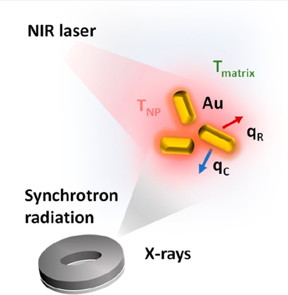 |
| Photothermal excitation of gold-based nanomaterials: the nanoparticle absorbs NIR (near infrared) light resulting in a localized heating. X-rays act as a probe of the local temperature. Image credit: NanoLetteres |
Abstract:
In hyperthermia treatments, the temperature is raised above
physiological levels to induce the death of cancerous cells. The *local
application of hyperthermia is key for a successful treatment* and to
reduce damage to the healthy surrounding tissues. Going down to the
nanoscale, nanoparticles can be used in hyperthermia treatments acting
as nanoheaters and triggering cellular damage and/or inducing drug
release in a selective manner.
Nanothermometry to improve anticancer strategies
Madrid, Spain | Posted on February 10th, 2021The optimization of the heat capability of the nanoparticles is very
important to better adjust the therapeutic thermal onset, since, in some
cases, thermal healing effects may occurs though local heating without a
macroscopic temperature rise. Measuring the nanoscale details of the
heating in the surrounding of the nanoparticles is challenging; so far
indirect methods have been tested.
In their /Nano Letters /publication, a group of researchers led by Dr.
Ana Espinosa (IMDEA Nanociencia) and Álvaro Muñoz-Noval (UCM) have
proposed the measurement of the nanoscale heating of gold-based
nanoparticles under hyperthermia conditions using X-ray absorption
spectroscopy as an onsite and direct nanothermometric method. The
results reveal *significant nanothermal gradients*, it is, high
temperature variations within a small volume and evidence a nanoscopic
local temperature significantly higher than global temperature
measurements. This method is versatile and allows to measure the heating
at the nanoscale for all types of particles and systems under
hyperthermia exposure.
This work is an outcome of Dr. Ana Espinosa’s research group at IMDEA
Nanociencia and has been partially funded by the “Atracción de
Talento”//Grant from Comunidad de Madrid, the Spanish Association
Against Cancer (AECC), and the Severo Ochoa Excellence award to IMDEA
Nanociencia (2017-2021).
####
For more information, please click here
Contacts:
IMDEA Nanociencia
C/Faraday 9
28049 Madrid, Spain
Tel.: +34 91 299 87 00
www.nanociencia.imdea.org
Twitter: @IMDEA_Nano
Facebook: @IMDEANanociencia
Instagram: @IMDEANanociencia
Copyright © IMDEA Nanociencia
If you have a comment, please Contact us.Issuers of news releases, not 7th Wave, Inc. or Nanotechnology Now, are solely responsible for the accuracy of the content.
Bookmark:


| Related Links |
| Related News Press |
News and information
 Quantum computer improves AI predictions April 17th, 2026
Flexible sensor gains sensitivity under pressure April 17th, 2026
A reusable chip for particulate matter sensing April 17th, 2026
Detecting vibrational quantum beating in the predissociation dynamics of SF6 using time-resolved photoelectron spectroscopy April 17th, 2026
Cancer
New molecular technology targets tumors and simultaneously silences two ‘undruggable’ cancer genes August 8th, 2025
Ben-Gurion University of the Negev researchers several steps closer to harnessing patient's own T-cells to fight off cancer June 6th, 2025
Self-propelled protein-based nanomotors for enhanced cancer therapy by inducing ferroptosis June 6th, 2025
Possible Futures
A fundamentally new therapeutic approach to cystic fibrosis: Nanobody repairs cellular defect April 17th, 2026
UC Irvine physicists discover method to reverse ‘quantum scrambling’ : The work addresses the problem of information loss in quantum computing system April 17th, 2026
Nanomedicine
A fundamentally new therapeutic approach to cystic fibrosis: Nanobody repairs cellular defect April 17th, 2026
New molecular technology targets tumors and simultaneously silences two ‘undruggable’ cancer genes August 8th, 2025
New imaging approach transforms study of bacterial biofilms August 8th, 2025
Electrifying results shed light on graphene foam as a potential material for lab grown cartilage June 6th, 2025
Discoveries
Quantum computer improves AI predictions April 17th, 2026
Flexible sensor gains sensitivity under pressure April 17th, 2026
A reusable chip for particulate matter sensing April 17th, 2026
Detecting vibrational quantum beating in the predissociation dynamics of SF6 using time-resolved photoelectron spectroscopy April 17th, 2026
Announcements
A fundamentally new therapeutic approach to cystic fibrosis: Nanobody repairs cellular defect April 17th, 2026
UC Irvine physicists discover method to reverse ‘quantum scrambling’ : The work addresses the problem of information loss in quantum computing system April 17th, 2026
Interviews/Book Reviews/Essays/Reports/Podcasts/Journals/White papers/Posters
A fundamentally new therapeutic approach to cystic fibrosis: Nanobody repairs cellular defect April 17th, 2026
UC Irvine physicists discover method to reverse ‘quantum scrambling’ : The work addresses the problem of information loss in quantum computing system April 17th, 2026
Nanobiotechnology
A fundamentally new therapeutic approach to cystic fibrosis: Nanobody repairs cellular defect April 17th, 2026
New molecular technology targets tumors and simultaneously silences two ‘undruggable’ cancer genes August 8th, 2025
New imaging approach transforms study of bacterial biofilms August 8th, 2025
Electrifying results shed light on graphene foam as a potential material for lab grown cartilage June 6th, 2025
 |
||
 |
||
| The latest news from around the world, FREE | ||
 |
||
|
|
||
| Premium Products | ||
 |
||
|
Only the news you want to read!
Learn More |
||
 |
||
|
Full-service, expert consulting
Learn More |
||
|
|
||