Home > Press > Arctic warming and diminishing sea ice are influencing the atmosphere: Researchers of the University of Helsinki have resolved for the first time, how the environment affects the formation of nanoparticles in the Arctic. The results give additional insight into the future of melt
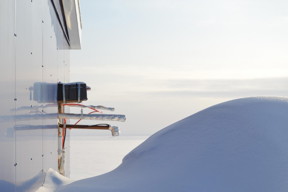 |
| Measurements in Northern Greenland CREDIT Nina Sarnela |
Abstract:
The researchers of the Institute for Atmospheric and Earth system research at the University of Helsinki have investigated how atmospheric particles are formed in the Arctic. Until recent studies, the molecular processes of particle formation in the high Arctic remained a mystery.
Arctic warming and diminishing sea ice are influencing the atmosphere: Researchers of the University of Helsinki have resolved for the first time, how the environment affects the formation of nanoparticles in the Arctic. The results give additional insight into the future of melt
Helsinki, Finland | Posted on January 29th, 2021During their expeditions to the Arctic, the scientists collected measurements for 12 months in total. The results of the extensive research project were recently published in the Geophysical Research Letters journal.
The researchers discovered that atmospheric vapors, particles, and cloud formation have clear differences within various Arctic environments. The study clarifies how Arctic warming and sea ice loss strengthens processes where different vapors are emitted to the atmosphere. The thinning of sea ice enables more iodine emissions while broader open waters enable more emissions of sulfur-containing vapors.
Higher concentrations of vapors result in a higher amount of particles. This on the other hand will lead to more clouds, which can - depending on the season and location - either slow down or accelerate the Arctic warming. Detailed knowledge of these processes is crucial in order to understand the consequences of global warming.
"Our observations are contributing to further understanding of what happens in the Arctic atmosphere due to warming. In general, atmospheric particles and clouds play an important role in regulating the atmosphere's temperature, and any changing behavior of these has consequences on Arctic warming. Arctic areas are especially sensitive to changes in cloudiness and albedo", says Lisa Beck, a doctoral student at the Institute for Atmospheric and Earth System Research (INAR).
More information about the future of melting sea ice
The researchers conducted measurements in Northern Greenland at Villum research station and in Svalbard at Ny-Ålesund for 6-months at each station. While both sites are located at similar latitudes, about 1000 km south of the North Pole, their environments are very different. Villum-station is surrounded by sea ice all year round, while the warm sea currents cause the sea around Ny-Ålesund to remain open.
In Northern Greenland the researchers discovered that in the spring after the Polar night the microalgae below the sea ice started to emit iodine compounds to the atmosphere. As the spring continues, the thinning sea ice leads to the emission of even more iodine compounds. These compounds form molecular clusters that can grow into bigger particles.
In Svalbard, surrounded by open waters, the observations showed how sulfur-compounds emitted by phytoplankton could form a large amount of particles that could grow fast, and can even form cloud droplets. In the studies of Svalbard also organic compounds were detected.
The large amount and role of organic compounds in the Arctic particle formation surprised the researchers.
"We did not expect to observe many organic vapors in the cold and bare Arctic environment as they have been mainly seen in areas covered by forests. We are planning to continue the studies in Svalbard to figure out what these organic compounds are and where they are coming from", Beck says.
The particle concentrations in Svalbard were clearly higher than the ones measured in Northern-Greenland.
"Currently, the Arctic sea ice is melting fast. As a result, we can assume that the processes observed in Svalbard will be more common in the Arctic areas that will be liberated from sea ice", Beck says.
###
The published research is connected to the recent Polarstern studies that have continued the studies in the high Arctic in the middle of sea ice areas.
####
For more information, please click here
Contacts:
Aino Pekkarinen
050-359-3953
@helsinkiuni
Copyright © University of Helsinki
If you have a comment, please Contact us.Issuers of news releases, not 7th Wave, Inc. or Nanotechnology Now, are solely responsible for the accuracy of the content.
Bookmark:


| Related Links |
| Related News Press |
News and information
 Quantum computer improves AI predictions April 17th, 2026
Flexible sensor gains sensitivity under pressure April 17th, 2026
A reusable chip for particulate matter sensing April 17th, 2026
Detecting vibrational quantum beating in the predissociation dynamics of SF6 using time-resolved photoelectron spectroscopy April 17th, 2026
Possible Futures
A fundamentally new therapeutic approach to cystic fibrosis: Nanobody repairs cellular defect April 17th, 2026
UC Irvine physicists discover method to reverse ‘quantum scrambling’ : The work addresses the problem of information loss in quantum computing system April 17th, 2026
Discoveries
Quantum computer improves AI predictions April 17th, 2026
Flexible sensor gains sensitivity under pressure April 17th, 2026
A reusable chip for particulate matter sensing April 17th, 2026
Detecting vibrational quantum beating in the predissociation dynamics of SF6 using time-resolved photoelectron spectroscopy April 17th, 2026
Announcements
A fundamentally new therapeutic approach to cystic fibrosis: Nanobody repairs cellular defect April 17th, 2026
UC Irvine physicists discover method to reverse ‘quantum scrambling’ : The work addresses the problem of information loss in quantum computing system April 17th, 2026
Interviews/Book Reviews/Essays/Reports/Podcasts/Journals/White papers/Posters
A fundamentally new therapeutic approach to cystic fibrosis: Nanobody repairs cellular defect April 17th, 2026
UC Irvine physicists discover method to reverse ‘quantum scrambling’ : The work addresses the problem of information loss in quantum computing system April 17th, 2026
Environment
A reusable chip for particulate matter sensing April 17th, 2026
Researchers unveil a groundbreaking clay-based solution to capture carbon dioxide and combat climate change June 6th, 2025
 |
||
 |
||
| The latest news from around the world, FREE | ||
 |
||
|
|
||
| Premium Products | ||
 |
||
|
Only the news you want to read!
Learn More |
||
 |
||
|
Full-service, expert consulting
Learn More |
||
|
|
||