Home > Press > Scientists synthetize new material for high-performance supercapacitors
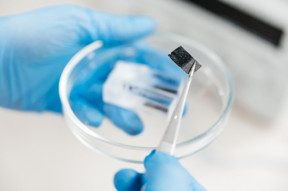 |
| Photo: modified rGO supercapacitor electrodes |
Abstract:
Scientists of Tomsk Polytechnic University jointly with colleagues from the University of Lille (Lille, France) synthetized a new material based on reduced graphene oxide (rGO) for supercapacitors, energy storage devices. The rGO modification method with the use of organic molecules, derivatives of hypervalent iodine, allowed obtaining a material that stores 1.7 times more electrical energy. The research findings are published in Electrochimica Acta academic journal (IF: 6,215; Q1).
Scientists synthetize new material for high-performance supercapacitors
Tomsk, Russia | Posted on January 19th, 2021A supercapacitor is an electrochemical device for storage and release of electric charge. Unlike batteries, they store and release energy several times faster and do not contain lithium.
A supercapacitor is an element with two electrodes separated by an organic or inorganic electrolyte. The electrodes are coated with an electric charge accumulating material. The modern trend in science is to use various materials based on graphene, one of the thinnest and most durable materials known to man. The researchers of TPU and the University of Lille used reduced graphene oxide (rGO), a cheap and available material.
"Despite their potential, supercapacitors are not wide-spread yet. For further development of the technology, it is required to enhance the efficiency of supercapacitors. One of the key challenges here is to increase the energy capacity.
It can be achieved by expanding the surface area of an energy storage material, rGO in this particular case. We found a simple and quite fast method. We used exceptionally organic molecules under mild conditions and did not use expensive and toxic metals," Pavel Postnikov, Associate Professor of TPU Research School of Chemistry and Applied Biomedical Science and the research supervisor says.
Reduced graphene oxide in a powder form is deposited on electrodes. As a result, the electrode becomes coated with hundreds of nanoscale layers of the substance. The layers tend to agglomerate, in other words, to sinter. To expand the surface area of a material, the interlayer spacing should be increased.
"For this purpose, we modified rGO with organic molecules, which resulted in the interlayer spacing increase. Insignificant differences in interlayer spacing allowed increasing energy capacity of the material by 1.7 times. That is, 1 g of the new material can store 1.7 times more energy in comparison with a pristine reduced graphene oxide," Elizaveta Sviridova, Junior Research Fellow of TPU Research School of Chemistry and Applied Biomedical Sciences and one of the authors of the article explains.
The reaction proceeded through the formation of active arynes from iodonium salts. They kindle scientists` interest due to their property to form a single layer of new organic groups on material surfaces. The TPU researchers have been developing the chemistry of iodonium salts for many years.
"The modification reaction proceeds under mild conditions by simply mixing the solution of iodonium salt with reduced graphene oxide. If we compare it with other methods of reduced graphene oxide functionalization, we have achieved the highest indicators of material energy capacity increase," Elizaveta Sviridova says.
###
The research work was conducted with the support of the Russian Science Foundation.
####
For more information, please click here
Contacts:
Alina Borovskaia
7-923-419-5528
@TPUnews_en
Copyright © Tomsk Polytechnic University
If you have a comment, please Contact us.Issuers of news releases, not 7th Wave, Inc. or Nanotechnology Now, are solely responsible for the accuracy of the content.
Bookmark:


| Related Links |
| Related News Press |
News and information
 Quantum computer improves AI predictions April 17th, 2026
Flexible sensor gains sensitivity under pressure April 17th, 2026
A reusable chip for particulate matter sensing April 17th, 2026
Detecting vibrational quantum beating in the predissociation dynamics of SF6 using time-resolved photoelectron spectroscopy April 17th, 2026
Govt.-Legislation/Regulation/Funding/Policy
Quantum computer improves AI predictions April 17th, 2026
Metasurfaces smooth light to boost magnetic sensing precision January 30th, 2026
New imaging approach transforms study of bacterial biofilms August 8th, 2025
Possible Futures
A fundamentally new therapeutic approach to cystic fibrosis: Nanobody repairs cellular defect April 17th, 2026
UC Irvine physicists discover method to reverse ‘quantum scrambling’ : The work addresses the problem of information loss in quantum computing system April 17th, 2026
Discoveries
Quantum computer improves AI predictions April 17th, 2026
Flexible sensor gains sensitivity under pressure April 17th, 2026
A reusable chip for particulate matter sensing April 17th, 2026
Detecting vibrational quantum beating in the predissociation dynamics of SF6 using time-resolved photoelectron spectroscopy April 17th, 2026
Announcements
A fundamentally new therapeutic approach to cystic fibrosis: Nanobody repairs cellular defect April 17th, 2026
UC Irvine physicists discover method to reverse ‘quantum scrambling’ : The work addresses the problem of information loss in quantum computing system April 17th, 2026
Interviews/Book Reviews/Essays/Reports/Podcasts/Journals/White papers/Posters
A fundamentally new therapeutic approach to cystic fibrosis: Nanobody repairs cellular defect April 17th, 2026
UC Irvine physicists discover method to reverse ‘quantum scrambling’ : The work addresses the problem of information loss in quantum computing system April 17th, 2026
Battery Technology/Capacitors/Generators/Piezoelectrics/Thermoelectrics/Energy storage
Decoding hydrogen‑bond network of electrolyte for cryogenic durable aqueous zinc‑ion batteries January 30th, 2026
COF scaffold membrane with gate‑lane nanostructure for efficient Li+/Mg2+ separation January 30th, 2026
MXene nanomaterials enter a new dimension Multilayer nanomaterial: MXene flakes created at Drexel University show new promise as 1D scrolls January 30th, 2026
 |
||
 |
||
| The latest news from around the world, FREE | ||
 |
||
|
|
||
| Premium Products | ||
 |
||
|
Only the news you want to read!
Learn More |
||
 |
||
|
Full-service, expert consulting
Learn More |
||
|
|
||