Home > Press > Physicists propose a new theory to explain one dimensional quantum liquids formation
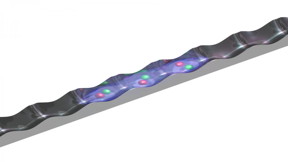 |
| One dimensional quantum lattice liquids. CREDIT I. Morera et al. Phys. Rev. Lett |
Abstract:
Liquids are ubiquitous in Nature: from the water that we consume daily to superfluid helium which is a quantum liquid appearing at temperatures as low as only a few degrees above the absolute zero. A common feature of these vastly different liquids is being self-bound in free space in the form of droplets. Understanding from a microscopic perspective how a liquid is formed by adding particles one by one is a significant challenge.
Physicists propose a new theory to explain one dimensional quantum liquids formation
Barcelona, Spain | Posted on January 15th, 2021Recently, a new type of quantum droplets has been experimentally observed in ultracold atomic systems. These ones are made of alkaline atoms which are cooled down to extremely low temperatures of the order of nanokelvins. The main peculiarity of these systems is that they are the most dilute liquids ever experimentally observed. An extraordinary experimental control over the system opens the possibility of unraveling the mechanism leading to the formation of quantum droplets.
In a recent article published in Physical Review Letters, researchers from the Institute of Cosmos Sciences of the University of Barcelona (ICCUB) Ivan Morera and the late Prof. Artur Polls led by Prof. Bruno Juliá-Díaz, in collaboration with Prof. Grigori Astrakharchik from UPC, present a microscopic theory of lattice quantum droplets which explains their formation.
The team of researchers has shown that the formation of the quantum droplet can be explained in terms of effective interactions between dimers (bound states of two particles). Moreover, by solving the four-body problem they have shown that tetramers (bound states of four particles) can appear and they can be interpreted as simple bound states of two dimers.
The properties of these tetramers already coincide with the ones of large quantum droplets which indicates that many of the feature properties of the many-body liquid are contained in the tetramer. They also discussed the possibility of observing these strongly correlated droplets in dipolar bosons or bosonic mixtures in optical lattices.
####
For more information, please click here
Contacts:
Bibiana Bonmati
0093-403-5544
Copyright © University of Barcelona
If you have a comment, please Contact us.Issuers of news releases, not 7th Wave, Inc. or Nanotechnology Now, are solely responsible for the accuracy of the content.
Bookmark:


| Related Links |
| Related News Press |
News and information
 Quantum computer improves AI predictions April 17th, 2026
Flexible sensor gains sensitivity under pressure April 17th, 2026
A reusable chip for particulate matter sensing April 17th, 2026
Detecting vibrational quantum beating in the predissociation dynamics of SF6 using time-resolved photoelectron spectroscopy April 17th, 2026
Quantum Physics
Detecting vibrational quantum beating in the predissociation dynamics of SF6 using time-resolved photoelectron spectroscopy April 17th, 2026
Beyond silicon: Electronics at the scale of a single molecule January 30th, 2026
MXene nanomaterials enter a new dimension Multilayer nanomaterial: MXene flakes created at Drexel University show new promise as 1D scrolls January 30th, 2026
Chemistry
Projecting light to dispense liquids: A new route to ultra-precise microdroplets January 30th, 2026
From sensors to smart systems: the rise of AI-driven photonic noses January 30th, 2026
Single-atom catalysts change spin state when boosted by a magnetic field June 4th, 2025
Quantum chemistry
A 1960s idea inspires NBI researchers to study hitherto inaccessible quantum states June 6th, 2025
Possible Futures
A fundamentally new therapeutic approach to cystic fibrosis: Nanobody repairs cellular defect April 17th, 2026
UC Irvine physicists discover method to reverse ‘quantum scrambling’ : The work addresses the problem of information loss in quantum computing system April 17th, 2026
Discoveries
Quantum computer improves AI predictions April 17th, 2026
Flexible sensor gains sensitivity under pressure April 17th, 2026
A reusable chip for particulate matter sensing April 17th, 2026
Detecting vibrational quantum beating in the predissociation dynamics of SF6 using time-resolved photoelectron spectroscopy April 17th, 2026
Announcements
A fundamentally new therapeutic approach to cystic fibrosis: Nanobody repairs cellular defect April 17th, 2026
UC Irvine physicists discover method to reverse ‘quantum scrambling’ : The work addresses the problem of information loss in quantum computing system April 17th, 2026
Interviews/Book Reviews/Essays/Reports/Podcasts/Journals/White papers/Posters
A fundamentally new therapeutic approach to cystic fibrosis: Nanobody repairs cellular defect April 17th, 2026
UC Irvine physicists discover method to reverse ‘quantum scrambling’ : The work addresses the problem of information loss in quantum computing system April 17th, 2026
Quantum nanoscience
Beyond silicon: Electronics at the scale of a single molecule January 30th, 2026
MXene nanomaterials enter a new dimension Multilayer nanomaterial: MXene flakes created at Drexel University show new promise as 1D scrolls January 30th, 2026
ICFO researchers overcome long-standing bottleneck in single photon detection with twisted 2D materials August 8th, 2025
 |
||
 |
||
| The latest news from around the world, FREE | ||
 |
||
|
|
||
| Premium Products | ||
 |
||
|
Only the news you want to read!
Learn More |
||
 |
||
|
Full-service, expert consulting
Learn More |
||
|
|
||