Home > Press > Controlling chemical catalysts with sculpted light
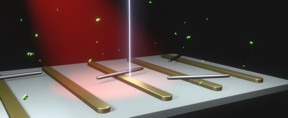 |
| Depiction of the experimental setup where palladium nanorods lie atop gold nanobars. In this image, an electron beam is directed at the sample to watch the catalytic interactions between the hydrogen molecules (in green) and the palladium catalyst. The light driving the illumination is shown in red. CREDIT Katherine Sytwu |
Abstract:
Like a person breaking up a cat fight, the role of catalysts in a chemical reaction is to hurry up the process - and come out of it intact. And, just as not every house in a neighborhood has someone willing to intervene in such a battle, not every part of a catalyst participates in the reaction. But what if one could convince the unengaged parts of a catalyst to get involved? Chemical reactions could occur faster or more efficiently.
Controlling chemical catalysts with sculpted light
Stanford, CA | Posted on January 15th, 2021Stanford University material scientists led by Jennifer Dionne have done just that by using light and advanced fabrication and characterization techniques to endow catalysts with new abilities.
In a proof-of-concept experiment, rods of palladium that were approximately 1/200th the width of a human hair served as catalysts. The researchers placed these nanorods above gold nanobars that focused and "sculpted" the light around the catalyst. This sculpted light changed the regions on the nanorods where chemical reactions - which release hydrogen - took place. This work, published Jan. 14 in Science, could be an early step toward more efficient catalysts, new forms of catalytic transformations and potentially even catalysts capable of sustaining more than one reaction at once.
"This research is an important step in realizing catalysts that are optimized from the atomic-scale to the reactor-scale," said Dionne, associate professor of materials science and engineering who is senior author of the paper. "The aim is to understand how, with the appropriate shape and composition, we can maximize the reactive area of the catalyst and control which reactions are occurring."
A mini lab
Simply being able to observe this reaction required an exceptional microscope, capable of imaging an active chemical process on an extremely small scale. "It's difficult to observe how catalysts change under reaction conditions because the nanoparticles are extremely small," said Katherine Sytwu, a former graduate student in the Dionne lab and lead author of the paper. "The atomic-scale features of a catalyst generally dictate where a transformation happens, and so it's crucial to distinguish what's happening within the small nanoparticle."
For this particular reaction - and the later experiments on controlling the catalyst - the microscope also had to be compatible with the introduction of gas and light into the sample.
To accomplish all of this, the researchers used an environmental transmission electron microscope at the Stanford Nano-Shared Facilities with a special attachment, previously developed by the Dionne lab, to introduce light. As their name suggests, transmission electron microscopes use electrons to image samples, which allows for a higher level of magnification than a classic optical microscope, and the environmental feature of this microscope means that gas can be added into what is otherwise an airless environment.
"You basically have a mini lab where you can do experiments and visualize what's happening at a near-atomic level," said Sytwu.
Under certain temperature and pressure conditions, hydrogen-rich palladium will release its hydrogen atoms. In order to see how light would affect this standard catalytic transformation, the researchers customized a gold nanobar - designed using equipment at the Stanford Nano-Shared Facilities and the Stanford Nanofabrication Facility - to sit below the palladium and act as an antenna, collecting the incoming light and funneling it to the nearby catalyst.
"First we needed to understand how these materials transform naturally. Then, we started to think about how we could modify and actually control how these nanoparticles change," said Sytwu.
Without light, the most reactive points of the dehydrogenation are the two tips of the nanorod. The reaction then travels through the nanorod, popping out hydrogen along the way. With light, however, the researchers were able to manipulate this reaction so that it traveled from the middle outward or from one tip to the other. Based on the location of the gold nanobar and the illumination conditions, the researchers managed to produce a variety of alternative hotspots.
Bond breaking and breakthroughs
This work is one of the rare instances showing that it is possible to tweak how catalysts behave even after they are made. It opens up significant potential for increasing efficiency at the single-catalyst level. A single catalyst could play the role of many, using light to perform several of the same reactions across its surface or potentially increase the number of sites for reactions. Light control may also help scientists avoid unwanted, extraneous reactions that sometimes occur alongside desired ones. Dionne's most aspirational goal is to someday develop efficient catalysts capable of breaking down plastic at a molecular level and transforming it back to its source material for recycling.
Dionne emphasized that this work, and whatever comes next, would not be possible without the shared facilities and resources available at Stanford. (These researchers also used the Stanford Research Computing Center to do their data analysis.) Most labs cannot afford to have this advanced equipment on their own, so sharing it increases access and expert support.
"What we can learn about the world and how we can enable the next big breakthrough is so critically enabled by shared research platforms," said Dionne, who is also senior associate vice provost for research platforms/shared facilities. "These spaces not only offer critical tools, but a really amazing community of researchers."
###
Additional Stanford co-authors include former postdoctoral scholar Michal Vadai, former doctoral student Fariah Hayee, and graduate students Daniel K. Angell, Alan Dai and Jefferson Dixon.
This research was funded by the SLAC National Accelerator Laboratory; the National Science Foundation, including the Alan T. Waterman award, the U.S. Department of Energy (partially as part of the "Photonics at Thermodynamic Limits" Energy Frontier Research Center), Office of Science, Division of Materials Science and Engineering, the Gabilan Stanford Graduate Fellowship, the TomKat Center for Sustainable Energy at Stanford, the Diversifying Academia, Recruiting Excellence (DARE) Doctoral Fellowship Program at Stanford. Dionne is also a courtesy faculty in Radiology, member of the Wu Tsai Neurosciences Institute and Stanford Bio-X, and an affiliate of the Precourt Institute for Energy.
####
For more information, please click here
Contacts:
Taylor Kubota
650-724-7707
@stanford
Copyright © Stanford University
If you have a comment, please Contact us.Issuers of news releases, not 7th Wave, Inc. or Nanotechnology Now, are solely responsible for the accuracy of the content.
Bookmark:


| Related News Press |
News and information
 Simulating magnetization in a Heisenberg quantum spin chain April 5th, 2024
NRL charters Navy’s quantum inertial navigation path to reduce drift April 5th, 2024
Discovery points path to flash-like memory for storing qubits: Rice find could hasten development of nonvolatile quantum memory April 5th, 2024
Chemistry
What heat can tell us about battery chemistry: using the Peltier effect to study lithium-ion cells March 8th, 2024
Nanoscale CL thermometry with lanthanide-doped heavy-metal oxide in TEM March 8th, 2024
Focused ion beam technology: A single tool for a wide range of applications January 12th, 2024
Laboratories
A battery’s hopping ions remember where they’ve been: Seen in atomic detail, the seemingly smooth flow of ions through a battery’s electrolyte is surprisingly complicated February 16th, 2024
NRL discovers two-dimensional waveguides February 16th, 2024
Govt.-Legislation/Regulation/Funding/Policy
NRL charters Navy’s quantum inertial navigation path to reduce drift April 5th, 2024
Discovery points path to flash-like memory for storing qubits: Rice find could hasten development of nonvolatile quantum memory April 5th, 2024
Chemical reactions can scramble quantum information as well as black holes April 5th, 2024
Possible Futures
Discovery points path to flash-like memory for storing qubits: Rice find could hasten development of nonvolatile quantum memory April 5th, 2024
With VECSELs towards the quantum internet Fraunhofer: IAF achieves record output power with VECSEL for quantum frequency converters April 5th, 2024
Announcements
NRL charters Navy’s quantum inertial navigation path to reduce drift April 5th, 2024
Discovery points path to flash-like memory for storing qubits: Rice find could hasten development of nonvolatile quantum memory April 5th, 2024
Interviews/Book Reviews/Essays/Reports/Podcasts/Journals/White papers/Posters
Simulating magnetization in a Heisenberg quantum spin chain April 5th, 2024
Discovery points path to flash-like memory for storing qubits: Rice find could hasten development of nonvolatile quantum memory April 5th, 2024
Photonics/Optics/Lasers
With VECSELs towards the quantum internet Fraunhofer: IAF achieves record output power with VECSEL for quantum frequency converters April 5th, 2024
Nanoscale CL thermometry with lanthanide-doped heavy-metal oxide in TEM March 8th, 2024
Optically trapped quantum droplets of light can bind together to form macroscopic complexes March 8th, 2024
HKUST researchers develop new integration technique for efficient coupling of III-V and silicon February 16th, 2024
 |
||
 |
||
| The latest news from around the world, FREE | ||
 |
||
|
|
||
| Premium Products | ||
 |
||
|
Only the news you want to read!
Learn More |
||
 |
||
|
Full-service, expert consulting
Learn More |
||
|
|
||