Home > Press > Faraday fabrics? MXene-coated fabric could contain electronic interference in wearable devices
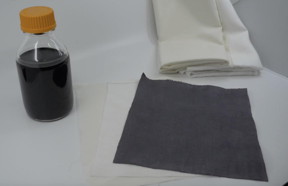 |
| Coating standard cotton or linen fabric with a solution of MXene material can imbue it with substantial electromagnetic shielding capabilities, according to new research from Drexel University. CREDIT Drexel University |
Abstract:
Researchers at Drexel University's College of Engineering have reported that fabric coated with a conductive, two-dimensional material called MXene, is highly effective at blocking electromagnetic waves and potentially harmful radiation. The discovery is a key development for efforts to weave technological capabilities into clothing and accessories.
Faraday fabrics? MXene-coated fabric could contain electronic interference in wearable devices
Philadelphia, PA | Posted on December 11th, 2020Materials that block electromagnetic waves had a commercial moment a handful of years ago when fears that high-tech thieves could scan or copy credit cards, passports or hack into laptops and contactless car keys had people putting them in special wallets, bags and protected pockets. While reporting suggests these fears were overblown, the demand for this sort of textile is likely to grow as more manufacturers incorporate sensing and communication technologies into fabrics.
They could also be deployed in national defense organizations to shield devices from tracing and hacking and to protect people from strong microwave radiation - the kind that might have been used against American and Canadian diplomats according to recent reports.
"Wearable devices will need shielding from the electromagnetic interference (EMI) regularly produced by mobile devices, and that shielding should be integrated as part of the garment," said Yury Gogotsi, PhD, Distinguished University and Bach professor at Drexel, who led research recently published in the materials science journal CARBON. "We have known for some time that MXene has the ability to block electromagnetic interference better than other materials, but this discovery shows that it can effectively adhere to fabrics and maintain its unique shielding capabilities."
The interference comes from residual electromagnetic fields produced by electronics devices. Users notice it as a buzz, a slowing or temporary stall in a device's function. It's a momentary inconvenience, but these moments are becoming more frequent with expanded use of mobile devices and connected technology - including wearables.
Improving the design of these devices, according to Gogotsi, entails using a shielding material to contain electromagnetic field generated by the device, as well as protecting it from interference produced by other devices. Gogotsi's team, which first produced and studied the conductive two-dimensional MXene materials nearly a decade ago, has been testing MXene coatings for this role, with promising results.
"MXenes are well-suited for use as shielding because they can be stably produced as a spray coating, an ink or a paint, so they can be applied to textiles without adding much weight or taking up more room," Gogotsi said. "We have also discovered that MXene shielding can absorb and reflect electromagnetic waves, so it not protects the wearable devices and electronic gadgets, but also protect people from strong electromagnetic field."
The researchers' most recent finding shows that dip-coating regular cotton or linen fabric in a MXene solution will turn it into an equally formidable shielding material - blocking EMI at greater than 99.9% effectiveness.
MXene flakes suspended in solution naturally adhere to the fibers in conventional cotton and linen fabrics because of their electric charge. This produces a thorough and durable coating, without the need for the pre- or post-treatment processes to produce most commercial conductive yarns and fabrics.
As part of the study, the MXene-coated fabrics were tested after being stored under normal conditions for two years and they showed only a slight drop in shielding efficiency - roughly 10%.
"This work provides a much-improved alternative to current EMI shielding textiles," said Simge Uzun, a doctoral student in Gogotsi's research group, who conducted this research as a part of her PhD program. "Not only do MXene-coated fabrics exceed the performance of commercial metal-coated fabrics, but they can be sustainably produced by coating form aqueous solution without extra processing or chemical additives."
####
For more information, please click here
Contacts:
Britt Faulstick
215-895-2617
@DrexelNews
Copyright © Drexel University
If you have a comment, please Contact us.Issuers of news releases, not 7th Wave, Inc. or Nanotechnology Now, are solely responsible for the accuracy of the content.
Bookmark:


| Related Links |
| Related News Press |
News and information
 Quantum computer improves AI predictions April 17th, 2026
Flexible sensor gains sensitivity under pressure April 17th, 2026
A reusable chip for particulate matter sensing April 17th, 2026
Detecting vibrational quantum beating in the predissociation dynamics of SF6 using time-resolved photoelectron spectroscopy April 17th, 2026
2 Dimensional Materials
Flexible sensor gains sensitivity under pressure April 17th, 2026
Flexible Electronics
Flexible sensor gains sensitivity under pressure April 17th, 2026
Flexible electronics integrated with paper-thin structure for use in space January 17th, 2025
Beyond wires: Bubble technology powers next-generation electronics:New laser-based bubble printing technique creates ultra-flexible liquid metal circuits November 8th, 2024
Wearable electronics
Breakthrough brings body-heat powered wearable devices closer to reality December 13th, 2024
Govt.-Legislation/Regulation/Funding/Policy
Quantum computer improves AI predictions April 17th, 2026
Metasurfaces smooth light to boost magnetic sensing precision January 30th, 2026
New imaging approach transforms study of bacterial biofilms August 8th, 2025
Possible Futures
A fundamentally new therapeutic approach to cystic fibrosis: Nanobody repairs cellular defect April 17th, 2026
UC Irvine physicists discover method to reverse ‘quantum scrambling’ : The work addresses the problem of information loss in quantum computing system April 17th, 2026
Discoveries
Quantum computer improves AI predictions April 17th, 2026
Flexible sensor gains sensitivity under pressure April 17th, 2026
A reusable chip for particulate matter sensing April 17th, 2026
Detecting vibrational quantum beating in the predissociation dynamics of SF6 using time-resolved photoelectron spectroscopy April 17th, 2026
Announcements
A fundamentally new therapeutic approach to cystic fibrosis: Nanobody repairs cellular defect April 17th, 2026
UC Irvine physicists discover method to reverse ‘quantum scrambling’ : The work addresses the problem of information loss in quantum computing system April 17th, 2026
Interviews/Book Reviews/Essays/Reports/Podcasts/Journals/White papers/Posters
A fundamentally new therapeutic approach to cystic fibrosis: Nanobody repairs cellular defect April 17th, 2026
UC Irvine physicists discover method to reverse ‘quantum scrambling’ : The work addresses the problem of information loss in quantum computing system April 17th, 2026
 |
||
 |
||
| The latest news from around the world, FREE | ||
 |
||
|
|
||
| Premium Products | ||
 |
||
|
Only the news you want to read!
Learn More |
||
 |
||
|
Full-service, expert consulting
Learn More |
||
|
|
||