Home > Press > Phytoplankton disturbed by nanoparticles: Due to its antibacterial properties, nanosilver is used in a wide range of products from textiles to cosmetics; but nanosilver if present at high concentrations also disrupts the metabolism of algae that are essential for the aquatic food
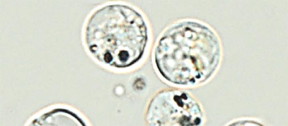 |
| This nanoparticle disrupts the metabolism of algae. CREDIT UNIGE/ Wei Liu |
Abstract:
Products derived from nanotechnology are efficient and highly sought-after, yet their effects on the environment are still poorly understood. A research team from the University of Geneva (UNIGE), working in collaboration with the University of California at Santa Barbara, have investigated the effects of nanosilver, currently used in almost 450 products for its antibacterial properties, on the algae known as Poterioochromonas malhamensis. The results - published in the journal Scientific Reports - show that nanosilver and its derivative, ionic silver, disturb the alga's entire metabolism. Its membrane becomes more permeable, the cellular reactive oxygen species increases and photosynthesis is less effective. The Swiss-American team was able to demonstrate for the first time the metabolic perturbations induced by nanosilver following its uptake in the food vacuoles of freshwater algae, paving the way for early detection of the metabolic changes before they express themselves physiologically.
Phytoplankton disturbed by nanoparticles: Due to its antibacterial properties, nanosilver is used in a wide range of products from textiles to cosmetics; but nanosilver if present at high concentrations also disrupts the metabolism of algae that are essential for the aquatic food
Geneva, Switzerland | Posted on November 27th, 2020The nanosilver is used for its antibacterial properties and is employed in textiles and cosmetics, inter alia. In addition, the agro-food, biomedical and biopharmaceutical industry is interested in it for developing drugs, devices and pesticides. «Since nanosilver is designed to destroy, repel or render harmless noxious organisms such as bacteria, scientists have realised that it might also be harmful to organisms that are crucial to our environment,» begins Vera Slaveykova from the Department F.A. Forel for Environmental and Aquatic Sciences in UNIGE's Faculty of Sciences. To assess the influence of nanotechnology products on phytoplankton and to evaluate the impacts on aquatic environment, the researcher team conducted a study on the alga Poterioochromonas malhamensis as a model phytoplankton species. «The phytoplankton are everywhere, in lakes and oceans," continues Professor Slaveykova. «As a whole, phytoplankton generate almost half of the oxygen we breathe. And they have a second essential role, since they are at the base of the food chain. If they accumulate nanoparticles, these will be integrated into the aquatic food chain».
Multiple disturbances
The study led by Professor Slaveykova shows that treating the algae with nanosilver disrupts the metabolism of the amino acids that are vital for producing cellular proteins, the nucleotide metabolism that is important for genes, and fatty and tricarboxylic acids making up the membranes, as well as the photosynthesis and photorespiration elements.
The study results suggest that the silver ions released by the silver nanoparticles are the main toxicity factor. «The nanosilver is internalised in the algal cells by the phagocytotic mechanism used to supply cells with organic matter,» continues Professor Slaveykova. The study is the first to demonstrate that nanoparticles can follow such internalisation path in a species of phytoplankton. «These measurements were carried out in Geneva by Dr Liu using transmission electron microscopy. This entry mechanism is only known in Poterioochromonas malhamensis; it is still unknown if other phytoplankton species express it,» explains the Geneva researcher.
To finish demonstrating nanosilver's toxicity, the international research team highlighted the fact that metabolic disturbances induce physiological dysfunctions. Professor Slaveykova observed lipid peroxidation leading to membrane permeabilization, increased oxidative stress and less efficient photosynthesis - and, it follows, reduced oxygen production.
An Approach That Needs to Be Implemented
The study underlines the full potential of metabolomics geared towards the molecular basis of the disruptions observed. «It's a fundamental contribution to the field: although the metabolomics approaches are properly in place in medical and pharmaceutical sciences, it's not at all the case for environmental toxicology where phytoplankton metabolomics is still in its infancy. The metabolomics is, therefore, a technique that offers the possibility of early detection of changes induced by a toxin, upstream of more global effects such as the alga growth inhibition and their impact on oxygen production. As it's never easy to demonstrate the relationships between cause and effect in complex environment, it is now essential to use approaches like these.»
####
For more information, please click here
Contacts:
Vera I. Slaveykova
41-223-790-335
@UNIGEnews
Copyright © University of Geneva
If you have a comment, please Contact us.Issuers of news releases, not 7th Wave, Inc. or Nanotechnology Now, are solely responsible for the accuracy of the content.
Bookmark:


| Related Links |
| Related News Press |
News and information
 Quantum computer improves AI predictions April 17th, 2026
Flexible sensor gains sensitivity under pressure April 17th, 2026
A reusable chip for particulate matter sensing April 17th, 2026
Detecting vibrational quantum beating in the predissociation dynamics of SF6 using time-resolved photoelectron spectroscopy April 17th, 2026
Possible Futures
A fundamentally new therapeutic approach to cystic fibrosis: Nanobody repairs cellular defect April 17th, 2026
UC Irvine physicists discover method to reverse ‘quantum scrambling’ : The work addresses the problem of information loss in quantum computing system April 17th, 2026
Discoveries
Quantum computer improves AI predictions April 17th, 2026
Flexible sensor gains sensitivity under pressure April 17th, 2026
A reusable chip for particulate matter sensing April 17th, 2026
Detecting vibrational quantum beating in the predissociation dynamics of SF6 using time-resolved photoelectron spectroscopy April 17th, 2026
Announcements
A fundamentally new therapeutic approach to cystic fibrosis: Nanobody repairs cellular defect April 17th, 2026
UC Irvine physicists discover method to reverse ‘quantum scrambling’ : The work addresses the problem of information loss in quantum computing system April 17th, 2026
Interviews/Book Reviews/Essays/Reports/Podcasts/Journals/White papers/Posters
A fundamentally new therapeutic approach to cystic fibrosis: Nanobody repairs cellular defect April 17th, 2026
UC Irvine physicists discover method to reverse ‘quantum scrambling’ : The work addresses the problem of information loss in quantum computing system April 17th, 2026
Environment
A reusable chip for particulate matter sensing April 17th, 2026
Researchers unveil a groundbreaking clay-based solution to capture carbon dioxide and combat climate change June 6th, 2025
Safety-Nanoparticles/Risk management
Tiny nanosheets, big leap: A new sensor detects ethanol at ultra-low levels January 30th, 2026
Onion-like nanoparticles found in aircraft exhaust May 14th, 2025
Closing the gaps — MXene-coating filters can enhance performance and reusability February 28th, 2025
 |
||
 |
||
| The latest news from around the world, FREE | ||
 |
||
|
|
||
| Premium Products | ||
 |
||
|
Only the news you want to read!
Learn More |
||
 |
||
|
Full-service, expert consulting
Learn More |
||
|
|
||