Home > Press > Turning a hot spot into a cold spot: Fano-shaped local-field responses probed by a quantum dot
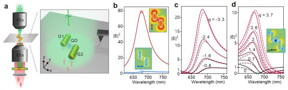 |
| (a) Schematics of the QD-loaded nanoantenna excited by a polarization-controlled light beam. (b) Simulated spectral dispersions and spatial distributions of the local-field responses under x-polarized and y-polarized excitation. (c,d) Simulated spectral dispersions of local-field responses under elliptically polarized excitation. The spectra exhibit Fano lineshapes with tunable Fano asymmetry parameter q and nearly vanishing Fano dips. Local-field distributions show that at the Fano dips the hot spot at the nanogap can be turned into a cold spot. CREDIT by Juan Xia, Jianwei Tang, Fanglin Bao, Yongcheng Sun, Maodong Fang, Guanjun Cao, Julian Evans, and Sailing He |
Abstract:
Optical nanoantennas can convert propagating light to local fields. The local-field responses can be engineered to exhibit nontrivial features in spatial, spectral and temporal domains. Local-field interferences play a key role in the engineering of the local-field responses. By controlling the local-field interferences, researchers have demonstrated local-field responses with various spatial distributions, spectral dispersions and temporal dynamics. Different degrees of freedom of the excitation light have been used to control the local-field interferences, such as the polarization, the beam shape and beam position, and the incidence direction. Despite the remarkable progress, achieving fully controllable local-field interferences remains a major challenge. A fully controllable local-field interference should be controllable between a constructive interference and a complete destructive interference. This would bring unprecedented benefit for the engineering of the local-field responses.
Turning a hot spot into a cold spot: Fano-shaped local-field responses probed by a quantum dot
Changchun, China | Posted on October 9th, 2020In a new paper published in Light Science & Application, a team of scientists from China, led by Professor Sailing He from Zhejiang University and Professor Jianwei Tang from Huazhong University of Science and Technology, have experimentally demonstrated that based on a fully controllable local-field interference designed in the nanogap of a nanoantenna, a local-field hot spot can be turned into a cold spot, and the spectral dispersion of the local-field response can exhibit dynamically tunable Fano lineshapes with nearly vanishing Fano dips. By simply controlling the excitation polarization, the Fano asymmetry parameter q can be tuned from negative to positive values, and correspondingly, the Fano dip can be tuned across a broad wavelength range. At the Fano dips, the local-field intensity is strongly suppressed by up to ~50-fold.
The nanoantenna is an asymmetric dimer of colloidal gold nanorods, with a nanogap between the nanorods. The local-field response in the nanogap has the following features: First, local field can be excited by both orthogonal polarizations; Second, the local-field polarization has a negligible dependence on the excitation polarization; Third, the local-field response is resonant for one excitation polarization, but nonresonant for the orthogonal excitation polarization. The first two features make the local-field interferences fully controllable. The third feature further enables Fano-shaped local-field responses.
For experimental study of the local-field responses, it is crucial to probe the local fields at specified spatial and spectral positions. The scientists use a single quantum dot as a tiny sensors to probe the local-field spectrum in the nanogap of the nanoantenna. When the quantum dot is placed in the local field, it is excited by the local field, and its photoluminescence intensity can reveal the local-field response through comparison with its photoluminescence intensity excited directly by the incident light.
Superb fabrication technique is needed to fabricate such a tiny nanoantenna and put the tiny quantum dot sensor into the nanogap. The scientists use the sharp tip of an atomic force microscope (AFM) to do this job, pushing nanoparticles together on a glass substrate.
The scientists summarized the relevance of their work:
"Turning a local-field hot spot into a cold spot significantly expands the dynamic range for local-field engineering. The demonstrated low-background and dynamically tuneable Fano-shaped local-field responses can contribute as design elements to the toolbox for spatial, spectral and temporal local-field engineering."
"More importantly, the low background and high tunability of the Fano lineshapes indicate that local-field interferences can be made fully controllable. Since the local-field interferences play a key role in the spatial, spectral and temporal engineering of the local-field responses, this encouraging conclusion may further inspire diverse designs of local-field responses with novel spatial distributions, spectral dispersions and temporal dynamics, which may find application in nanoscopy, spectroscopy, nano-optical quantum control and nanolithography."
####
For more information, please click here
Contacts:
Jianwei Tang
Copyright © Changchun Institute of Optics, Fine Mechanics and Physics, Chinese Academy of Sciences
If you have a comment, please Contact us.Issuers of news releases, not 7th Wave, Inc. or Nanotechnology Now, are solely responsible for the accuracy of the content.
Bookmark:


| Related Links |
| Related News Press |
News and information
 Quantum computer improves AI predictions April 17th, 2026
Flexible sensor gains sensitivity under pressure April 17th, 2026
A reusable chip for particulate matter sensing April 17th, 2026
Detecting vibrational quantum beating in the predissociation dynamics of SF6 using time-resolved photoelectron spectroscopy April 17th, 2026
Wireless/telecommunications/RF/Antennas/Microwaves
Researchers develop molecular qubits that communicate at telecom frequencies October 3rd, 2025
HKUST researchers develop new integration technique for efficient coupling of III-V and silicon February 16th, 2024
Discoveries
Quantum computer improves AI predictions April 17th, 2026
Flexible sensor gains sensitivity under pressure April 17th, 2026
A reusable chip for particulate matter sensing April 17th, 2026
Detecting vibrational quantum beating in the predissociation dynamics of SF6 using time-resolved photoelectron spectroscopy April 17th, 2026
Announcements
A fundamentally new therapeutic approach to cystic fibrosis: Nanobody repairs cellular defect April 17th, 2026
UC Irvine physicists discover method to reverse ‘quantum scrambling’ : The work addresses the problem of information loss in quantum computing system April 17th, 2026
Interviews/Book Reviews/Essays/Reports/Podcasts/Journals/White papers/Posters
A fundamentally new therapeutic approach to cystic fibrosis: Nanobody repairs cellular defect April 17th, 2026
UC Irvine physicists discover method to reverse ‘quantum scrambling’ : The work addresses the problem of information loss in quantum computing system April 17th, 2026
Quantum Dots/Rods
A new kind of magnetism November 17th, 2023
IOP Publishing celebrates World Quantum Day with the announcement of a special quantum collection and the winners of two prestigious quantum awards April 14th, 2023
Qubits on strong stimulants: Researchers find ways to improve the storage time of quantum information in a spin rich material January 27th, 2023
NIST’s grid of quantum islands could reveal secrets for powerful technologies November 18th, 2022
 |
||
 |
||
| The latest news from around the world, FREE | ||
 |
||
|
|
||
| Premium Products | ||
 |
||
|
Only the news you want to read!
Learn More |
||
 |
||
|
Full-service, expert consulting
Learn More |
||
|
|
||