Home > Press > New boron material of high hardness created by plasma chemical vapor deposition: The goal is material that approaches a diamond in hardness and can survive extreme pressure, temperature and corrosive environments
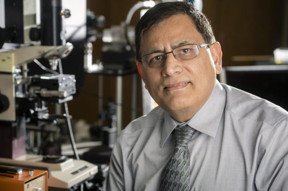 |
| This is Yogesh Vohra. CREDIT UAB |
Abstract:
Yogesh Vohra, Ph.D., uses microwave-plasma chemical vapor deposition to create thin crystal films of never-before-seen materials. This effort seeks materials that approach a diamond in hardness and are able to survive extreme pressure, temperature and corrosive environments. The search for new materials is motivated by the desire to overcome limitations of diamond, which tends to oxidize at temperatures higher than 600 degrees Celsius and also chemically reacts with ferrous metals.
New boron material of high hardness created by plasma chemical vapor deposition: The goal is material that approaches a diamond in hardness and can survive extreme pressure, temperature and corrosive environments
Birmingham, AL | Posted on April 17th, 2020Vohra, a professor and university scholar in the University of Alabama at Birmingham Department of Physics, now reports, in the journal Scientific Reports, synthesis of a novel boron-rich boron-carbide material. This film, grown on a 1-inch wafer of silicon, is chemically stable, has 37 percent the hardness of cubic diamond and acts as an insulator.
Equally important, experimental testing of the new material -- including X-ray diffraction and measurement of the material's hardness and Young's modulus -- agrees closely with predicted values computed by the UAB team of researchers led by Cheng-Chien Chen, Ph.D., assistant professor of physics at UAB. The predicted values come from first-principles analysis, which uses supercomputer-driven density functional theory calculations of positively charged nuclei and negatively charged electrons. Thus, Vohra, Chen and colleagues have both made a novel boron-carbon compound and have shown the predictive power of first principles analysis to foretell the properties of these materials.
The new material has the chemical formula B50C2, which means 50 atoms of boron and two atoms of carbon in each subunit of the crystal structure. The crucial issue is where the two carbon atoms are placed in each crystal subunit; insertion of the carbons at other sites leads to materials that are unstable and metallic. The precise placement of carbons is achieved by varying growth conditions.
The current B50C2 material was grown in a microwave plasma chemical vapor deposition system using hydrogen as the carrier gas and diborane -- 90 percent hydrogen gas, 10 percent B2H6 and parts per million carbon -- as the reactive gas. Samples were grown at a low pressure equivalent to the atmospheric pressure 15 miles above Earth. The substrate temperature was about 750 degrees Celsius.
"Boron-rich boron-carbide materials synthesis by chemical vapor deposition methods continues to be relatively unexplored and a challenging endeavor," Vohra said. "The challenge is to find the correct set of conditions that are favorable for growth of the desired phase."
"Our present studies provide validation of the density functional theory in predicting stable crystal structure and providing a metastable synthesis pathway for boron-rich boron-carbide material for applications under extreme conditions of pressure, temperature and corrosive environments."
###
Co-authors with Vohra and Chen for the paper, "First-principles predictions and synthesis of B50C2 by chemical vapor deposition," are Paul A. Baker, Wei-Chih Chen and Shane A. Catledge, UAB Department of Physics.
Support came from the National Science Foundation under cooperative agreement OIA1655280, with the help of NSF Major Research Instrumentation grant DMR1725016.
####
For more information, please click here
Contacts:
Jeff Hansen
205-209-2355
Copyright © University of Alabama at Birmingham
If you have a comment, please Contact us.Issuers of news releases, not 7th Wave, Inc. or Nanotechnology Now, are solely responsible for the accuracy of the content.
Bookmark:


| Related Links |
| Related News Press |
News and information
 Quantum computer improves AI predictions April 17th, 2026
Flexible sensor gains sensitivity under pressure April 17th, 2026
A reusable chip for particulate matter sensing April 17th, 2026
Detecting vibrational quantum beating in the predissociation dynamics of SF6 using time-resolved photoelectron spectroscopy April 17th, 2026
Thin films
Tiny nanosheets, big leap: A new sensor detects ethanol at ultra-low levels January 30th, 2026
Utilizing palladium for addressing contact issues of buried oxide thin film transistors April 5th, 2024
Understanding the mechanism of non-uniform formation of diamond film on tools: Paving the way to a dry process with less environmental impact March 24th, 2023
New study introduces the best graphite films: The work by Distinguished Professor Feng Ding at UNIST has been published in the October 2022 issue of Nature Nanotechnology November 4th, 2022
Govt.-Legislation/Regulation/Funding/Policy
Quantum computer improves AI predictions April 17th, 2026
Metasurfaces smooth light to boost magnetic sensing precision January 30th, 2026
New imaging approach transforms study of bacterial biofilms August 8th, 2025
Possible Futures
A fundamentally new therapeutic approach to cystic fibrosis: Nanobody repairs cellular defect April 17th, 2026
UC Irvine physicists discover method to reverse ‘quantum scrambling’ : The work addresses the problem of information loss in quantum computing system April 17th, 2026
Discoveries
Quantum computer improves AI predictions April 17th, 2026
Flexible sensor gains sensitivity under pressure April 17th, 2026
A reusable chip for particulate matter sensing April 17th, 2026
Detecting vibrational quantum beating in the predissociation dynamics of SF6 using time-resolved photoelectron spectroscopy April 17th, 2026
Materials/Metamaterials/Magnetoresistance
First real-time observation of two-dimensional melting process: Researchers at Mainz University unveil new insights into magnetic vortex structures August 8th, 2025
Researchers unveil a groundbreaking clay-based solution to capture carbon dioxide and combat climate change June 6th, 2025
A 1960s idea inspires NBI researchers to study hitherto inaccessible quantum states June 6th, 2025
Institute for Nanoscience hosts annual proposal planning meeting May 16th, 2025
Announcements
A fundamentally new therapeutic approach to cystic fibrosis: Nanobody repairs cellular defect April 17th, 2026
UC Irvine physicists discover method to reverse ‘quantum scrambling’ : The work addresses the problem of information loss in quantum computing system April 17th, 2026
Interviews/Book Reviews/Essays/Reports/Podcasts/Journals/White papers/Posters
A fundamentally new therapeutic approach to cystic fibrosis: Nanobody repairs cellular defect April 17th, 2026
UC Irvine physicists discover method to reverse ‘quantum scrambling’ : The work addresses the problem of information loss in quantum computing system April 17th, 2026
Tools
Metasurfaces smooth light to boost magnetic sensing precision January 30th, 2026
From sensors to smart systems: the rise of AI-driven photonic noses January 30th, 2026
Japan launches fully domestically produced quantum computer: Expo visitors to experience quantum computing firsthand August 8th, 2025
Aerospace/Space
Decoding hydrogen‑bond network of electrolyte for cryogenic durable aqueous zinc‑ion batteries January 30th, 2026
ICFO researchers overcome long-standing bottleneck in single photon detection with twisted 2D materials August 8th, 2025
Onion-like nanoparticles found in aircraft exhaust May 14th, 2025
 |
||
 |
||
| The latest news from around the world, FREE | ||
 |
||
|
|
||
| Premium Products | ||
 |
||
|
Only the news you want to read!
Learn More |
||
 |
||
|
Full-service, expert consulting
Learn More |
||
|
|
||