Home > Press > Moving faster in a crowd
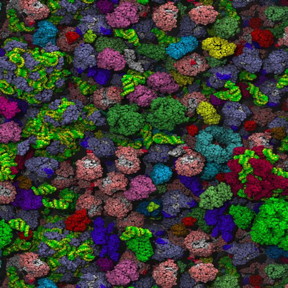 |
| Molecular model of the crowded interior of a bacterial cell. New research shows that particles can move more quickly through crowds if the crowding molecules are non-uniformly distributed. CREDIT Adrian H Elcock, CC BY 2.0 ( https://creativecommons.org/licenses/by/2.0/legalcode ) |
Abstract:
Cell particles move more quickly through a crowded cellular environment when the crowding molecules are non-uniformly distributed. New research also shows that particle transport in crowded cells can actually be faster than movement in a non-crowded environment as long as the particles are moving from densely crowded areas to less crowded areas. Understanding the rate at which particles move in these environments can help researchers to better understand cellular processes that require multiple molecules to "find" each other in the crowded environment of the cell. A paper describing the research, by a team of Penn State scientists, appears online in the journal ACS Nano.
Moving faster in a crowd
University Park, PA | Posted on August 30th, 2019"Crowding is common in living systems at different length scales, from busy hallways down to dense cellular cytoplasm," said Ayusman Sen, Verne M. Willaman Professor of Chemistry and Distinguished Professor of Chemistry and Chemical Engineering at Penn State and one of the leaders of the research team. "The insides of cells are very, very crowded with proteins, macromolecules and organelles. Molecules that are involved in chemical reactions required by the cell must be transported through this crowded, viscous environment to find their partner reagents. If the environment is uniformly crowded, movement slows, but we know that the inside of a cell is non-uniform; there are gradients of macromolecules and other species. So, we were interested in how these gradients would influence transport at the nanoscale."
The researchers compared the movement of various "tracer" colloids--insoluble particles suspended in a liquid--through different environments using microfluidics. A microfluidic device can be filled with different solutions in which the researchers establish gradients--from high to low--of "crowder" macro-molecules in the fluid. The tracers, which can be large or small, hard or soft and deformable, are fluorescently labeled allowing the researchers to track their movement with a confocal microscope.
"We were surprised to see that the tracers moved faster in gradients of crowders than they did through a fluid with no crowders at all," said Farzad Mohajerani, a graduate student in chemical engineering at Penn State and co-first author of the paper. "We think that the densely packed crowders actually put a pressure on the tracers to force them toward less dense areas. Large tracer molecules moved faster than small ones, and soft, deformable tracers moved faster than hard ones."
"The soft, deformable tracers are better representatives of actual species moving around in cells," said Matthew Collins, a graduate student in chemistry at Penn State and co-first author of the paper. "We think that they can move faster because, unlike hard particles, they can squeeze through tighter areas."
"Our experiments and model not only show that molecules can move faster through gradients of macromolecular crowding, we think that these rates of movement may increase further inside actual living cells where other active moving molecules could increase the crowding pressure," said Sen.
###
In addition to Sen, Collins, and Mohajerani, the research team at Penn State included Subhadip Ghosh, Rajarshi Guha, Tae-Hee Lee, Peter J. Butler, and Darrel Velegol. The research was funded by the U.S. National Science Foundation.
####
For more information, please click here
Contacts:
Sam Sholtis
814-865-1390
Copyright © Penn State
If you have a comment, please Contact us.Issuers of news releases, not 7th Wave, Inc. or Nanotechnology Now, are solely responsible for the accuracy of the content.
Bookmark:


| Related Links |
| Related News Press |
News and information
 Quantum computer improves AI predictions April 17th, 2026
Flexible sensor gains sensitivity under pressure April 17th, 2026
A reusable chip for particulate matter sensing April 17th, 2026
Detecting vibrational quantum beating in the predissociation dynamics of SF6 using time-resolved photoelectron spectroscopy April 17th, 2026
Microfluidics/Nanofluidics
Projecting light to dispense liquids: A new route to ultra-precise microdroplets January 30th, 2026
Implantable device shrinks pancreatic tumors: Taming pancreatic cancer with intratumoral immunotherapy April 14th, 2023
Researchers design new inks for 3D-printable wearable bioelectronics: Potential uses include printing electronic tattoos for medical tracking applications August 19th, 2022
Govt.-Legislation/Regulation/Funding/Policy
Quantum computer improves AI predictions April 17th, 2026
Metasurfaces smooth light to boost magnetic sensing precision January 30th, 2026
New imaging approach transforms study of bacterial biofilms August 8th, 2025
Possible Futures
A fundamentally new therapeutic approach to cystic fibrosis: Nanobody repairs cellular defect April 17th, 2026
UC Irvine physicists discover method to reverse ‘quantum scrambling’ : The work addresses the problem of information loss in quantum computing system April 17th, 2026
Nanomedicine
A fundamentally new therapeutic approach to cystic fibrosis: Nanobody repairs cellular defect April 17th, 2026
New molecular technology targets tumors and simultaneously silences two ‘undruggable’ cancer genes August 8th, 2025
New imaging approach transforms study of bacterial biofilms August 8th, 2025
Electrifying results shed light on graphene foam as a potential material for lab grown cartilage June 6th, 2025
Discoveries
Quantum computer improves AI predictions April 17th, 2026
Flexible sensor gains sensitivity under pressure April 17th, 2026
A reusable chip for particulate matter sensing April 17th, 2026
Detecting vibrational quantum beating in the predissociation dynamics of SF6 using time-resolved photoelectron spectroscopy April 17th, 2026
Announcements
A fundamentally new therapeutic approach to cystic fibrosis: Nanobody repairs cellular defect April 17th, 2026
UC Irvine physicists discover method to reverse ‘quantum scrambling’ : The work addresses the problem of information loss in quantum computing system April 17th, 2026
Interviews/Book Reviews/Essays/Reports/Podcasts/Journals/White papers/Posters
A fundamentally new therapeutic approach to cystic fibrosis: Nanobody repairs cellular defect April 17th, 2026
UC Irvine physicists discover method to reverse ‘quantum scrambling’ : The work addresses the problem of information loss in quantum computing system April 17th, 2026
Grants/Sponsored Research/Awards/Scholarships/Gifts/Contests/Honors/Records
Quantum computer improves AI predictions April 17th, 2026
Detecting vibrational quantum beating in the predissociation dynamics of SF6 using time-resolved photoelectron spectroscopy April 17th, 2026
Metasurfaces smooth light to boost magnetic sensing precision January 30th, 2026
Nanobiotechnology
A fundamentally new therapeutic approach to cystic fibrosis: Nanobody repairs cellular defect April 17th, 2026
New molecular technology targets tumors and simultaneously silences two ‘undruggable’ cancer genes August 8th, 2025
New imaging approach transforms study of bacterial biofilms August 8th, 2025
Electrifying results shed light on graphene foam as a potential material for lab grown cartilage June 6th, 2025
 |
||
 |
||
| The latest news from around the world, FREE | ||
 |
||
|
|
||
| Premium Products | ||
 |
||
|
Only the news you want to read!
Learn More |
||
 |
||
|
Full-service, expert consulting
Learn More |
||
|
|
||