Home > Press > From nata de coco to computer screens: Cellulose gets a chance to shine: Researchers at Osaka University meticulously measured the optical birefringence of highly aligned cellulose nanofibers, paving the way for sharper television, computer, and smartphone screens
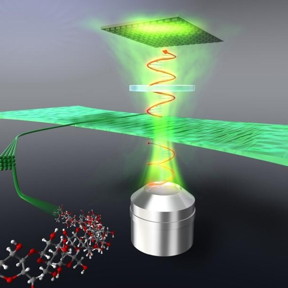 |
| Control of optical retardation by the aligned cellulose film. CREDIT Osaka University |
Abstract:
A team at the Institute of Scientific and Industrial Research at Osaka University has determined the optical parameters of cellulose molecules with unprecedented precision. They found that cellulose's intrinsic birefringence, which describes how a material reacts differently to light of various orientations, is powerful enough to be used in optical displays, such as flexible screens or electronic paper.
From nata de coco to computer screens: Cellulose gets a chance to shine: Researchers at Osaka University meticulously measured the optical birefringence of highly aligned cellulose nanofibers, paving the way for sharper television, computer, and smartphone screens
Osaka, Japan | Posted on April 19th, 2019Cellulose is an ancient material that may be poised for a major comeback. It has been utilized for millennia as the primary component of paper books, cotton clothing, and nata de coco, a tropical dessert made from coconut water. While books made of dead trees and plain old shirts might seem passé in world increasingly filled with tablets and smartphones, researchers at Osaka University have shown that cellulose might have just what it takes to make our modern electronic screens cheaper and provide sharper, more vibrant images.
Cellulose, a naturally occurring polymer, consists of many long molecular chains. Because of its rigidity and strength, cellulose helps maintain the structural integrity of the cell walls in plants. It makes up about 99% of the nanofibers that comprise nata de coco, and helps create its unique and tasty texture.
The team at Osaka University achieved better results using unidirectionally-aligned cellulose nanofiber films created by stretching hydrogels from nata de coco at various rates. Nata de coco nanofibers allow the cellulose chains to be straight on the molecular level, and this is helpful for the precise determination of the intrinsic birefringence--that is, the maximum birefringence of fully extended polymer chains. The researchers were also able to measure the birefringence more accurately through improvements in method. "Using high quality samples and methods, we were able to reliably determine the inherent birefringence of cellulose, for which very different values had been previously estimated," says senior author Masaya Nogi.
The main application the researchers envision is as light compensation films for liquid crystal displays (LCDs), since they operate by controlling the brightness of pixels with filters that allow only one orientation of light to pass through. Potentially, any smartphone, computer, or television that has an LCD screen could see improved contrast, along with reduced color unevenness and light leakage with the addition of cellulose nanofiber films.
"Cellulose nanofibers are promising light compensation materials for optoelectronics, such as flexible displays and electronic paper, since they simultaneously have good transparency, flexibility, dimensional stability, and thermal conductivity," says lead author Kojiro Uetani. "So look for this ancient material in your future high-tech devices."
####
About Osaka University
Osaka University was founded in 1931 as one of the seven imperial universities of Japan and now has expanded to one of Japan's leading comprehensive universities. The University has now embarked on open research revolution from a position as Japan's most innovative university and among the most innovative institutions in the world according to the Nature Index Innovation 2017. The university's ability to innovate from the stage of fundamental research through the creation of useful technology with economic impact stems from its broad disciplinary spectrum.
Website: https://resou.osaka-u.ac.jp/en/top
For more information, please click here
Contacts:
Saori Obayashi
81-661-055-886
Copyright © Osaka University
If you have a comment, please Contact us.Issuers of news releases, not 7th Wave, Inc. or Nanotechnology Now, are solely responsible for the accuracy of the content.
Bookmark:


| Related Links |
| Related News Press |
News and information
 Quantum computer improves AI predictions April 17th, 2026
Flexible sensor gains sensitivity under pressure April 17th, 2026
A reusable chip for particulate matter sensing April 17th, 2026
Detecting vibrational quantum beating in the predissociation dynamics of SF6 using time-resolved photoelectron spectroscopy April 17th, 2026
Display technology/LEDs/SS Lighting/OLEDs
Spinel-type sulfide semiconductors to operate the next-generation LEDs and solar cells For solar-cell absorbers and green-LED source October 3rd, 2025
Efficient and stable hybrid perovskite-organic light-emitting diodes with external quantum efficiency exceeding 40 per cent July 5th, 2024
Govt.-Legislation/Regulation/Funding/Policy
Quantum computer improves AI predictions April 17th, 2026
Metasurfaces smooth light to boost magnetic sensing precision January 30th, 2026
New imaging approach transforms study of bacterial biofilms August 8th, 2025
Possible Futures
A fundamentally new therapeutic approach to cystic fibrosis: Nanobody repairs cellular defect April 17th, 2026
UC Irvine physicists discover method to reverse ‘quantum scrambling’ : The work addresses the problem of information loss in quantum computing system April 17th, 2026
Discoveries
Quantum computer improves AI predictions April 17th, 2026
Flexible sensor gains sensitivity under pressure April 17th, 2026
A reusable chip for particulate matter sensing April 17th, 2026
Detecting vibrational quantum beating in the predissociation dynamics of SF6 using time-resolved photoelectron spectroscopy April 17th, 2026
Materials/Metamaterials/Magnetoresistance
First real-time observation of two-dimensional melting process: Researchers at Mainz University unveil new insights into magnetic vortex structures August 8th, 2025
Researchers unveil a groundbreaking clay-based solution to capture carbon dioxide and combat climate change June 6th, 2025
A 1960s idea inspires NBI researchers to study hitherto inaccessible quantum states June 6th, 2025
Institute for Nanoscience hosts annual proposal planning meeting May 16th, 2025
Announcements
A fundamentally new therapeutic approach to cystic fibrosis: Nanobody repairs cellular defect April 17th, 2026
UC Irvine physicists discover method to reverse ‘quantum scrambling’ : The work addresses the problem of information loss in quantum computing system April 17th, 2026
Interviews/Book Reviews/Essays/Reports/Podcasts/Journals/White papers/Posters
A fundamentally new therapeutic approach to cystic fibrosis: Nanobody repairs cellular defect April 17th, 2026
UC Irvine physicists discover method to reverse ‘quantum scrambling’ : The work addresses the problem of information loss in quantum computing system April 17th, 2026
 |
||
 |
||
| The latest news from around the world, FREE | ||
 |
||
|
|
||
| Premium Products | ||
 |
||
|
Only the news you want to read!
Learn More |
||
 |
||
|
Full-service, expert consulting
Learn More |
||
|
|
||