Home > Press > Wood-based Technology Creates Electricity from Heat (Nature Materials)
 |
Abstract:
Researchers at the University of Maryland have created a heat-to-electricity device that runs on ions that could someday harness the body’s heat to provide energy.
Wood-based Technology Creates Electricity from Heat (Nature Materials)
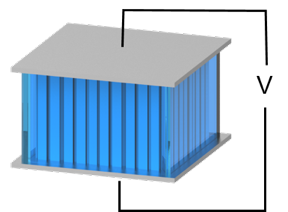
College Park, MD | Posted on March 25th, 2019Liangbing Hu and Robert Briber of the department of materials science, and Siddhartha Das of mechanical engineering, transformed a piece of wood into a flexible membrane that generates energy from the same type of electric current (ions) that the human body runs on. This energy is generated using charged channel walls and other unique properties of the wood’s natural nanostructures. With this new wood-based technology, they can use a small temperature differential to efficiently generate ionic voltage, as demonstrated in a paperpublished March 25 in the journal Nature Materials.
If you’ve ever been outside during a lightning storm, you’ve seen that generating charge between two very different temperatures is easy. But for small temperature differences, it is more difficult. Hu, Briber and Das tackled this challenge. Hu said they now have “demonstrated their proof-of-concept device to harvest low-grade heat using nanoionic behavior of processed wood nanostructures”.
Trees grow channels that move water between the roots and the leaves. These are made up of fractally-smaller channels, and at the level of a single cell, channels just nanometers or less across. The team has harnessed these channels to regulate ions.
The researchers used basswood, which is a fast-growing tree with low environmental impact. They treated the wood and removed two components – lignin, that makes the wood brown and adds strength, and hemicellulose, which winds around the layers of cells binding them together. This gives the remaining cellulose its signature flexibility. This process also converts the structure of the cellulose from type I to type II which is a key to enhancing ion conductivity.
A membrane, made of a thin slice of wood, was bordered by platinum electrodes, with sodium-based electrolyte infiltrated into the cellulose. The regulate the ion flow inside the tiny channels and generate electrical signal. “The charged channel walls can establish an electrical field that appears on the nanofibers and thus help effectively regulate ion movement under a thermal gradient,” said Tian Li, the first author of the paper.
Li said that the sodium ions in the electrolyte insert into the aligned channels, which is made possible by the crystal structure conversion of cellulose and by dissociation of the surface functional groups.
“We are the first to show that, this type of membrane, with its expansive arrays of aligned cellulose, can be used as a high-performance ion selective membrane by nanofluidics and molecular streaming and greatly extends the applications of sustainable cellulose into nanoionics,” Li summed up the paper.
This latest work builds on, and adds to, extensive previous UMD research to develop novel and potentially high impact applications of modified wood.
Current affiliations for the researchers are:
University of Maryland College Park – Tian Li, Xin Zhang, Steven D. Lacey, Ruiyu Mi, Feng Jiang, Jianwei Song, Jiaqi Dai, Yonggang Yao, Robert M. Briber & Liangbing Hu of the Department of Materials Science and Engineering, and Guang Chen & Siddhartha Das, Department of Mechanical Engineering
University of Colorado – Xinpeng Zhao & Ronggui Yang, Department of Mechanical Engineering
University of British Columbia – Feng Jiang & Zhongqi Liu, Department of Wood Science.
####
For more information, please click here
Contacts:
Martha J. R. Heil
Science Communicator, Maryland NanoCenter
301-405-0876 (office)
626-354-5613 (cell)
office: 1118 Kim Engineering Building
mail: Mailroom, A.V. Williams Building, 8223 Paint Branch Dr.
University of Maryland
College Park, MD 20742
Copyright © University of Maryland
If you have a comment, please Contact us.Issuers of news releases, not 7th Wave, Inc. or Nanotechnology Now, are solely responsible for the accuracy of the content.
Bookmark:


| Related Links |
 UMD Researchers Create Super Wood Stronger Than Most Metals (Feb. 2018):
Wood Windows are Cooler than Glass (June 2013):
A Battery Made of Wood? (August 2016)
| Related News Press |
News and information
Quantum computer improves AI predictions April 17th, 2026
Flexible sensor gains sensitivity under pressure April 17th, 2026
A reusable chip for particulate matter sensing April 17th, 2026
Detecting vibrational quantum beating in the predissociation dynamics of SF6 using time-resolved photoelectron spectroscopy April 17th, 2026
Possible Futures
A fundamentally new therapeutic approach to cystic fibrosis: Nanobody repairs cellular defect April 17th, 2026
UC Irvine physicists discover method to reverse ‘quantum scrambling’ : The work addresses the problem of information loss in quantum computing system April 17th, 2026
Discoveries
Quantum computer improves AI predictions April 17th, 2026
Flexible sensor gains sensitivity under pressure April 17th, 2026
A reusable chip for particulate matter sensing April 17th, 2026
Detecting vibrational quantum beating in the predissociation dynamics of SF6 using time-resolved photoelectron spectroscopy April 17th, 2026
Announcements
A fundamentally new therapeutic approach to cystic fibrosis: Nanobody repairs cellular defect April 17th, 2026
UC Irvine physicists discover method to reverse ‘quantum scrambling’ : The work addresses the problem of information loss in quantum computing system April 17th, 2026
Interviews/Book Reviews/Essays/Reports/Podcasts/Journals/White papers/Posters
A fundamentally new therapeutic approach to cystic fibrosis: Nanobody repairs cellular defect April 17th, 2026
UC Irvine physicists discover method to reverse ‘quantum scrambling’ : The work addresses the problem of information loss in quantum computing system April 17th, 2026
Energy
Sensors innovations for smart lithium-based batteries: advancements, opportunities, and potential challenges August 8th, 2025
Simple algorithm paired with standard imaging tool could predict failure in lithium metal batteries August 8th, 2025
 |
||
 |
||
| The latest news from around the world, FREE | ||
 |
||
|
|
||
| Premium Products | ||
 |
||
|
Only the news you want to read!
Learn More |
||
 |
||
|
Full-service, expert consulting
Learn More |
||
|
|
||