Home > Press > Bringing the atomic world into full color: Researchers turn atomic force microscope measurements into color images
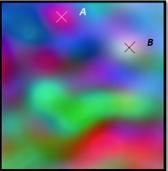 |
| This is an example of silicon atoms represented in color. CREDIT 2017 Hideki Kawakatsu, Kawakatsu Laboratory, Institute of Industrial Science, The University of Tokyo. |
Abstract:
A French and Japanese research group has developed a new way of visualizing the atomic world by turning data scanned by an atomic force microscope into clear color images. The newly developed method, which enables observation of materials and substances like alloys, semiconductors, and chemical compounds in a relatively short time, holds promise of becoming widely used in the research and development of surfaces and devices.
Bringing the atomic world into full color: Researchers turn atomic force microscope measurements into color images
Paris, France and Tokyo, Japan | Posted on October 19th, 2017Individual molecules and atoms are much smaller than the wavelengths of light that we can see. Visualizing such tiny structures requires special instruments that often provide black-and-white representations of the positions of atoms. Atomic force microscopes (AFMs) are among the most powerful tools available for probing surfaces at the atomic scale level. A nanoscale tip moving over a surface can not only give all kinds of information about the physical positions of atoms but also give data on their chemical properties and behavior. However, much of this information is lost when the AFM signals are processed.
Now, researchers centered at the University of Tokyo's Institute of Industrial Science (IIS), led by Professor Hideki Kawakatsu, have created a new way of operating AFMs and visualizing the data to extract structural and chemical information into clear, full-color images. These findings were recently published in Applied Physics Letters.
"AFM is an extremely versatile technique and our approach of linking the AFM tip height to the bottom of the frequency curve enabled us to perform measurements at the same time but without the risk of losing information from the surface," study lead author Pierre Etienne Allain, a LIMMS/CNRS-IIS postdoctoral researcher, says.
People often perform AFM measurements by keeping the AFM tip at a fixed height while measuring changes in its vibrations as it interacts with the surface. Alternatively, it is possible to move the AFM tip up and down so that the frequency of the vibrations stays the same. Both these approaches have their advantages, but they also carry disadvantages in that one can be very time consuming, and the other can result in loss of information.
The IIS-led researchers developed a way of moving the AFM tip and transforming the data so the tip stays above the surface in a position where the vibrational frequency is strongly influenced by the surface.
Another benefit of this approach is that the model yields three variables, to which the researchers assigned the colors red, blue, and green, respectively, thereby enabling them to produce full-color images. They also successfully tested their method on a silicon surface.
"If the colors in the image are the same, we can say the signals come from the same type of atom and surroundings," coauthor and fellow postdoctoral researcher Denis Damiron says. "This new way of representing complex chemical and physical information from a surface could let us probe the movements and behavior of atoms in unprecedented detail."
Collaborating institutions:
CNRS
The University of Electro-Communications
Funding:
CNRS, MEXT, JST, IIS UTokyo, the JSPS Postdoctoral Fellowship and Core-to-Core Programs
####
About University of Tokyo
The University of Tokyo is Japan's leading university and one of the world's top research universities. The vast research output of some 6,000 researchers is published in the world's top journals across the arts and sciences. Our vibrant student body of around 15,000 undergraduate and 15,000 graduate students includes over 2,000 international students. Find out more at http://www.u-tokyo.ac.jp/en/ or follow us on Twitter at @UTokyo_News_en.
For more information, please click here
Contacts:
Research contact:
Professor Hideki Kawakatsu
Centre for Interdisciplinary Research on Micro-Nano Methods (CIRMM), Institute of Industrial Science, The University of Tokyo
4-6-1 Komaba, Meguro-ku, Tokyo 153-8505, Japan
Tel: +81-3-5452-6201
Fax:+81-3-5452-6199
Email:
Press officer contact:
Megumi Ijichi
Public Relations Office
Institute of Industrial Science, The University of Tokyo
4-6-1 Komaba, Meguro-ku, Tokyo 153-8505, Japan
Tel: +81-3-5452-6738
Fax: +81-3-5452-6746
Email:
Copyright © University of Tokyo
If you have a comment, please Contact us.Issuers of news releases, not 7th Wave, Inc. or Nanotechnology Now, are solely responsible for the accuracy of the content.
Bookmark:


| Related Links |
 Institute of Industrial Science, The University of Tokyo:
| Related News Press |
News and information
Quantum computer improves AI predictions April 17th, 2026
Flexible sensor gains sensitivity under pressure April 17th, 2026
A reusable chip for particulate matter sensing April 17th, 2026
Detecting vibrational quantum beating in the predissociation dynamics of SF6 using time-resolved photoelectron spectroscopy April 17th, 2026
Imaging
Simple algorithm paired with standard imaging tool could predict failure in lithium metal batteries August 8th, 2025
First real-time observation of two-dimensional melting process: Researchers at Mainz University unveil new insights into magnetic vortex structures August 8th, 2025
New imaging approach transforms study of bacterial biofilms August 8th, 2025
Videos/Movies
ICFO researchers overcome long-standing bottleneck in single photon detection with twisted 2D materials August 8th, 2025
Govt.-Legislation/Regulation/Funding/Policy
Quantum computer improves AI predictions April 17th, 2026
Metasurfaces smooth light to boost magnetic sensing precision January 30th, 2026
New imaging approach transforms study of bacterial biofilms August 8th, 2025
Possible Futures
A fundamentally new therapeutic approach to cystic fibrosis: Nanobody repairs cellular defect April 17th, 2026
UC Irvine physicists discover method to reverse ‘quantum scrambling’ : The work addresses the problem of information loss in quantum computing system April 17th, 2026
Chip Technology
A reusable chip for particulate matter sensing April 17th, 2026
Metasurfaces smooth light to boost magnetic sensing precision January 30th, 2026
Discoveries
Quantum computer improves AI predictions April 17th, 2026
Flexible sensor gains sensitivity under pressure April 17th, 2026
A reusable chip for particulate matter sensing April 17th, 2026
Detecting vibrational quantum beating in the predissociation dynamics of SF6 using time-resolved photoelectron spectroscopy April 17th, 2026
Announcements
A fundamentally new therapeutic approach to cystic fibrosis: Nanobody repairs cellular defect April 17th, 2026
UC Irvine physicists discover method to reverse ‘quantum scrambling’ : The work addresses the problem of information loss in quantum computing system April 17th, 2026
Interviews/Book Reviews/Essays/Reports/Podcasts/Journals/White papers/Posters
A fundamentally new therapeutic approach to cystic fibrosis: Nanobody repairs cellular defect April 17th, 2026
UC Irvine physicists discover method to reverse ‘quantum scrambling’ : The work addresses the problem of information loss in quantum computing system April 17th, 2026
Tools
Metasurfaces smooth light to boost magnetic sensing precision January 30th, 2026
From sensors to smart systems: the rise of AI-driven photonic noses January 30th, 2026
Japan launches fully domestically produced quantum computer: Expo visitors to experience quantum computing firsthand August 8th, 2025
Grants/Sponsored Research/Awards/Scholarships/Gifts/Contests/Honors/Records
Quantum computer improves AI predictions April 17th, 2026
Detecting vibrational quantum beating in the predissociation dynamics of SF6 using time-resolved photoelectron spectroscopy April 17th, 2026
Metasurfaces smooth light to boost magnetic sensing precision January 30th, 2026
Research partnerships
Lab to industry: InSe wafer-scale breakthrough for future electronics August 8th, 2025
HKU physicists uncover hidden order in the quantum world through deconfined quantum critical points April 25th, 2025
 |
||
 |
||
| The latest news from around the world, FREE | ||
 |
||
|
|
||
| Premium Products | ||
 |
||
|
Only the news you want to read!
Learn More |
||
 |
||
|
Full-service, expert consulting
Learn More |
||
|
|
||