Home > Press > Nano 'sandwich' offers unique properties: Rice University researchers simulate two-dimensional hybrids for optoelectronics
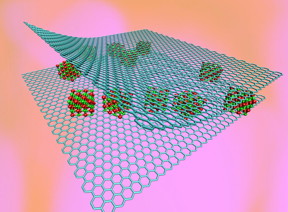 |
| Nanoclusters of magnesium oxide sandwiched between layers of graphene make a compound with unique electronic and optical properties, according to researchers at Rice University who made computer simulations of the material. CREDIT Lei Tao/Rice University |
Abstract:
Rice University researchers have modeled a nanoscale sandwich, the first in what they hope will become a molecular deli for materials scientists.
Nano 'sandwich' offers unique properties: Rice University researchers simulate two-dimensional hybrids for optoelectronics
Houston, TX | Posted on February 27th, 2017Their recipe puts two slices of atom-thick graphene around nanoclusters of magnesium oxide that give the super-strong, conductive material expanded optoelectronic properties.
Rice materials scientist Rouzbeh Shahsavari and his colleagues built computer simulations of the compound and found it would offer features suitable for sensitive molecular sensing, catalysis and bio-imaging. Their work could help researchers design a range of customizable hybrids of two- and three-dimensional structures with encapsulated molecules, Shahsavari said.
The research appears this month in the Royal Society of Chemistry journal Nanoscale.
The scientists were inspired by experiments elsewhere in which various molecules were encapsulated using van der Waals forces to draw components together. The Rice-led study was the first to take a theoretical approach to defining the electronic and optical properties of one of those "made" samples, two-dimensional magnesium oxide in bilayer graphene, Shahsavari said.
"We knew if there was an experiment already performed, we would have a great reference point that would make it easier to verify our computations, thus allowing more reliable expansion of our computational results to identify performance trends beyond the reach of experiments," Shahsavari said.
Graphene on its own has no band gap - the characteristic that makes a material a semiconductor. But the hybrid does, and this band gap could be tunable, depending on the components, Shahsavari said. The enhanced optical properties are also tunable and useful, he said.
"We saw that while this single flake of magnesium oxide absorbed one kind of light emission, when it was trapped between two layers of graphene, it absorbed a wide spectrum. That could be an important mechanism for sensors," he said.
Shahsavari said his group's theory should be applicable to other two-dimensional materials, like hexagonal boron-nitride, and molecular fillings. "There is no single material that can solve all the technical problems of the world," he said. "It always comes down to making hybrid materials to synergize the best features of multiple components to do a specific job. My group is working on these hybrid materials by tweaking their components and structures to meet new challenges."
###
Farzaneh Shayeganfar, a visiting research scientist at Rice and researcher at Shahid Rajaee Teacher Training University, Tehran, Iran, is lead author of the paper. Co-authors are Javad Beheshtiyan and Mehdi Neek-Amal, both of Shahid Rajaee and the University of Antwerp, Belgium.
Rice University and the Iran Science Elites Federation supported the research. Computing resources were supplied by Rice's National Science Foundation-supported DAVinCI supercomputer administered by Rice's Center for Research Computing and were procured in partnership with Rice's Ken Kennedy Institute for Information Technology.
####
About Rice University
Located on a 300-acre forested campus in Houston, Rice University is consistently ranked among the nation's top 20 universities by U.S. News & World Report. Rice has highly respected schools of Architecture, Business, Continuing Studies, Engineering, Humanities, Music, Natural Sciences and Social Sciences and is home to the Baker Institute for Public Policy. With 3,879 undergraduates and 2,861 graduate students, Rice's undergraduate student-to-faculty ratio is 6-to-1. Its residential college system builds close-knit communities and lifelong friendships, just one reason why Rice is ranked No. 1 for happiest students and for lots of race/class interaction by the Princeton Review. Rice is also rated as a best value among private universities by Kiplinger's Personal Finance. To read "What they're saying about Rice," go to http://tinyurl.com/RiceUniversityoverview .
Follow Rice News and Media Relations via Twitter @RiceUNews
For more information, please click here
Contacts:
David Ruth
713-348-6327
Copyright © Rice University
If you have a comment, please Contact us.Issuers of news releases, not 7th Wave, Inc. or Nanotechnology Now, are solely responsible for the accuracy of the content.
Bookmark:


| Related Links |
 Multiscale Materials Laboratory home page:
George R. Brown School of Engineering:
Rice Department of Civil and Environmental Engineering:
Rice Department of Materials Science and NanoEngineering:
| Related News Press |
News and information
Decoding hydrogen‑bond network of electrolyte for cryogenic durable aqueous zinc‑ion batteries January 30th, 2026
COF scaffold membrane with gate‑lane nanostructure for efficient Li+/Mg2+ separation January 30th, 2026
MXene nanomaterials enter a new dimension Multilayer nanomaterial: MXene flakes created at Drexel University show new promise as 1D scrolls January 30th, 2026
2 Dimensional Materials
MXene nanomaterials enter a new dimension Multilayer nanomaterial: MXene flakes created at Drexel University show new promise as 1D scrolls January 30th, 2026
ICFO researchers overcome long-standing bottleneck in single photon detection with twisted 2D materials August 8th, 2025
First real-time observation of two-dimensional melting process: Researchers at Mainz University unveil new insights into magnetic vortex structures August 8th, 2025
Closing the gaps — MXene-coating filters can enhance performance and reusability February 28th, 2025
Graphene/ Graphite
Electrifying results shed light on graphene foam as a potential material for lab grown cartilage June 6th, 2025
Breakthrough in proton barrier films using pore-free graphene oxide: Kumamoto University researchers achieve new milestone in advanced coating technologies September 13th, 2024
Govt.-Legislation/Regulation/Funding/Policy
Metasurfaces smooth light to boost magnetic sensing precision January 30th, 2026
New imaging approach transforms study of bacterial biofilms August 8th, 2025
Electrifying results shed light on graphene foam as a potential material for lab grown cartilage June 6th, 2025
Possible Futures
Decoding hydrogen‑bond network of electrolyte for cryogenic durable aqueous zinc‑ion batteries January 30th, 2026
COF scaffold membrane with gate‑lane nanostructure for efficient Li+/Mg2+ separation January 30th, 2026
Chip Technology
Metasurfaces smooth light to boost magnetic sensing precision January 30th, 2026
Beyond silicon: Electronics at the scale of a single molecule January 30th, 2026
Lab to industry: InSe wafer-scale breakthrough for future electronics August 8th, 2025
Optical computing/Photonic computing
ICFO researchers overcome long-standing bottleneck in single photon detection with twisted 2D materials August 8th, 2025
Programmable electron-induced color router array May 14th, 2025
Nanophotonic platform boosts efficiency of nonlinear-optical quantum teleportation April 25th, 2025
Groundbreaking research unveils unified theory for optical singularities in photonic microstructures December 13th, 2024
Sensors
Tiny nanosheets, big leap: A new sensor detects ethanol at ultra-low levels January 30th, 2026
From sensors to smart systems: the rise of AI-driven photonic noses January 30th, 2026
Sensors innovations for smart lithium-based batteries: advancements, opportunities, and potential challenges August 8th, 2025
Discoveries
From sensors to smart systems: the rise of AI-driven photonic noses January 30th, 2026
Decoding hydrogen‑bond network of electrolyte for cryogenic durable aqueous zinc‑ion batteries January 30th, 2026
COF scaffold membrane with gate‑lane nanostructure for efficient Li+/Mg2+ separation January 30th, 2026
Announcements
Decoding hydrogen‑bond network of electrolyte for cryogenic durable aqueous zinc‑ion batteries January 30th, 2026
COF scaffold membrane with gate‑lane nanostructure for efficient Li+/Mg2+ separation January 30th, 2026
Photonics/Optics/Lasers
Metasurfaces smooth light to boost magnetic sensing precision January 30th, 2026
From sensors to smart systems: the rise of AI-driven photonic noses January 30th, 2026
ICFO researchers overcome long-standing bottleneck in single photon detection with twisted 2D materials August 8th, 2025
Research partnerships
Lab to industry: InSe wafer-scale breakthrough for future electronics August 8th, 2025
HKU physicists uncover hidden order in the quantum world through deconfined quantum critical points April 25th, 2025
 |
||
 |
||
| The latest news from around the world, FREE | ||
 |
||
|
|
||
| Premium Products | ||
 |
||
|
Only the news you want to read!
Learn More |
||
 |
||
|
Full-service, expert consulting
Learn More |
||
|
|
||