Home > Press > Next-generation illumination using silicon quantum dot-based white-blue LED
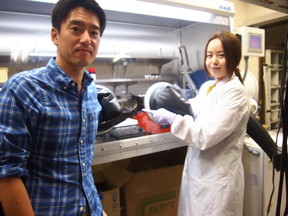 |
| Professor Ken-ichi Saitow, Natural Science Center for Basic Research and Development, Hiroshima University and Graduate student Yunzi Xin, Graduate School of Science, Hiroshima University, have fabricated an Si QD hybrid LED.
CREDIT: Natural Science Center for Basic Research and Development, Hiroshima University |
Abstract:
A Si quantum dot (QD)-based hybrid inorganic/organic light-emitting diode (LED) that exhibits white-blue electroluminescence has been fabricated by Professor Ken-ichi SAITOW (Natural Science Center for Basic Research and Development, Hiroshima University), Graduate student Yunzi XIN (Graduate School of Science, Hiroshima University), and their collaborators. A hybrid LED is expected to be a next-generation illumination device for producing flexible lighting and display, and this is achieved for the Si QD-based white-blue LED. For details, refer to "White-blue electroluminescence from a Si quantum dot hybrid light-emitting diode," in Applied Physics Letters; DOI: 10.1063/1.4921415.
Next-generation illumination using silicon quantum dot-based white-blue LED
Hiroshima, Japan | Posted on June 7th, 2015The Si QD hybrid LED was developed using a simple method; almost all processes were solution-based and conducted at ambient temperature and pressure. Conductive polymer solutions and a colloidal Si QD solution were deposited on the glass substrate. The current and optical power densities of the LED are, respectively, 280 and 350 times greater than those reported previously for such a device at the same voltage (6 V). In addition, the active area of the LED is 4 mm2, which is 40 times larger than that of a typical commercial LED; the thickness of the LED is 0.5 mm.
Professor Saitow stated, "QD LED has attracted significant attention as a next-generation LED. Although several breakthroughs will be required for achieving implementation, a QD-based hybrid LED allows us to give so fruitful feature that we cannot imagine."
###
Regarding quantum dots (QDs): Semiconductor QDs can produce full-color luminescence through tuning of the particle size. QDs have attracted significant attention as potential components of next-generation solid-state light sources, including LEDs.
####
For more information, please click here
Contacts:
Norifumi Miyokawa
Copyright © Hiroshima University
If you have a comment, please Contact us.Issuers of news releases, not 7th Wave, Inc. or Nanotechnology Now, are solely responsible for the accuracy of the content.
Bookmark:


| Related News Press |
News and information
 Quantum computer improves AI predictions April 17th, 2026
Flexible sensor gains sensitivity under pressure April 17th, 2026
A reusable chip for particulate matter sensing April 17th, 2026
Detecting vibrational quantum beating in the predissociation dynamics of SF6 using time-resolved photoelectron spectroscopy April 17th, 2026
Display technology/LEDs/SS Lighting/OLEDs
Spinel-type sulfide semiconductors to operate the next-generation LEDs and solar cells For solar-cell absorbers and green-LED source October 3rd, 2025
Efficient and stable hybrid perovskite-organic light-emitting diodes with external quantum efficiency exceeding 40 per cent July 5th, 2024
Govt.-Legislation/Regulation/Funding/Policy
Quantum computer improves AI predictions April 17th, 2026
Metasurfaces smooth light to boost magnetic sensing precision January 30th, 2026
New imaging approach transforms study of bacterial biofilms August 8th, 2025
Discoveries
Quantum computer improves AI predictions April 17th, 2026
Flexible sensor gains sensitivity under pressure April 17th, 2026
A reusable chip for particulate matter sensing April 17th, 2026
Detecting vibrational quantum beating in the predissociation dynamics of SF6 using time-resolved photoelectron spectroscopy April 17th, 2026
Announcements
A fundamentally new therapeutic approach to cystic fibrosis: Nanobody repairs cellular defect April 17th, 2026
UC Irvine physicists discover method to reverse ‘quantum scrambling’ : The work addresses the problem of information loss in quantum computing system April 17th, 2026
Interviews/Book Reviews/Essays/Reports/Podcasts/Journals/White papers/Posters
A fundamentally new therapeutic approach to cystic fibrosis: Nanobody repairs cellular defect April 17th, 2026
UC Irvine physicists discover method to reverse ‘quantum scrambling’ : The work addresses the problem of information loss in quantum computing system April 17th, 2026
Quantum Dots/Rods
A new kind of magnetism November 17th, 2023
IOP Publishing celebrates World Quantum Day with the announcement of a special quantum collection and the winners of two prestigious quantum awards April 14th, 2023
Qubits on strong stimulants: Researchers find ways to improve the storage time of quantum information in a spin rich material January 27th, 2023
NIST’s grid of quantum islands could reveal secrets for powerful technologies November 18th, 2022
 |
||
 |
||
| The latest news from around the world, FREE | ||
 |
||
|
|
||
| Premium Products | ||
 |
||
|
Only the news you want to read!
Learn More |
||
 |
||
|
Full-service, expert consulting
Learn More |
||
|
|
||