Home > Press > Desirable defects: A new meta-material based on colloids and liquid crystals
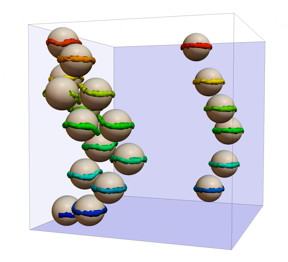 |
| This is a simulation of colloids in liquid crystals. CREDIT: SISSA |
Abstract:
"Generally, flaws are the last thing you'd want in a liquid crystal", explains Giuseppe D'Adamo, postdoctoral fellow at SISSA. "However, this new method allows us to exploit the defects in the material to our advantage". D'Adamo is first author of a paper just published in Physical Review Letters. The study made computer models of colloidal suspensions in liquid crystals subjected to electrical fields modulated over time. Colloids are particles in suspension (i.e., a condition halfway between dispersion and solution) in a liquid.
Desirable defects: A new meta-material based on colloids and liquid crystals
Trieste, Italy | Posted on April 30th, 2015These composite materials have been receiving plenty of attention for their optical properties for some time now, but the use of electrical fields to modify them at will is an absolute novelty. "Our simulations demonstrate that by switching on or off an electrical field of appropriate intensity we can re-order the colloids by arranging them into columns or planes", comments Cristian Micheletti of SISSA, co-author of the paper. "This easy-to-control plasticity could make the material suitable for optical-electronic devices such as e-readers, for example".
Liquid crystals are particular types of liquids. In a normal liquid, molecules have no systematic arrangement and, viewed from any angle, they always appear the same. The molecules forming liquid crystals, by contrast, are arranged in precise patterns often dictated by their shape. To get an idea of what happens in a liquid crystal, imagine a fluid made up of tiny needles which, instead of being arranged chaotically, all point in the same direction. This also means that if we look at the liquid from different viewpoints it will change in appearance, for example it might appear lighter or darker (have you ever seen this happen in LCD monitors, especially the older models?).
"The useful natural tendency of liquid crystal molecules to spontaneously arrange themselves in a certain pattern can be counteracted by introducing colloids in the fluid. In our case, we used microscopic spherical particles, which 'force' the molecules coming into contact with their surface to adapt and rotate in a different direction" explains D'Adamo. "This creates 'defect lines' in the material, i.e., circumscribed variations in the orientation of molecules which result in a local change in the optical properties of the medium".
More in detail...
These defect lines have an important effect: they enable remote interactions among colloidal particles, by holding them together as if they were thin strings. "Liquid crystal molecules tend to align along the electrical field. By switching the field on and off we create competition between the spontaneous order of the liquid crystal, the order dictated by the surface of the colloidal particles and, finally, the order created by the electrical potential", says Micheletti. "This competition produces many defect lines that act on the colloids by moving them or clustering them".
"It's a bit like pulling the invisible strings of a puppet: by carefully modulating the electrical fields we can, in principle, make all the particles move and arrange them as we like, by creating defect lines with the shape we want" continues D'Adamo. "An important detail is that the colloidal configurations are metastable, which means that once the electrical field has been switched off the colloids remain in their last position for a very long time".
In brief, this implies that the system only requires energy when it changes configuration, a major saving. "In this respect, the method works like the electronic ink used in digital readers, and it would be interesting to explore its applicability in this sense", concludes Micheletti. The study, carried out with the collaboration of SISSA, the University of Edinburgh and the University of Padova, has been included as an Editors' Suggestion among the Highlights of the journal Physical Review Letters.
####
For more information, please click here
Contacts:
federica sgorbissa
0039-040-378-7644
Copyright © International School of Advanced Studies (SISSA)
If you have a comment, please Contact us.Issuers of news releases, not 7th Wave, Inc. or Nanotechnology Now, are solely responsible for the accuracy of the content.
Bookmark:


| Related Links |
| Related News Press |
News and information
 Quantum computer improves AI predictions April 17th, 2026
Flexible sensor gains sensitivity under pressure April 17th, 2026
A reusable chip for particulate matter sensing April 17th, 2026
Detecting vibrational quantum beating in the predissociation dynamics of SF6 using time-resolved photoelectron spectroscopy April 17th, 2026
Display technology/LEDs/SS Lighting/OLEDs
Spinel-type sulfide semiconductors to operate the next-generation LEDs and solar cells For solar-cell absorbers and green-LED source October 3rd, 2025
Efficient and stable hybrid perovskite-organic light-emitting diodes with external quantum efficiency exceeding 40 per cent July 5th, 2024
Discoveries
Quantum computer improves AI predictions April 17th, 2026
Flexible sensor gains sensitivity under pressure April 17th, 2026
A reusable chip for particulate matter sensing April 17th, 2026
Detecting vibrational quantum beating in the predissociation dynamics of SF6 using time-resolved photoelectron spectroscopy April 17th, 2026
Materials/Metamaterials/Magnetoresistance
First real-time observation of two-dimensional melting process: Researchers at Mainz University unveil new insights into magnetic vortex structures August 8th, 2025
Researchers unveil a groundbreaking clay-based solution to capture carbon dioxide and combat climate change June 6th, 2025
A 1960s idea inspires NBI researchers to study hitherto inaccessible quantum states June 6th, 2025
Institute for Nanoscience hosts annual proposal planning meeting May 16th, 2025
Announcements
A fundamentally new therapeutic approach to cystic fibrosis: Nanobody repairs cellular defect April 17th, 2026
UC Irvine physicists discover method to reverse ‘quantum scrambling’ : The work addresses the problem of information loss in quantum computing system April 17th, 2026
Interviews/Book Reviews/Essays/Reports/Podcasts/Journals/White papers/Posters
A fundamentally new therapeutic approach to cystic fibrosis: Nanobody repairs cellular defect April 17th, 2026
UC Irvine physicists discover method to reverse ‘quantum scrambling’ : The work addresses the problem of information loss in quantum computing system April 17th, 2026
 |
||
 |
||
| The latest news from around the world, FREE | ||
 |
||
|
|
||
| Premium Products | ||
 |
||
|
Only the news you want to read!
Learn More |
||
 |
||
|
Full-service, expert consulting
Learn More |
||
|
|
||