Home > Press > Silver implant nanotech killing infections: NC State Industrial & Systems Engineering Research Team Arms Implants With Battery-Activated Nanotechnology
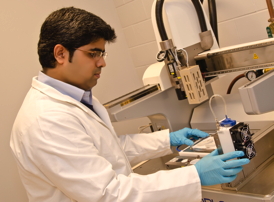 |
| Rohan Shirwalker |
Abstract:
As the number of joint replacement surgeries in the U.S. grows, so are concerns about the complications of infection from antibiotic-resistant "superbugs." Biomedical engineers at NC State University are fighting back by developing nanotechnology built directly into orthopedic implants using a battery-activated device to power an army of microscopic germ-killers. Even antibiotic-resistant bacteria such as MRSA are on the hit list.
Silver implant nanotech killing infections: NC State Industrial & Systems Engineering Research Team Arms Implants With Battery-Activated Nanotechnology
Raleigh, NC | Posted on March 14th, 2015At the NC State Department of Industrial and Systems Engineering (ISE), one of the nation's leading engineering departments specializing in advanced systems and processes, researchers have been engineering ways to apply a low-intensity electrical charge to a silver-titanium implant, releasing low-toxicity silver ions that kill or neutralize bacteria. The power source, similar to a watch battery, can be integrated into the implant design. The body's own fluids act as a conducting medium between battery and silver, enabling the low-level charge. Broad application of the system could result in a milestone achievement in the fight against infection.
Research and testing conducted by Dr. Rohan Shirwaiker (ISE Assistant Professor and Adjunct Assistant Professor of Biomedical Engineering) and PhD candidate George Tan has shown a 99% decrease in bacteria growth on and around implants after 24 hours and an infection-free environment after 48 hours. Shirwaiker and Tan are also exploring the possibility of a smartphone app to control the power source and the release of silver ions remotely, and track the biophysical activity around the implant area.
"Silver has long been known for its anti-bacterial properties, but first it must ionize to be effective," said Shirwaiker. "The breakthrough was in demonstrating that a little electric current to the silver on the implant releases the ion particles, which attach to bacteria cells and either kill them or prevent them from replicating."
At a recent conference of the American Academy of Orthopedic Surgeons, a presentation by Shirwaiker received top honors, naming him Best Young Investigator. Shirwaiker was the only engineer among the medical researchers invited to showcase their work. A study conducted in collaboration with University of North Carolina Department of Orthopaedics to investigate the performance of implant prototypes in rats is currently in review in a leading biomedical journal.
"What we are exploring now is how to precisely control the level of silver that is released so that no healthy cells are compromised," said Tan. "This is a system that could potentially be incorporated into any type of surgical implant."
There are over a million joint replacement surgeries performed each year in the U.S. alone, and treatments for post-surgical infections cost the healthcare system more than $1.6 billion annually. Innovations in silver microbial technology could eventually have a wide-ranging impact on the healthcare industry while improving outcomes and quality of life for patients.
####
About North Carolina State University
NC State University’s Edward P. Fitts Department of Industrial and Systems Engineering is among the top ranked programs in the country. The department brings together industry professionals and academic leaders across innovative and cutting edge curriculum and technology development, including regenerative medicine, health systems and 3D printing.
For more information, please click here
Contacts:
Charles Upchurch
(919) 277-1175
Copyright © North Carolina State University
If you have a comment, please Contact us.Issuers of news releases, not 7th Wave, Inc. or Nanotechnology Now, are solely responsible for the accuracy of the content.
Bookmark:


| Related News Press |
News and information
 Quantum computer improves AI predictions April 17th, 2026
Flexible sensor gains sensitivity under pressure April 17th, 2026
A reusable chip for particulate matter sensing April 17th, 2026
Detecting vibrational quantum beating in the predissociation dynamics of SF6 using time-resolved photoelectron spectroscopy April 17th, 2026
Nanomedicine
A fundamentally new therapeutic approach to cystic fibrosis: Nanobody repairs cellular defect April 17th, 2026
New molecular technology targets tumors and simultaneously silences two ‘undruggable’ cancer genes August 8th, 2025
New imaging approach transforms study of bacterial biofilms August 8th, 2025
Electrifying results shed light on graphene foam as a potential material for lab grown cartilage June 6th, 2025
Discoveries
Quantum computer improves AI predictions April 17th, 2026
Flexible sensor gains sensitivity under pressure April 17th, 2026
A reusable chip for particulate matter sensing April 17th, 2026
Detecting vibrational quantum beating in the predissociation dynamics of SF6 using time-resolved photoelectron spectroscopy April 17th, 2026
Announcements
A fundamentally new therapeutic approach to cystic fibrosis: Nanobody repairs cellular defect April 17th, 2026
UC Irvine physicists discover method to reverse ‘quantum scrambling’ : The work addresses the problem of information loss in quantum computing system April 17th, 2026
Interviews/Book Reviews/Essays/Reports/Podcasts/Journals/White papers/Posters
A fundamentally new therapeutic approach to cystic fibrosis: Nanobody repairs cellular defect April 17th, 2026
UC Irvine physicists discover method to reverse ‘quantum scrambling’ : The work addresses the problem of information loss in quantum computing system April 17th, 2026
 |
||
 |
||
| The latest news from around the world, FREE | ||
 |
||
|
|
||
| Premium Products | ||
 |
||
|
Only the news you want to read!
Learn More |
||
 |
||
|
Full-service, expert consulting
Learn More |
||
|
|
||