Home > Press > Wearable sensor clears path to long-term EKG, EMG monitoring
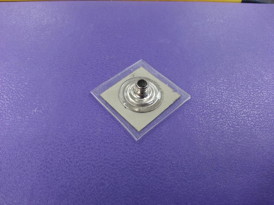 |
| A new electrophysiological sensor developed at North Carolina State University is as accurate as the 'wet electrode' sensors used in hospitals for EKGs and EMGs, but can be used for long-term monitoring and is more accurate than existing sensors when a patient is moving.
CREDIT: Yong Zhu |
Abstract:
Researchers from North Carolina State University have developed a new, wearable sensor that uses silver nanowires to monitor electrophysiological signals, such as electrocardiography (EKG) or electromyography (EMG). The new sensor is as accurate as the "wet electrode" sensors used in hospitals, but can be used for long-term monitoring and is more accurate than existing sensors when a patient is moving.
Wearable sensor clears path to long-term EKG, EMG monitoring
Raleigh, NC | Posted on January 20th, 2015Long-term monitoring of electrophysiological signals can be used to track patient health or assist in medical research, and may also be used in the development of new powered prosthetics that respond to a patient's muscular signals.
Electrophysiological sensors used in hospitals, such as EKGs, use wet electrodes that rely on an electrolytic gel between the sensor and the patient's skin to improve the sensor's ability to pick up the body's electrical signals. However, this technology poses problems for long-term monitoring, because the gel dries up - irritating the patient's skin and making the sensor less accurate.
The new nanowire sensor is comparable to the wet sensors in terms of signal quality, but is a "dry" electrode - it doesn't use a gel layer, so doesn't pose the same problems that wet sensors do.
"People have developed other dry electrodes in the past few years, and some have demonstrated the potential to rival the wet electrodes, but our new electrode has better signal quality than most - if not all - of the existing dry electrodes. It is more accurate," says Dr. Yong Zhu, an associate professor of mechanical and aerospace engineering at NC State and senior author of a paper describing the work. "In addition, our electrode is mechanically robust, because the nanowires are inlaid in the polymer."
The sensors stem from Zhu's earlier work to create highly conductive and elastic conductors made from silver nanowires, and consist of one layer of nanowires in a stretchable polymer.
The new sensor is also more accurate than existing technologies at monitoring electrophysiological signals when a patient is in motion.
"The silver nanowire sensors conform to a patient's skin, creating close contact," Zhu says. "And, because the nanowires are so flexible, the sensor maintains that close contact even when the patient moves. The nanowires are also highly conductive, which is key to the high signal quality."
The new sensors are also compatible with standard EKG- and EMG-reading devices.
"I think these sensors are essentially ready for use," Zhu says "The raw materials of the sensor are comparable in cost to existing wet sensors, but we are still exploring ways of improving the manufacturing process to reduce the overall cost."
###
An uncorrected proof of the paper, "Wearable Silver Nanowire Dry Electrodes for Electrophysiological Sensing," was published online Jan. 14 in RSC Advances, immediately after acceptance. Lead author of the paper is Amanda Myers, a Ph.D. student at NC State. The paper was co-authored by Dr. Helen Huang, an associate professor in the joint biomedical engineering program at NC State and the University of North Carolina at Chapel Hill.
The work was supported by the National Science Foundation through the ASSIST Engineering Research Center at NC State, under grant number EEC-1160483.
####
For more information, please click here
Contacts:
Matt Shipman
919-515-6386
Copyright © North Carolina State University
If you have a comment, please Contact us.Issuers of news releases, not 7th Wave, Inc. or Nanotechnology Now, are solely responsible for the accuracy of the content.
Bookmark:


| Related News Press |
News and information
 Quantum computer improves AI predictions April 17th, 2026
Flexible sensor gains sensitivity under pressure April 17th, 2026
A reusable chip for particulate matter sensing April 17th, 2026
Detecting vibrational quantum beating in the predissociation dynamics of SF6 using time-resolved photoelectron spectroscopy April 17th, 2026
Nanomedicine
A fundamentally new therapeutic approach to cystic fibrosis: Nanobody repairs cellular defect April 17th, 2026
New molecular technology targets tumors and simultaneously silences two ‘undruggable’ cancer genes August 8th, 2025
New imaging approach transforms study of bacterial biofilms August 8th, 2025
Electrifying results shed light on graphene foam as a potential material for lab grown cartilage June 6th, 2025
Sensors
Flexible sensor gains sensitivity under pressure April 17th, 2026
Tiny nanosheets, big leap: A new sensor detects ethanol at ultra-low levels January 30th, 2026
From sensors to smart systems: the rise of AI-driven photonic noses January 30th, 2026
Sensors innovations for smart lithium-based batteries: advancements, opportunities, and potential challenges August 8th, 2025
Discoveries
Quantum computer improves AI predictions April 17th, 2026
Flexible sensor gains sensitivity under pressure April 17th, 2026
A reusable chip for particulate matter sensing April 17th, 2026
Detecting vibrational quantum beating in the predissociation dynamics of SF6 using time-resolved photoelectron spectroscopy April 17th, 2026
Announcements
A fundamentally new therapeutic approach to cystic fibrosis: Nanobody repairs cellular defect April 17th, 2026
UC Irvine physicists discover method to reverse ‘quantum scrambling’ : The work addresses the problem of information loss in quantum computing system April 17th, 2026
Interviews/Book Reviews/Essays/Reports/Podcasts/Journals/White papers/Posters
A fundamentally new therapeutic approach to cystic fibrosis: Nanobody repairs cellular defect April 17th, 2026
UC Irvine physicists discover method to reverse ‘quantum scrambling’ : The work addresses the problem of information loss in quantum computing system April 17th, 2026
Research partnerships
Lab to industry: InSe wafer-scale breakthrough for future electronics August 8th, 2025
HKU physicists uncover hidden order in the quantum world through deconfined quantum critical points April 25th, 2025
 |
||
 |
||
| The latest news from around the world, FREE | ||
 |
||
|
|
||
| Premium Products | ||
 |
||
|
Only the news you want to read!
Learn More |
||
 |
||
|
Full-service, expert consulting
Learn More |
||
|
|
||