Home > Press > Gold nanoparticles show promise for early detection of heart attacks: NYU School of Engineering Professors collaborate with researchers from Peking University on a new test strip
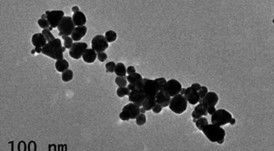 |
| Microscopic view of microplasma-gold nanoparticles on a new, highly sensitive, test strip that enables early detection of heart attacks. |
Abstract:
NYU Polytechnic School of Engineering professors have been collaborating with researchers from Peking University on a new test strip that is demonstrating great potential for the early detection of certain heart attacks.
Gold nanoparticles show promise for early detection of heart attacks: NYU School of Engineering Professors collaborate with researchers from Peking University on a new test strip
New York, NY | Posted on January 15th, 2015Kurt H. Becker, a professor in the Department of Applied Physics and the Department of Mechanical and Aerospace Engineering, and WeiDong Zhu, a research associate professor in the Department of Mechanical and Aerospace Engineering, are helping develop a new colloidal gold test strip for cardiac troponin I (cTn-I) detection. The new strip uses microplasma-generated gold nanoparticles (AuNPs) and shows much higher detection sensitivity than conventional test strips. The new cTn-I test is based on the specific immune-chemical reactions between antigen and antibody on immunochromatographic test strips using AuNPs.
Compared to AuNPs produced by traditional chemical methods, the surfaces of the gold nanoparticles generated by the microplasma-induced liquid chemical process attract more antibodies, which results in significantly higher detection sensitivity.
cTn-I is a specific marker for myocardial infarction. The cTn-I level in patients experiencing myocardial infarction is several thousand times higher than in healthy people. The early detection of cTn-I is therefore a key factor of heart attack diagnosis and therapy.
The use of microplasmas to generate AuNP is yet another application of the microplasma technology developed by Becker and Zhu. Microplasmas have been used successfully in dental applications (improved bonding, tooth whitening, root canal disinfection), biological decontamination (inactivation of microorganisms and biofilms), and disinfection and preservation of fresh fruits and vegetables.
The microplasma-assisted synthesis of AuNPs has great potential for other biomedical and therapeutic applications such as tumor detection, cancer imaging, drug delivery, and treatment of degenerative diseases such as Alzheimer's.
The routine use of gold nanoparticles in therapy and disease detection in patients is still years away: longer for therapeutic applications and shorter for biosensors. The biggest hurdle to overcome is the fact that the synthesis of monodisperse, size-controlled gold nanoparticles, even using microplasmas, is still a costly, time-consuming, and labor-intensive process, which limits their use currently to small-scale clinical studies, Becker explained.
The microplasma technology used in this work is based on research funded by the Air Force Office of Scientific Research and the National Science Foundation.
####
About NYU Polytechnic School of Engineering
The NYU Polytechnic School of Engineering dates to 1854, when the NYU School of Civil Engineering and Architecture as well as the Brooklyn Collegiate and Polytechnic Institute (widely known as Brooklyn Poly) were founded. Their successor institutions merged in January 2014 to create a comprehensive school of education and research in engineering and applied sciences, rooted in a tradition of invention, innovation and entrepreneurship. In addition to programs at its main campus in downtown Brooklyn, it is closely connected to engineering programs in NYU Abu Dhabi and NYU Shanghai, and it operates business incubators in downtown Manhattan and Brooklyn. For more information, visit engineering.nyu.edu.
For more information, please click here
Contacts:
Kathleen Hamilton
718-260-3792
Copyright © NYU Polytechnic School of Engineering
If you have a comment, please Contact us.Issuers of news releases, not 7th Wave, Inc. or Nanotechnology Now, are solely responsible for the accuracy of the content.
Bookmark:


| Related Links |
| Related News Press |
News and information
 Quantum computer improves AI predictions April 17th, 2026
Flexible sensor gains sensitivity under pressure April 17th, 2026
A reusable chip for particulate matter sensing April 17th, 2026
Detecting vibrational quantum beating in the predissociation dynamics of SF6 using time-resolved photoelectron spectroscopy April 17th, 2026
Govt.-Legislation/Regulation/Funding/Policy
Quantum computer improves AI predictions April 17th, 2026
Metasurfaces smooth light to boost magnetic sensing precision January 30th, 2026
New imaging approach transforms study of bacterial biofilms August 8th, 2025
Nanomedicine
A fundamentally new therapeutic approach to cystic fibrosis: Nanobody repairs cellular defect April 17th, 2026
New molecular technology targets tumors and simultaneously silences two ‘undruggable’ cancer genes August 8th, 2025
New imaging approach transforms study of bacterial biofilms August 8th, 2025
Electrifying results shed light on graphene foam as a potential material for lab grown cartilage June 6th, 2025
Discoveries
Quantum computer improves AI predictions April 17th, 2026
Flexible sensor gains sensitivity under pressure April 17th, 2026
A reusable chip for particulate matter sensing April 17th, 2026
Detecting vibrational quantum beating in the predissociation dynamics of SF6 using time-resolved photoelectron spectroscopy April 17th, 2026
Announcements
A fundamentally new therapeutic approach to cystic fibrosis: Nanobody repairs cellular defect April 17th, 2026
UC Irvine physicists discover method to reverse ‘quantum scrambling’ : The work addresses the problem of information loss in quantum computing system April 17th, 2026
Interviews/Book Reviews/Essays/Reports/Podcasts/Journals/White papers/Posters
A fundamentally new therapeutic approach to cystic fibrosis: Nanobody repairs cellular defect April 17th, 2026
UC Irvine physicists discover method to reverse ‘quantum scrambling’ : The work addresses the problem of information loss in quantum computing system April 17th, 2026
Military
Quantum engineers ‘squeeze’ laser frequency combs to make more sensitive gas sensors January 17th, 2025
Chainmail-like material could be the future of armor: First 2D mechanically interlocked polymer exhibits exceptional flexibility and strength January 17th, 2025
Single atoms show their true color July 5th, 2024
NRL charters Navy’s quantum inertial navigation path to reduce drift April 5th, 2024
Research partnerships
Lab to industry: InSe wafer-scale breakthrough for future electronics August 8th, 2025
HKU physicists uncover hidden order in the quantum world through deconfined quantum critical points April 25th, 2025
 |
||
 |
||
| The latest news from around the world, FREE | ||
 |
||
|
|
||
| Premium Products | ||
 |
||
|
Only the news you want to read!
Learn More |
||
 |
||
|
Full-service, expert consulting
Learn More |
||
|
|
||