Home > Press > Photonic crystal nanolaser biosensor simplifies DNA detection: New device offers a simpler and potentially less expensive way to detect DNA and other biomolecules through changes in surface charge density or solution pH
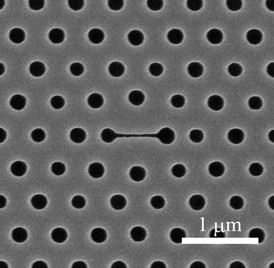 |
| This image shows a top view of the group's nanolaser, in which the center narrow slot (horizontal line) is the main part of the sensor. The periodic holes form a photonic crystal, and although the size of the holes appears to fluctuate they've been intentionally modified so the laser's emission is effectively extracted to the top.
CREDIT: Toshihiko Baba/Yokohama National University |
Abstract:
A simple method to sense DNA, as well as potential biomarker proteins of cancer or other diseases such as Alzheimer's, may soon be within reach - thanks to the work of a team of Yokohama National University researchers in Japan.
Photonic crystal nanolaser biosensor simplifies DNA detection: New device offers a simpler and potentially less expensive way to detect DNA and other biomolecules through changes in surface charge density or solution pH
Washington, DC | Posted on January 13th, 2015As the team reports in Applied Physics Letters, from AIP Publishing, they created a photonic crystal nanolaser biosensor capable of detecting the adsorption of biomolecules based on the laser's wavelength shift.
Equally impressive, the nanolaser biosensor enables detection of the surface charge from its laser emission intensity, which in turn can also be used to sense the adsorption of biomolecules. Using laser intensity to detect biomolecules is potentially less expensive than the fluorescent tagging or spectroscopy techniques typically used in biosensors because it is a simpler procedure.
When the team first set out to explore photonic crystal nanolaser sensors, they weren't focusing on the intensity of the laser emission because it's sensitive to the quality of the fabricated laser and, frankly, they didn't expect it to show sensing signals.
"In the beginning we focused on wavelength behavior, but quickly noticed that [the laser emission] intensity is influenced by both pH and polymers," noted Toshihiko Baba, a professor in Yokohama National University's Department of Electrical and Computer Engineering. "Our results were very reproducible and, interestingly, we found that the behaviors of the wavelength and intensity are independent."
The team was surprised by these results, which they discovered when they deposited a protective film of thin zirconium dioxide (ZrO2) over the device using atomic layer deposition, and then tried sensing in liquids of high or low pH and liquids containing charged polymers. The coating was necessary to protect the nanolaser from damage and unwanted wavelength drift.
The nanolaser device can sense surface charge because the surface charge changes the occupancy rate of electrons at the surface states in the semiconductor of the nanolaser, Baba explained. "This modifies the semiconductor's emission efficiency."
So far, the team's work is the first report of the detection of surface charges using such photonic sensors. "It enables detection of the adsorption of biomolecules from the nanolaser biosensor both in terms of wavelength and intensity," Baba said. Since it involves different physical parameters, the researchers can examine the details of the biomolecules.
It also "enables detection of the adsorption by measuring only its intensity, which is a significant advantage compared to conventional methods," Baba added.
One conventional biosensing method "relies on fluorescent labels that are functionalized to biomolecules in advance," he elaborated. "We can easily see the target biomolecules by using photoexcitation, which is the de facto standard method used today in bioscience and medical diagnoses." The downside? The functionalization process of the fluorescent labels is expensive.
For this reason, many research groups have developed label-free methods such as those using resonance in optical cavities and plasmonic states. However, these require spectral analyses using spectroscopy of wavelength or resonance optical angle - also expensive.
By contrast, the team's nanolaser biosensor needs neither labels nor spectrometers if they use the intensity change. This greatly simplifies detection, which they've already demonstrated in the case of DNA.
Among the many potential applications for the nanolaser biosensor, the team hopes "to apply it to sensing DNA, biomarker proteins of cancer, Alzheimers, etc., from human bodily fluids such as blood - as a simpler procedure than any others before now," noted Baba. "Next we'll be investigating the sensitivity, selectivity, and stability of this phenomenon. If these issues can be cleared, it will move another step toward practical use."
"Our research project, which runs from 2012 to 2016, ultimately targets the development of a photonic crystal nanolaser sensor for biomarker detection," said Baba. "We're working to further simplify and improve the sensor so that it will be ready for practical use within a few years."
###
The team's work is funded by a research grant from the Ministry of Education, Culture, Sports, Science, and Technology in Japan.
####
About American Institute of Physics
Applied Physics Letters features concise, rapid reports on significant new findings in applied physics. The journal covers new experimental and theoretical research on applications of physics phenomena related to all branches of science, engineering, and modern technology. See: apl.aip.org
For more information, please click here
Contacts:
Jason Socrates Bardi
240-535-4954
Copyright © American Institute of Physics
If you have a comment, please Contact us.Issuers of news releases, not 7th Wave, Inc. or Nanotechnology Now, are solely responsible for the accuracy of the content.
Bookmark:


| Related Links |
| Related News Press |
News and information
 Quantum computer improves AI predictions April 17th, 2026
Flexible sensor gains sensitivity under pressure April 17th, 2026
A reusable chip for particulate matter sensing April 17th, 2026
Detecting vibrational quantum beating in the predissociation dynamics of SF6 using time-resolved photoelectron spectroscopy April 17th, 2026
Nanomedicine
A fundamentally new therapeutic approach to cystic fibrosis: Nanobody repairs cellular defect April 17th, 2026
New molecular technology targets tumors and simultaneously silences two ‘undruggable’ cancer genes August 8th, 2025
New imaging approach transforms study of bacterial biofilms August 8th, 2025
Electrifying results shed light on graphene foam as a potential material for lab grown cartilage June 6th, 2025
Sensors
Flexible sensor gains sensitivity under pressure April 17th, 2026
Tiny nanosheets, big leap: A new sensor detects ethanol at ultra-low levels January 30th, 2026
From sensors to smart systems: the rise of AI-driven photonic noses January 30th, 2026
Sensors innovations for smart lithium-based batteries: advancements, opportunities, and potential challenges August 8th, 2025
Discoveries
Quantum computer improves AI predictions April 17th, 2026
Flexible sensor gains sensitivity under pressure April 17th, 2026
A reusable chip for particulate matter sensing April 17th, 2026
Detecting vibrational quantum beating in the predissociation dynamics of SF6 using time-resolved photoelectron spectroscopy April 17th, 2026
Announcements
A fundamentally new therapeutic approach to cystic fibrosis: Nanobody repairs cellular defect April 17th, 2026
UC Irvine physicists discover method to reverse ‘quantum scrambling’ : The work addresses the problem of information loss in quantum computing system April 17th, 2026
Interviews/Book Reviews/Essays/Reports/Podcasts/Journals/White papers/Posters
A fundamentally new therapeutic approach to cystic fibrosis: Nanobody repairs cellular defect April 17th, 2026
UC Irvine physicists discover method to reverse ‘quantum scrambling’ : The work addresses the problem of information loss in quantum computing system April 17th, 2026
Nanobiotechnology
A fundamentally new therapeutic approach to cystic fibrosis: Nanobody repairs cellular defect April 17th, 2026
New molecular technology targets tumors and simultaneously silences two ‘undruggable’ cancer genes August 8th, 2025
New imaging approach transforms study of bacterial biofilms August 8th, 2025
Electrifying results shed light on graphene foam as a potential material for lab grown cartilage June 6th, 2025
Photonics/Optics/Lasers
Metasurfaces smooth light to boost magnetic sensing precision January 30th, 2026
From sensors to smart systems: the rise of AI-driven photonic noses January 30th, 2026
 |
||
 |
||
| The latest news from around the world, FREE | ||
 |
||
|
|
||
| Premium Products | ||
 |
||
|
Only the news you want to read!
Learn More |
||
 |
||
|
Full-service, expert consulting
Learn More |
||
|
|
||