Home > Press > A nanofibrous conduit suitable for repair of long-segment sciatic nerve defects
 |
Abstract:
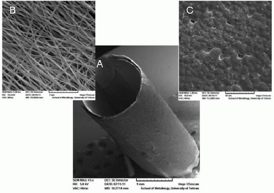
Autografts or allografts are commonly used in neurosurgery. Unfortunately, autografts have limitations such as body injury, repeated surgeries and disproportion of grafted nerve tissue in terms of size and structure. In addition, a similar problem, i.e., stimulation of the immune system, will be encountered in transplantation of allografts or xenografts. Some studies used artificial nerve conduits to repair nerve defects. Among the artificial nerve conduits used, nanofibrous poly(3-hydroxybutyrate-co-3-hydroxyvalerate) (PHBV) conduits exhibit several advantages. One advantage of these nerve conduits is that they can be bent to an angle of up to 180˚ and then restore to their original shape, which is necessary for adaptation inside a living system. Moreover, the PHBV conduits have a thin wall and a highly porous structure, which are important determinants for nutrient transport into the conduit. A further advantage is that they can be easily fabricated and rolled to any required length and diameter by heat processing. Dr. Esmaeil Biazar and team from Islamic Azad University, Tonekabon, Iran used nanofibrous PHBV conduit and autologous sciatic nerve to bridge 30-mm-long rat sciatic nerve gaps. Within 4 months after surgery, rat sciatic nerve functional recovery was evaluated per month by behavioral analyses. Results showed that rat sciatic nerve functional recovery was similar after nanofibrous PHBV conduit and autologous nerve grafting. These findings, published in the Neural Regeneration Research (Vol. 8, No. 27, 2013), suggest that nanofibrous PHBV conduit is suitable in use for repair of long-segment sciatic nerve defects.
A nanofibrous conduit suitable for repair of long-segment sciatic nerve defects
Shenyang, PR China | Posted on October 28th, 2013Article: " Efficacy of nanofibrous conduits in repair of long- segment sciatic nerve defects," by Esmaeil Biazar1, Saeed Heidari Keshel2, 3, Majid Pouya4 (1 Department of Biomaterial Engineering, Tonekabon Branch, Islamic Azad University, Tonekabon, Iran; 2 Student Research Committee, Proteomics Research Center, Faculty of Paramedical Sciences, Shahid Beheshti University of Medical Sciences, Tehran, Iran; 3 Department of Tissue Engineering, School of Advanced Technologies in Medicine, Tehran University of Medical Sciences, Tehran, Iran; 4 Faculty of Medical Sciences, Tonekabon Branch, Islamic Azad University, Tonekabon, Iran)
Biazar E, Heidari SK, Pouya M. Efficacy of nanofibrous conduits in repair of long-segment sciatic nerve defects. Neural Regen Res. 2013;8(27):2501-2509.
####
For more information, please click here
Contacts:
Meng Zhao
86-138-049-98773
Neural Regeneration Research
Copyright © Neural Regeneration Research
If you have a comment, please Contact us.Issuers of news releases, not 7th Wave, Inc. or Nanotechnology Now, are solely responsible for the accuracy of the content.
Bookmark:


| Related Links |
| Related News Press |
News and information
 Quantum computer improves AI predictions April 17th, 2026
Flexible sensor gains sensitivity under pressure April 17th, 2026
A reusable chip for particulate matter sensing April 17th, 2026
Detecting vibrational quantum beating in the predissociation dynamics of SF6 using time-resolved photoelectron spectroscopy April 17th, 2026
Nanomedicine
A fundamentally new therapeutic approach to cystic fibrosis: Nanobody repairs cellular defect April 17th, 2026
New molecular technology targets tumors and simultaneously silences two ‘undruggable’ cancer genes August 8th, 2025
New imaging approach transforms study of bacterial biofilms August 8th, 2025
Electrifying results shed light on graphene foam as a potential material for lab grown cartilage June 6th, 2025
Discoveries
Quantum computer improves AI predictions April 17th, 2026
Flexible sensor gains sensitivity under pressure April 17th, 2026
A reusable chip for particulate matter sensing April 17th, 2026
Detecting vibrational quantum beating in the predissociation dynamics of SF6 using time-resolved photoelectron spectroscopy April 17th, 2026
Announcements
A fundamentally new therapeutic approach to cystic fibrosis: Nanobody repairs cellular defect April 17th, 2026
UC Irvine physicists discover method to reverse ‘quantum scrambling’ : The work addresses the problem of information loss in quantum computing system April 17th, 2026
Interviews/Book Reviews/Essays/Reports/Podcasts/Journals/White papers/Posters
A fundamentally new therapeutic approach to cystic fibrosis: Nanobody repairs cellular defect April 17th, 2026
UC Irvine physicists discover method to reverse ‘quantum scrambling’ : The work addresses the problem of information loss in quantum computing system April 17th, 2026
Research partnerships
Lab to industry: InSe wafer-scale breakthrough for future electronics August 8th, 2025
HKU physicists uncover hidden order in the quantum world through deconfined quantum critical points April 25th, 2025
 |
||
 |
||
| The latest news from around the world, FREE | ||
 |
||
|
|
||
| Premium Products | ||
 |
||
|
Only the news you want to read!
Learn More |
||
 |
||
|
Full-service, expert consulting
Learn More |
||
|
|
||