Home > Press > Carbon nanocoils fracture like an automobile spring
 |
| Carbon nanocoils |
Abstract:
Carbon nanocoils (CNCs) composed of helical shaped carbon nanofibers have potential applications including mechanical springs, nano-solenoids, and field emitters.
However, in spite of the important applications of CNCs as mechanical spring for nano-eletcromechanical system (NEMS) there is a scarcity of data on CNC fracturing under tensile loads.
Here, Taiichiro Yonemura and colleagues at Toyohashi University of Technology describe the CNC fracturing properties of eight CNCs using focused ion beam (FIB) modification.
Carbon nanocoils fracture like an automobile spring
Toyohashi, Japan | Posted on March 5th, 2013CNC tensile tests were conducted as follows: The CNCs were installed into an FIB system with a tungsten (W) probe with a 500 nm tip diameter and the W probe moved until it adhered to CNC using Pt ion beam whereas the Si ion beam cut the CNC bottom; then the CNC-adhered W probe approaches a Si substrate surface, until the CNC was almost perpendicularly to the Si substrate. Tensile tests for 8 CNCs were carried out by gradually changing the distance between the Si substrate and the W probe.
The elongation behavior of CNCs in the FIB instrument was monitored. Experiments showed the CNC coil pitch to return to its original length after fracturing, thus confirming CNC to be a spring. The average stretch ratio of the 8 CNCs on the verge of fracture was 150%.
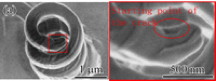
The ratio of the maximum to average stress on the fractured surface was estimated to be in the range 1.3 to 1.7 indicating stress concentrations on the coil wire inner edge, and scanning microscopy confirmed a hollow region on the inner edge of all fractured surfaces.
The starting point of the CNC fracturing observed in the inner edge matched that of industrial steel coil springs used in automobiles.
Reference:
Taiichiro Yonemura, Yoshiyuki Suda, Hideto Tanoue, Hirofumi Takikawa, Hitoshi Ue, Kazuki Shimizu and Yoshito Umeda.
Torsion Fracture of Carbon Nanocoils
Journal of Applied Physics, 112, 084311 (2012).
Digital Object Identifier (DOI): 10.1063/1.4758921
Department of Electrical and Electronic information Engineering, Toyohashi University of Technology.
Department website: www.tut.ac.jp/english/introduction/department02.html
####
About Toyohashi University of Technology
Founded in 1976, Toyohashi University of Technology is a vibrant modern institute with research activities reflecting the modern era of advanced electronics, engineering, and life sciences.
For more information, please click here
Contacts:
Toyohashi University of Technology
1-1 Hibarigaoka, Tempaku
Toyohashi, Aichi Prefecture, 441-8580, JAPAN
Inquiries: International Affairs Division
TEL: +81-532-44-6577
or +81-532-44-6546
FAX: +81-532-44-6557
Copyright © Toyohashi University of Technology
If you have a comment, please Contact us.Issuers of news releases, not 7th Wave, Inc. or Nanotechnology Now, are solely responsible for the accuracy of the content.
Bookmark:


| Related News Press |
News and information
 Quantum computer improves AI predictions April 17th, 2026
Flexible sensor gains sensitivity under pressure April 17th, 2026
A reusable chip for particulate matter sensing April 17th, 2026
Detecting vibrational quantum beating in the predissociation dynamics of SF6 using time-resolved photoelectron spectroscopy April 17th, 2026
Imaging
Simple algorithm paired with standard imaging tool could predict failure in lithium metal batteries August 8th, 2025
Discoveries
Quantum computer improves AI predictions April 17th, 2026
Flexible sensor gains sensitivity under pressure April 17th, 2026
A reusable chip for particulate matter sensing April 17th, 2026
Detecting vibrational quantum beating in the predissociation dynamics of SF6 using time-resolved photoelectron spectroscopy April 17th, 2026
Announcements
A fundamentally new therapeutic approach to cystic fibrosis: Nanobody repairs cellular defect April 17th, 2026
UC Irvine physicists discover method to reverse ‘quantum scrambling’ : The work addresses the problem of information loss in quantum computing system April 17th, 2026
Tools
Metasurfaces smooth light to boost magnetic sensing precision January 30th, 2026
From sensors to smart systems: the rise of AI-driven photonic noses January 30th, 2026
Japan launches fully domestically produced quantum computer: Expo visitors to experience quantum computing firsthand August 8th, 2025
 |
||
 |
||
| The latest news from around the world, FREE | ||
 |
||
|
|
||
| Premium Products | ||
 |
||
|
Only the news you want to read!
Learn More |
||
 |
||
|
Full-service, expert consulting
Learn More |
||
|
|
||