Home > Press > New taxonomy of platinum nanoclusters: The unexpected diversity of metallic nanoclusters’ inner structure has now been catalogued into families
 |
Abstract:
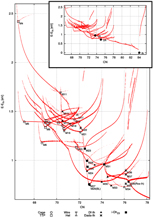
Physicists have gained new insights into the inner intricacies of the structural variations of metallic nanoclusters. This work by Luca Pavan, Cono Di Paola and Francesca Baletto from King's College London, UK, is about to be published in EPJ D. It takes us one step closer to tailoring on-demand characteristics of metallic nanoparticles. Indeed, the geometric structure of these nanoclusters influences their chemical and physical properties, which differ from those of individual molecules and of bulk metals.
New taxonomy of platinum nanoclusters: The unexpected diversity of metallic nanoclusters’ inner structure has now been catalogued into families
Germany | Posted on February 20th, 2013The problem resides in the difficulty in evaluating the optimal structure for such clusters in order to make them display specific properties and satisfy a particular technological need. This is because a system consisting of several interlinked atoms is far too complex for its optimal structure to be identified simply by resolving equations.
Instead, the authors applied a numerical simulation method, known as metadyamics, typically used to sample the energy landscape of biomolecules and proteins. This technique, quite new in the field of metallic nanoparticles, identifies structures corresponding to each minimum of the energy landscape. In addition, this approach gains a better insight into the interconnection of various structural motifs at given temperatures.
Specifically, this study describes an iterative approach for metadynamics in order to detect which are the key structures of 13-atom-strong platinum nanoclusters. The authors focused on identifying the most recurrent motifs that can play an important role during structural transformations of the nanoclusters.
In addition, the team proposed a complete way of cataloguing such structural motifs in families. The next step would be to understand how different geometrical shapes are connected and evaluate the energy cost for each transformation, from one type of geometry to another. Applications could, for example, be found in nanocatalysis and nanodevices for magnetic storage.
Reference
Pavan L., Di Paola C. and Baletto F. (2013), Sampling the Energy Landscape of Pt13 with Metadynamics, European Physical Journal D, DOI 0.1140/epjd/e2012-30560-y
####
For more information, please click here
Contacts:
Sophia Grein
49-622-148-78414
Copyright © Springer
If you have a comment, please Contact us.Issuers of news releases, not 7th Wave, Inc. or Nanotechnology Now, are solely responsible for the accuracy of the content.
Bookmark:


| Related Links |
| Related News Press |
News and information
 Quantum computer improves AI predictions April 17th, 2026
Flexible sensor gains sensitivity under pressure April 17th, 2026
A reusable chip for particulate matter sensing April 17th, 2026
Detecting vibrational quantum beating in the predissociation dynamics of SF6 using time-resolved photoelectron spectroscopy April 17th, 2026
Chemistry
Projecting light to dispense liquids: A new route to ultra-precise microdroplets January 30th, 2026
From sensors to smart systems: the rise of AI-driven photonic noses January 30th, 2026
"Nanoreactor" cage uses visible light for catalytic and ultra-selective cross-cycloadditions October 3rd, 2025
Cambridge chemists discover simple way to build bigger molecules – one carbon at a time June 6th, 2025
Memory Technology
Researchers tackle the memory bottleneck stalling quantum computing October 3rd, 2025
First real-time observation of two-dimensional melting process: Researchers at Mainz University unveil new insights into magnetic vortex structures August 8th, 2025
Utilizing palladium for addressing contact issues of buried oxide thin film transistors April 5th, 2024
Discoveries
Quantum computer improves AI predictions April 17th, 2026
Flexible sensor gains sensitivity under pressure April 17th, 2026
A reusable chip for particulate matter sensing April 17th, 2026
Detecting vibrational quantum beating in the predissociation dynamics of SF6 using time-resolved photoelectron spectroscopy April 17th, 2026
Announcements
A fundamentally new therapeutic approach to cystic fibrosis: Nanobody repairs cellular defect April 17th, 2026
UC Irvine physicists discover method to reverse ‘quantum scrambling’ : The work addresses the problem of information loss in quantum computing system April 17th, 2026
 |
||
 |
||
| The latest news from around the world, FREE | ||
 |
||
|
|
||
| Premium Products | ||
 |
||
|
Only the news you want to read!
Learn More |
||
 |
||
|
Full-service, expert consulting
Learn More |
||
|
|
||