Home > Press > Postnova Analytics Attending SCM-6 and EWPSC Conferences with Award Winning FFF Technolo
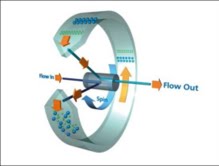 |
| The Postnova Centrifugal Field-Flow Fractionation separation principle. |
Abstract:
Postnova Analytics kick off the New Year 2013 with a busy schedule of conference attendance, where they will share experiences and demonstrate their award-winning Field-Flow Fractionation (FFF) systems. Featured instrument, the CF2000, is the first commercial Centrifugal FFF system designed for routine use. This groundbreaking instrument was the recent winner of a major European industry award for innovation.
Postnova Analytics Attending SCM-6 and EWPSC Conferences with Award Winning FFF Technolo
Landsberg-am-Lech, Germany | Posted on February 4th, 2013 The first chance to meet the team in 2013 will be at the 6th International Symposium on the Separation and Characterization of Natural and Synthetic Macromolecules (SCM-6) to be held in Dresden, Germany, from February 6 to 8, 2013. SCM-6 brings together scientists who share an interest in the separation and characterization of large molecules, and the conference creates a platform for delegates from diverging backgrounds with different perspectives to interact, discuss subjects of mutual interest, and discover new synergies.
Here, Postnova will present three posters - the first ‘Polymer Characterization using Thermal Field-Flow Fractionation' illustrates the excellent potential of Thermal FFF (TF3) compared to common SEC analysis for different polymers, such as polystyrene, poly(methyl methacrylate), mixed polymer samples and blends thereof. The ability to separate by size and chemical composition within the one method, highlights the predominance of TF3 over standard SEC methodologies. The poster explains the principle of the Thermal FFF technique, with the separation taking place between a cold wall on the bottom of the channel and a hot wall on the top. The extraordinary capabilities of this FFF technique is the opportunity to not only separate by size but also by chemical composition due to thermal diffusion. The results comparing the analysis of a PS and PMMA Standards and its mixtures is undertaken with SEC and FFF, illustrating that only TF3 can achieve a separation. Also common drawbacks of packed columns like shear-degradation, are overcome with FFF technology.
The second of the posters is entitled ‘Characterization of Rubber Polymers by Flow FFF' and explores the coupling of FFF technology of choice to suitable detector combinations (MALS, RI/UV). This enables the user to easily determine molecular weight and size distributions of macromolecules, which are important properties for polymers. Two synthetic rubber samples were analyzed and compared with a natural rubber sample.
The third poster focuses on ´Latex Nanoparticle Analysis by Flow FFF - DLS coupling´ and this explores the different separation forces applied, e.g. flow, thermal, centrifugal or gravitational. The techniques render variable results, enabling the end-user to choose the most appropriate technique of FFF-family separation to obtain the best performance for their particular application and nanoparticles. The poster shows that the FFF - DLS online coupling is a more precise tool for analysis of mixed latex nanoparticles, as opposed to traditional batch DLS measurements.
Also in February, Postnova will be in Kraków, Poland at the European Winter Conference on Plasma Spectrochemistry (EWCPS), being held from 10 to 15 February. The conference focuses on the major topics of analytical plasma spectrochemistry and Postnova Analytics will have on display the modular CF2000, which combines a powerful separation tool based on Field-Flow Fractionation principles, allowing the coupling to a range of different detectors like UV, DLS, MALS or even ICP-MS. The extended higher particle size separation range is between 7 nm to 50 µm, which provide a wide application range for characterization, such as proteins and polymers, from larger particles in one run with high resolution.
Rainer Jünger, Marketing Director of Postnova commented "FFF technology is providing huge benefits to scientists for the separation and characterization of macro species and particles, which are not able to be separated by other chromatography techniques. With the use of centrifugal field as the controlling force for the separation, particles in the laminar flow are separated by dynamic diffusion on the basis of size and density. This novel approach allows discrimination of materials that have the same particle size but different densities, which makes it ideal for nanoparticles but also is applicable in the microparticle size range. Jünger also added that another benefit is "there is no static phase in FFF separation so there is no interference, producing a very gentle separation. This is especially important for biological samples and cells, which might otherwise be damaged by being pressed through a column. Also it has a wide application range - for characterization of challenging biopharmaceutical, food, cosmetics, nanomaterial, but also environmental samples."
####
About Postnova Analytics GmbH
Postnova Analytics are experts in Field-Flow Fractionation (FFF) and Light Scattering technologies - the modern alternative to chromatography. Found in 1997 by Dr. Thorsten Klein in Munich, Germany, the company introduced the first commercial Asymmetrical Flow FFF (AF4) instrument. This system brought a new level of automation and separation performance to the market.
In 2001 Postnova Analytics acquired FFFractionation, a company based in Salt Lake City, Utah that had been a pioneer for the commercialization of FFF technology, and Postnova Analytics USA was formed. The new company became the sole provider of all variants of Field-Flow Fractionation. Following the acquisition, in 2003, Postnova moved into new headquarters in Landsberg-am-Lech, which is located in the Greater Munich area, in southern Germany.
Postnova Analytics continues to innovate, and now offers of a broad range of Field-Flow Fractionation and Light Scattering solutions, which are ideally suited for gentle, high resolution and matrix-free separations of large molecules and particles, which traditional chromatographic techniques cannot perform. FFF coupled to Multi-Angle Light Scattering (MALS) is the modern alternative to liquid chromatography (LC) and size exclusion SEC techniques, especially when it comes to separation, characterization and fractionation of nanoparticles, proteins, antibodies, biomacromolecules, polymers, adhesives, elastomers, rubbers and other large molecules or particles.
Postnova Analytics and Postnova Analytics USA registered trademarks of Postnova Analytics GmbH.
For more information, please click here
Contacts:
Jessica Auton
Kapler Communications
Phoenix House, Phoenix Park
Eaton Socon, Cambridgeshire
PE19 8EP, UK
Tel: +44 1480 471059
Mobile: +44 7867 308122
Rainer Jünger
Marketing Director
Postnova Analytics
Max-Planck-Str. 14
86899 Landsberg, Germany
Tel: +49 8191 985688-0
Copyright © Postnova Analytics GmbH
If you have a comment, please Contact us.Issuers of news releases, not 7th Wave, Inc. or Nanotechnology Now, are solely responsible for the accuracy of the content.
Bookmark:


| Related News Press |
News and information
 Researchers develop molecular qubits that communicate at telecom frequencies October 3rd, 2025
Next-generation quantum communication October 3rd, 2025
"Nanoreactor" cage uses visible light for catalytic and ultra-selective cross-cycloadditions October 3rd, 2025
Announcements
Rice membrane extracts lithium from brines with greater speed, less waste October 3rd, 2025
Researchers develop molecular qubits that communicate at telecom frequencies October 3rd, 2025
Next-generation quantum communication October 3rd, 2025
"Nanoreactor" cage uses visible light for catalytic and ultra-selective cross-cycloadditions October 3rd, 2025
Tools
Japan launches fully domestically produced quantum computer: Expo visitors to experience quantum computing firsthand August 8th, 2025
Rice researchers harness gravity to create low-cost device for rapid cell analysis February 28th, 2025
Events/Classes
Institute for Nanoscience hosts annual proposal planning meeting May 16th, 2025
A New Blue: Mysterious origin of the ribbontail ray’s electric blue spots revealed July 5th, 2024
Researchers demonstrate co-propagation of quantum and classical signals: Study shows that quantum encryption can be implemented in existing fiber networks January 20th, 2023
 |
||
 |
||
| The latest news from around the world, FREE | ||
 |
||
|
|
||
| Premium Products | ||
 |
||
|
Only the news you want to read!
Learn More |
||
 |
||
|
Full-service, expert consulting
Learn More |
||
|
|
||